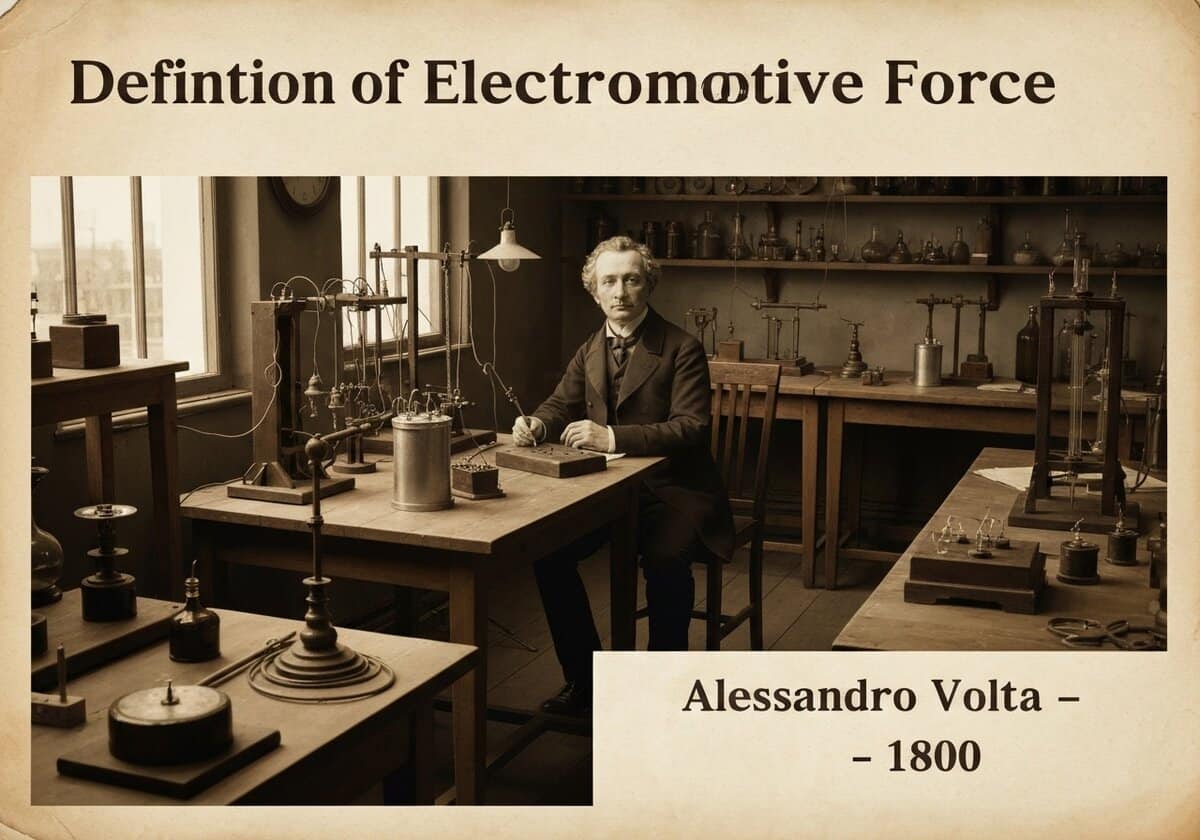
Définition de la force électromotrice (FEM)
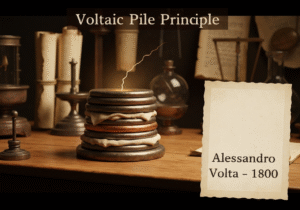
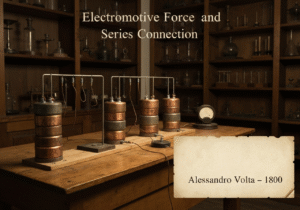
La force électromotrice ([latex]\mathcal{E}[/latex]) est le travail effectué par unité de charge électrique par une source non électrique, telle qu'une batterie ou un générateur. Malgré son nom, il ne s'agit pas d'une force mécanique mais d'un potentiel électrique, mesuré en volts. Il représente l'énergie convertie d'une autre forme (chimique, mécanique) en énergie électrique lorsqu'une charge traverse la source.
Electromotive force, or EMF, is a fundamental concept in electromagnetism that quantifies the energy conversion process within a source. When a charge [latex]q[/latex] moves through a device that provides EMF, the work done [latex]W[/latex] on the charge is given by [latex]W = \mathcal{E}q[/latex]. This work is performed by a non-conservative field, often called an impressed field [latex]\mathbf{E}_{im}[/latex], which is distinct from the conservative electrostatic field generated by static charges. The EMF is formally defined as the line integral of this impressed field around a closed loop: [latex]\mathcal{E} = \oint \mathbf{E}_{im} \cdot d\mathbf{l}[/latex].
This distinction is crucial. An electrostatic field, described by Coulomb’s law, is conservative, meaning the work it does on a charge around any closed loop is zero. This is why a simple configuration of static charges cannot sustain a continuous current in a circuit. An EMF source, however, provides the “push” to drive charges against the electrostatic field’s potential gradient, maintaining a current. In a battery, this impressed field arises from chemical processes at the electrodes. In a generator, it’s due to a changing magnetic field (Faraday’s law) or the motion of a conductor in a magnetic field (motional EMF). The EMF represents the maximum potential difference the source can provide when no current is flowing, also known as the open-circuit voltage. When current flows, the terminal voltage across the source is typically lower than the EMF due to internal resistance within the source itself.
UNESCO Nomenclature: 2205
- Électricité et magnétisme
Perturbation
Révolutionnaire
Usage
Utilisation généralisée
Précurseurs
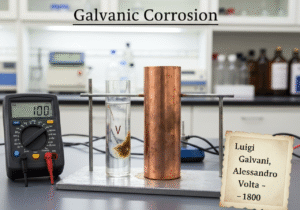
- Luigi Galvani’s discovery of “animal electricity”
- Charles-Augustin de Coulomb’s formulation of the law of electrostatic force
- Compréhension du potentiel électrique et de la charge
Applications
- alimenter tous les appareils électroniques
- véhicules électriques
- stockage d'énergie à l'échelle du réseau
- électronique portable
Idées d'innovations potentielles
En raison du trafic généré par les robots de scraping, actuellement supérieur à 40 000 par jour, ce contenu est réservé aux membres de la communauté.
> Connexion < ou > Registre < (100% gratuit) pour y accéder, ainsi qu'à tous les autres contenus et outils à accès restreint.
Related to: emf, electromotive force, voltage, potential difference, work, charge, battery, generator.