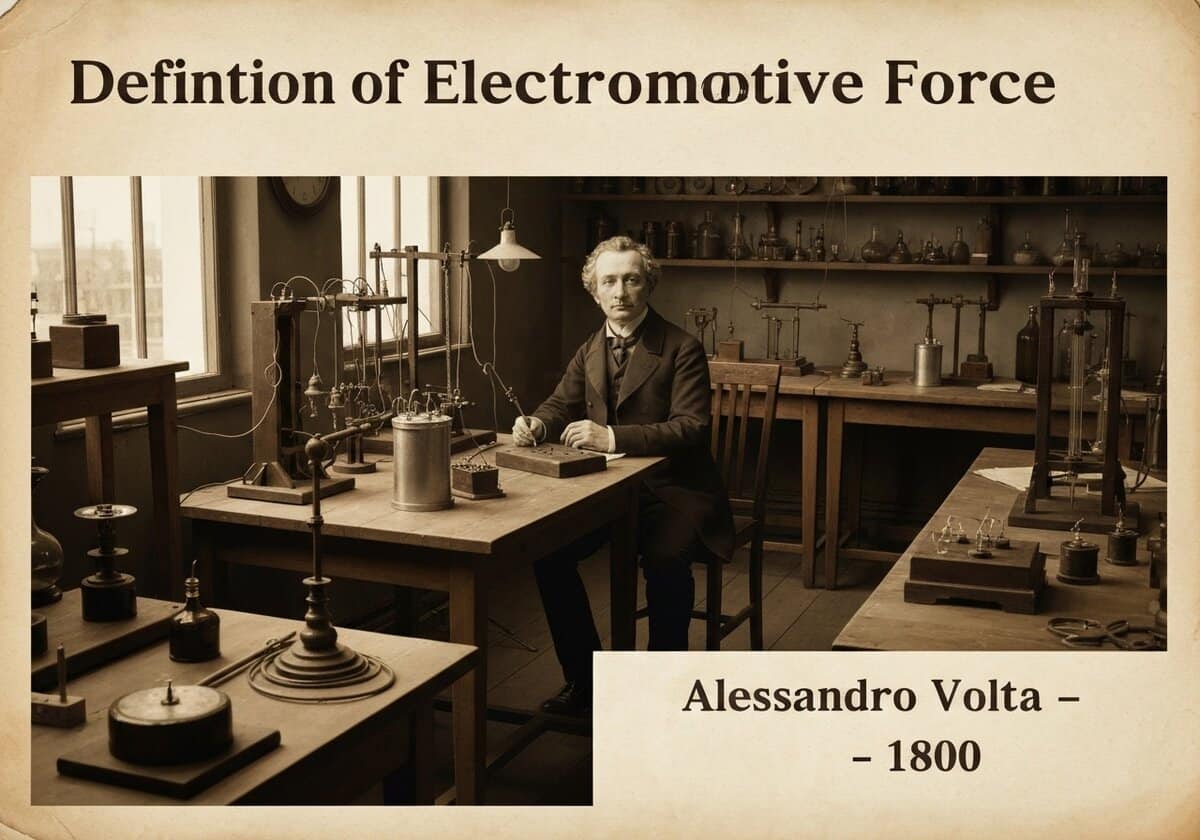
Definição de Força Eletromotriz (FEM)
A força eletromotriz ([latex]mathcal{E}[/latex]) é o trabalho realizado por unidade de carga elétrica por uma fonte não elétrica, como uma bateria ou um gerador. Apesar do nome, não se trata de uma força mecânica, mas sim de um potencial elétrico, medido em volts. Ela representa a energia convertida de outra forma (química, mecânica) em energia elétrica à medida que uma carga atravessa a fonte.
Electromotive force, or EMF, is a fundamental concept in electromagnetism that quantifies the energy conversion process within a source. When a charge [latex]q[/latex] moves through a device that provides EMF, the work done [latex]W[/latex] on the charge is given by [latex]W = \mathcal{E}q[/latex]. This work is performed by a non-conservative field, often called an impressed field [latex]\mathbf{E}_{im}[/latex], which is distinct from the conservative electrostatic field generated by static charges. The EMF is formally defined as the line integral of this impressed field around a closed loop: [latex]\mathcal{E} = \oint \mathbf{E}_{im} \cdot d\mathbf{l}[/latex].
This distinction is crucial. An electrostatic field, described by Coulomb’s law, is conservative, meaning the work it does on a charge around any closed loop is zero. This is why a simple configuration of static charges cannot sustain a continuous current in a circuit. An EMF source, however, provides the “push” to drive charges against the electrostatic field’s potential gradient, maintaining a current. In a battery, this impressed field arises from chemical processes at the electrodes. In a generator, it’s due to a changing magnetic field (Faraday’s law) or the motion of a conductor in a magnetic field (motional EMF). The EMF represents the maximum potential difference the source can provide when no current is flowing, also known as the open-circuit voltage. When current flows, the terminal voltage across the source is typically lower than the EMF due to internal resistance within the source itself.
UNESCO Nomenclature: 2205
Eletricidade e Magnetismo
Interrupção
Revolucionário
Precursores
- A descoberta da "eletricidade animal" por Luigi Galvani
- Formulação da lei da força eletrostática por Charles-Augustin de Coulomb
- Compreensão do potencial elétrico e da carga
Aplicações
- alimentando todos os dispositivos eletrônicos
- veículos elétricos
- armazenamento de energia em escala de rede
- eletrônicos portáteis
Ideias de Inovação Potencial
Devido ao tráfego de bots de coleta de dados, atualmente superior a 40 mil por dia, este conteúdo é reservado aos membros da comunidade.
> Login < ou > Registrar < (100% gratuito) para acessar isso, assim como todo o restante do conteúdo e das ferramentas restritas.
Relacionado a: força eletromotriz (fem), tensão, diferença de potencial, trabalho, carga, bateria, gerador.