Product Design, Manufacturing & Innovation Resources
Home » The Wave Equation (physics)

The Wave Equation (physics)

1747
  • Jean le Rond d’Alembert
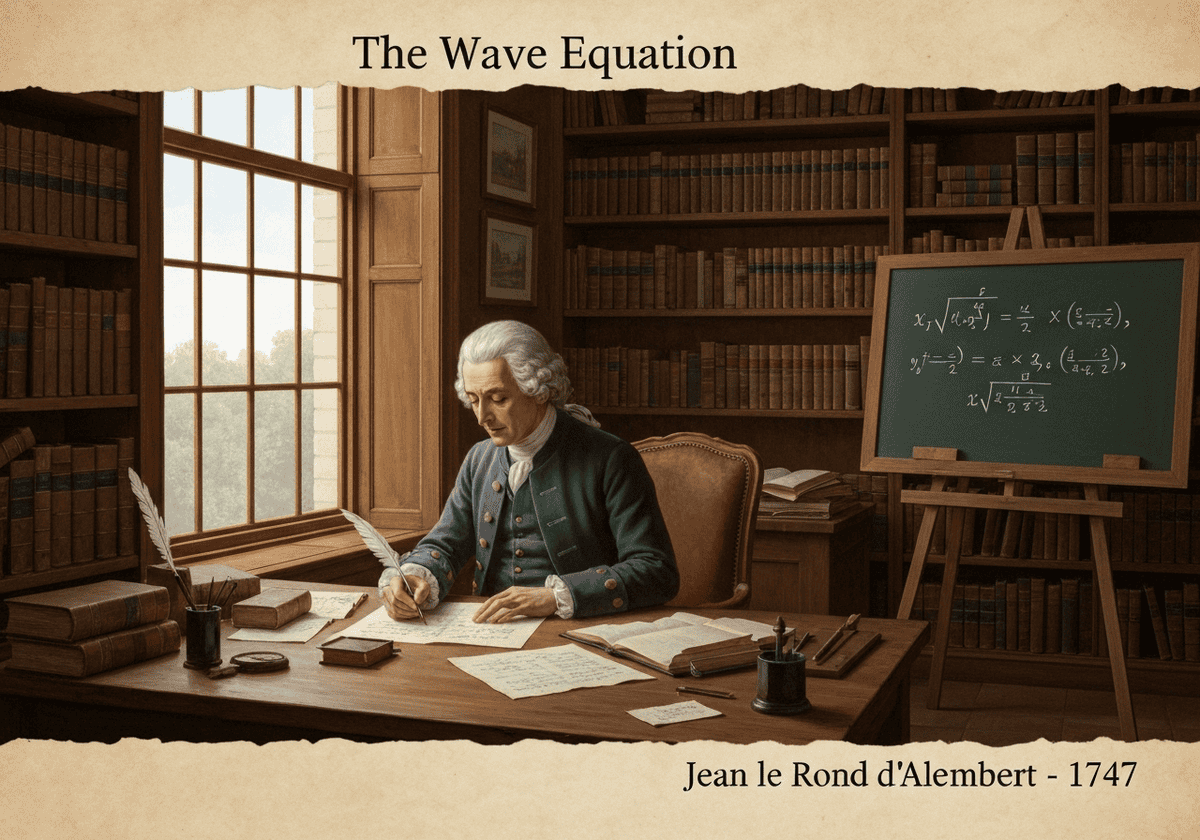
Jean le Rond d'Alembert developing the wave equation in a historical office setting.

(generated image for illustration only)

A second-order linear hyperbolic partial differential equation that governs the propagation of various types of waves. In its simplest form, it is written as \(\frac{\partial^2 u}{\partial t^2} = c^2 \nabla^2 u\), where \(u(\vec{x},t)\) is the amplitude of the wave, \(c\) is the wave speed, and \(\nabla^2\) is the Laplace operator. It models phenomena like vibrating strings, sound waves, and light waves.
The wave equation is the archetypal hyperbolic PDE. Unlike the heat equation, it is second-order in time, which gives rise to its oscillatory, wave-like solutions. The presence of the \(\frac{\partial^2 u}{\partial t^2}\) term implies that acceleration is proportional to the local curvature of the function, a relationship characteristic of restorative forces like tension in a string. The constant \(c\) represents the finite speed at which disturbances propagate through the medium.

A crucial feature of the wave equation is the principle of causality and finite propagation speed. A disturbance at a point \(\vec{x}_0\) at time \(t_0\) can only affect points \(\vec{x}\) at a later time \(t\) that are within a distance of \(c(t-t_0)\). This region is known as the ‘cone of influence’. Conversely, the value of the solution at \((\vec{x}, t)\) depends only on the initial data within its ‘domain of dependence’. This contrasts sharply with the infinite propagation speed of the heat equation.

In one spatial dimension, the equation \(u_{tt} = c^2 u_{xx}\) has a remarkably simple general solution, discovered by d’Alembert: \(u(x,t) = F(x-ct) + G(x+ct)\). This represents the superposition of two waves traveling in opposite directions with speed \(c\). The shapes of these waves, determined by the functions \(F\) and \(G\), are preserved as they propagate.

UNESCO Nomenclature: 1208
– Mathematical physics

Type

Abstract System

Disruption

Foundational

Usage

Widespread Use

Precursors

  • newton’s laws of motion
  • hooke’s law for elastic forces
  • development of calculus and partial derivatives
  • studies of vibrating strings by brook taylor and johann bernoulli

Applications

  • acoustics and audio engineering
  • electromagnetism (propagation of light and radio waves)
  • seismology for modeling earthquakes
  • fluid dynamics for surface waves
  • general relativity for gravitational waves

Patents:

NA

Potential Innovations Ideas

Due to scrapping bot traffic, currently more than 40k per day, this content is reserved to community members.
> Login < or > Register < (100% free) to access this, so as all other restricted content and tools.

Related to: wave equation, hyperbolic pde, d’alembert’s formula, wave propagation, acoustics, electromagnetism, speed of light, mathematical physics.

Historical Context

The Wave Equation (physics)

150
1640
1650
1747
1758
1777
1799
-550
1635
1650
1736
1750
1763-12-23
1780
1805

(if date is unknown or not relevant, e.g. "fluid mechanics", a rounded estimation of its notable emergence is provided)

Related Invention, Innovation & Technical Principles

Full size images and downloads are only available, 100% free, for registered members.

> Login <