Product Design, Manufacturing & Innovation Resources
Home » Dew Point

Dew Point

1800
  • John Dalton
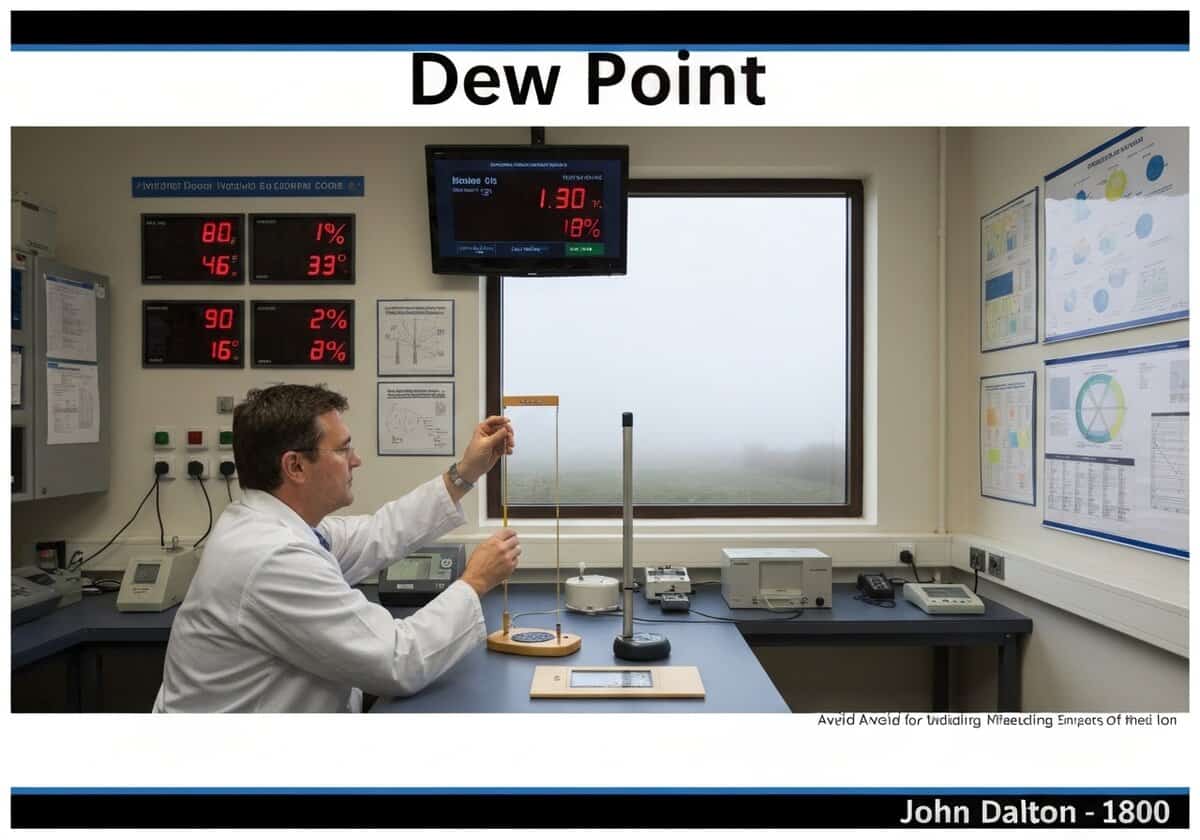
Meteorological laboratory measuring dew point with hygrometer and digital display.

(generated image for illustration only)

The dew point is the temperature to which air must be cooled, at constant pressure and water content, for it to become saturated with water vapor. At this temperature, the relative humidity is 100%. If the air cools further, water vapor will condense to form liquid water (dew), or deposit as frost if below freezing.
The dew point is a direct measure of the absolute amount of moisture in the air. Unlike relative humidity, which is temperature-dependent, the dew point remains constant as long as no water vapor is added or removed from the air parcel. When the air temperature and dew point temperature are equal, the air is saturated, and the relative humidity is 100%. The larger the difference between the air temperature and the dew point, the lower the relative humidity.

For instance, if the air temperature is 30°C and the dew point is 15°C, the air is relatively dry. If the temperature drops to 15°C overnight, dew will begin to form on surfaces. This concept is critical in many fields. In aviation, pilots use the dew point to calculate the cloud base height and predict the likelihood of carburetor icing. In construction, understanding the dew point within wall cavities is essential to prevent moisture buildup, which can lead to mold and structural damage. The dew point is also a better indicator of human comfort than relative humidity at high temperatures, as it reflects the actual amount of moisture that can inhibit sweat evaporation.

UNESCO Nomenclature: 2508
– Meteorology

Type

Abstract System

Disruption

Substantial

Usage

Widespread Use

Precursors

  • understanding of water’s phase changes (evaporation, condensation)
  • Dalton’s law of partial pressures
  • development of accurate thermometers
  • concept of vapor pressure

Applications

  • predicting fog and frost formation in aviation and agriculture
  • hvac system design to prevent condensation on surfaces
  • compressed air systems to prevent moisture damage
  • meteorological forecasting
  • determining human comfort levels (high dew points feel muggy)

Patents:

NA

Potential Innovations Ideas

Due to scrapping bot traffic, currently more than 40k per day, this content is reserved to community members.
> Login < or > Register < (100% free) to access this, so as all other restricted content and tools.

Related to: dew point, saturation, condensation, temperature, relative humidity, meteorology, absolute humidity, water vapor, frost point, comfort index.

Historical Context

Dew Point

1800
1838
1872
1910
1940
1940
1946
1650
1800
1852
1900
1912
1940
1940
1950

(if date is unknown or not relevant, e.g. "fluid mechanics", a rounded estimation of its notable emergence is provided)

Related Invention, Innovation & Technical Principles

Full size images and downloads are only available, 100% free, for registered members.

> Login <