Product Design, Manufacturing & Innovation Resources
Home » The Carbon-Fluorine Bond: the Source of PFAS Stability

The Carbon-Fluorine Bond: the Source of PFAS Stability

1940
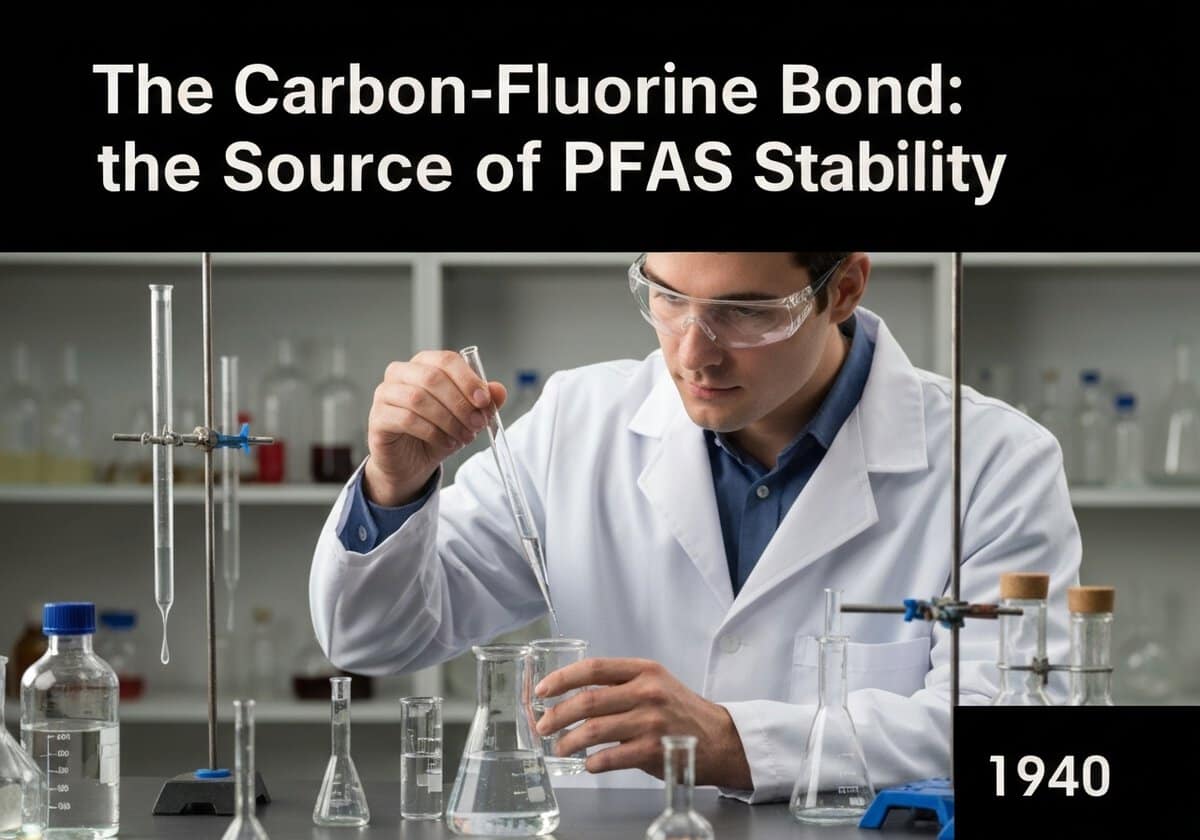
Chemist conducting experiment on PFAS in organic chemistry lab.

(generated image for illustration only)

Per- and polyfluoroalkyl substances (PFAS) are characterized by a chain of carbon atoms bonded to fluorine atoms. The carbon-fluorine (C-F) bond is one of the strongest single bonds in organic chemistry, with a bond dissociation energy around 485 kJ/mol. This extreme strength makes PFAS highly resistant to chemical, thermal, and biological degradation, leading to their environmental persistence.

The exceptional stability of per- and polyfluoroalkyl substances (PFAS) is fundamentally rooted in the properties of the carbon-fluorine (C-F) bond. Fluorine is the most electronegative element, creating a highly polarized bond with carbon. This results in a short bond length (around 1.35 Å) and a very high bond dissociation energy, making it extremely difficult to break. In perfluoroalkyl substances, where all non-terminal carbons are fully saturated with fluorine atoms, this effect is amplified. The fluorine atoms create a helical sheath around the carbon backbone, sterically protecting it from chemical attack. This ‘fluorine shield’ also repels both water (hydrophobicity) and oils (oleophobicity), a rare combination that makes PFAS effective surfactants. The cumulative inductive effect of multiple fluorine atoms also strengthens adjacent C-C bonds within the chain, further contributing to the molecule’s overall inertness. This chemical robustness is why PFAS are dubbed “forever chemicals”; they do not readily break down under natural environmental conditions, leading to their widespread accumulation.

UNESCO Nomenclature: 2506
– Organic chemistry

Type

Chemical Property

Disruption

Foundational

Usage

Widespread Use

Precursors

  • discovery of fluorine by henri moissan in 1886
  • development of quantum mechanics to explain chemical bonding (e.g., linus pauling’s work on electronegativity)
  • early synthesis of simple organofluorine compounds in the late 19th and early 20th centuries

Applications

  • non-stick coatings (teflon)
  • stain-resistant fabrics (scotchgard)
  • firefighting foams (AFFF)
  • water-repellent clothing
  • food packaging

Patents:

NA

Potential Innovations Ideas

Due to scrapping bot traffic, currently more than 40k per day, this content is reserved to community members.
> Login < or > Register < (100% free) to access this, so as all other restricted content and tools.

Related to: carbon-fluorine bond, pfas, perfluoroalkyl, stability, bond energy, organic chemistry, forever chemicals, electronegativity, persistence, organofluorine.

Historical Context

The Carbon-Fluorine Bond: the Source of PFAS Stability

1838
1872
1910
1940
1940
1946
1950
1800
1852
1900
1912
1940
1940
1950
1950

(if date is unknown or not relevant, e.g. "fluid mechanics", a rounded estimation of its notable emergence is provided)

Related Invention, Innovation & Technical Principles

Full size images and downloads are only available, 100% free, for registered members.

> Login <