Product Design, Manufacturing & Innovation Resources
بيت » Bézout’s Theorem

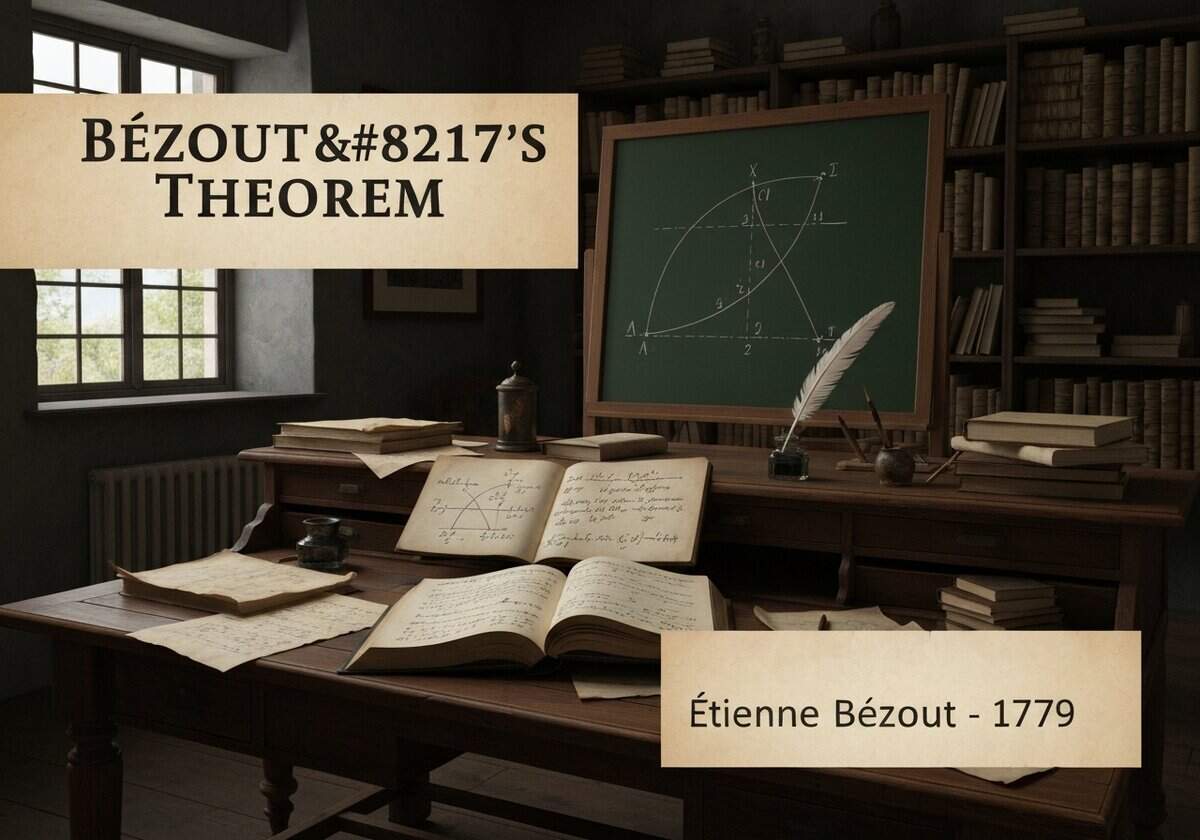
Bézout’s Theorem

1779
  • Étienne Bézout
Study room of Étienne Bézout showcasing Bézout's Theorem and algebraic curves.

(صورة توضيحية فقط)

Bézout’s theorem is a fundamental statement in intersection theory. It asserts that the number of intersection points of two plane algebraic curves of degrees [latex]m[/latex] and [latex]n[/latex] is exactly [latex]mn[/latex], provided that one works in a projective plane over an algebraically closed field, counts points with multiplicity, and includes points at infinity where parallel asymptotes meet.
Bézout’s theorem elegantly quantifies the intersection of curves. In the standard affine plane, the number of intersections can be less than [latex]mn[/latex] for several reasons. First, some solutions might have complex coordinates. Second, lines that are parallel in the affine plane can be thought of as meeting at a ‘point at infinity’; moving to the projective plane [latex]\mathbb{P}^2[/latex] systematically includes these points. Third, some intersection points might be ‘degenerate’, such as a line being tangent to a circle. In this case, the single point of tangency must be counted with a multiplicity of two for the theorem to hold. The concept of intersection multiplicity is a crucial and subtle part of the theory that makes the count exact.

For example, a parabola ([latex]y=x^2[/latex], degree 2) and a line ([latex]y=ax+b[/latex], degree 1) should intersect at [latex]2 \times 1 = 2[/latex] points. This is clear when the line cuts through the parabola. When the line is tangent, there is one point, but it has multiplicity 2. If the line doesn’t intersect the parabola in the real plane, there are two intersection points with complex coordinates. The theorem generalizes to higher dimensions, stating that [latex]n[/latex] hypersurfaces of degrees [latex]d_1, \dots, d_n[/latex] in [latex]\mathbb{P}^n[/latex] intersect in exactly [latex]d_1 \cdots d_n[/latex] points, again, when counted properly.

UNESCO Nomenclature: 1105
– Geometry

يكتب

نظام مجرد

خلل

Substantial

الاستخدام

استخدام واسع النطاق

مقدمات

  • الهندسة الإحداثية (ديكارت، فيرما)
  • نظرية المعادلات متعددة الحدود (newton(ماكلورين)
  • المفاهيم المبكرة للهندسة الإسقاطية (ديسارج، باسكال)
  • cramer’s paradox on the number of points defining a curve

التطبيقات

  • رسومات الكمبيوتر (حساب التقاطعات لتتبع الأشعة)
  • الروبوتات (حل الحركية العكسية لأذرع الروبوت)
  • الهندسة الحسابية وأنظمة التصميم بمساعدة الحاسوب والكام
  • نظرية الحذف لحل أنظمة كثيرة الحدود
  • ميكانيكا سماوية (تحليل المدارات)

براءات الاختراع:

NA

أفكار ابتكارية محتملة

  • خوارزميات اكتشاف الاصطدامات للسيارات ذاتية القيادة في البيئات المعقدة
  • محاكاة طي البروتين التي تتنبأ بالتكوينات المستقرة من خلال إيجاد تقاطعات أسطح الطاقة
  • تحليل نقاط الضعف في شبكات الكمبيوتر من خلال نمذجة حالات النظام كأصناف متقاطعة
  • التصميم الآلي للوصلات والتروس الميكانيكية
  • وضع مثالي لأجهزة الاستشعار في الشبكة اللاسلكية لتحقيق أقصى قدر من التغطية
  • تقنيات تحليل الشفرات لكسر الأنظمة القائمة على كثيرات الحدود متعددة المتغيرات
  • برامج التخطيط الحضري لتحسين تخطيطات البنية التحتية (على سبيل المثال، الطرق والأنابيب)
  • نماذج نظرية الألعاب لإيجاد نقاط التوازن في الألعاب متعددة اللاعبين
Related to: Bézout’s theorem, intersection theory, projective plane, algebraic curve, multiplicity, degree of a curve, polynomial system, points at infinity.

السياق التاريخي

Bézout’s Theorem

-300
-450
1585
1779
1799
1801
1850
1875
-300
-550
1750
1790
1800
1844
1874

(إذا كان التاريخ غير معروف أو غير ذي صلة، على سبيل المثال "ميكانيكا الموائع"، يتم توفير تقدير تقريبي لظهوره الملحوظ)

أحدث الإضافات

أهم المنشورات والمقالات

أفضل الأدوات الأصلية

السنة العاشرة عيد

الصور والتنزيلات بالحجم الكامل متاحة فقط، ومجانية تمامًا، للأعضاء المسجلين.