Product Design, Manufacturing & Innovation Resources
Home » Bernoulli’s Principle

Bernoulli’s Principle

1738
  • Daniel Bernoulli
Aircraft wing demonstrating Bernoulli's principle in fluid mechanics for lift generation.

(generated image for illustration only)

Bernoulli’s principle states that for an inviscid flow, an increase in a fluid’s speed occurs simultaneously with a decrease in pressure or a decrease in its potential energy. It is a statement of the conservation of energy for a moving fluid, commonly expressed as \(p + \frac{1}{2}\rho v^2 + \rho gh = \text{constant}\) along a streamline.


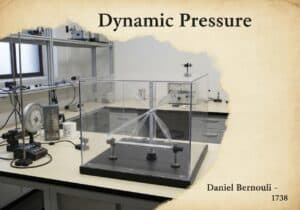
Bernoulli’s principle is derived from the principle of conservation of energy applied to an ideal fluid in motion. The equation’s three terms represent different forms of energy per unit volume. The term \(p\) is the static pressure, representing the internal energy of the fluid. The term \(\frac{1}{2}\rho v^2\) is the dynamic pressure, which is the kinetic energy of the fluid in motion. The final term, \(\rho gh\), is the hydrostatic pressure, representing the fluid’s potential energy due to its elevation \(h\) in a gravitational field \(g\). The principle asserts that the sum of these three terms remains constant along a single streamline.

It is crucial to understand the assumptions under which Bernoulli’s principle is valid: the flow must be steady (velocity at a point does not change with time), incompressible (density is constant), and inviscid (no frictional forces from viscosity). These are significant limitations, meaning the principle is an idealization. In real-world applications, viscous effects can cause energy losses that are not accounted for in the basic equation.

While often used to provide a simplified explanation for aerodynamic lift—where air traveling faster over the curved upper surface of a wing creates lower pressure compared to the flatter bottom surface—this is an incomplete picture. A full explanation of lift also requires considering Newton’s third law and the deflection of air downwards (downwash). Nevertheless, Bernoulli’s principle provides a powerful and intuitive tool for a first-order analysis of many fluid dynamics phenomena, from measuring flow rates with a Venturi meter to understanding how a perfume atomizer works.

UNESCO Nomenclature: 2210
– Mechanics

Type

Abstract System

Disruption

Foundational

Usage

Widespread Use

Precursors

  • isaac newton’s laws of motion
  • leonhard euler’s work on fluid dynamics
  • early concepts of conservation of energy
  • studies of pressure by evangelista torricelli and blaise pascal

Applications

  • aircraft wing lift generation (as a contributing factor)
  • carburetors in engines
  • venturi meters for flow measurement
  • atomizers and spray guns
  • pitot tubes for measuring airspeed

Patents:

NA

Potential Innovations Ideas

Due to scrapping bot traffic, currently more than 40k per day, this content is reserved to community members.
> Login < or > Register < (100% free) to access this, so as all other restricted content and tools.

Related to: bernoulli’s principle, fluid dynamics, conservation of energy, pressure, velocity, inviscid flow, streamline, aerodynamics.

Historical Context

Bernoulli’s Principle

1672
1687
1687
1738
1750
1757
1788
1650
1678
1687
1687
1738
1750
1785
1788

(if date is unknown or not relevant, e.g. "fluid mechanics", a rounded estimation of its notable emergence is provided)

Related Invention, Innovation & Technical Principles

Full size images and downloads are only available, 100% free, for registered members.

> Login <