Product Design, Manufacturing & Innovation Resources
집 » 베르누이의 원리

베르누이의 원리

1738
  • Daniel Bernoulli
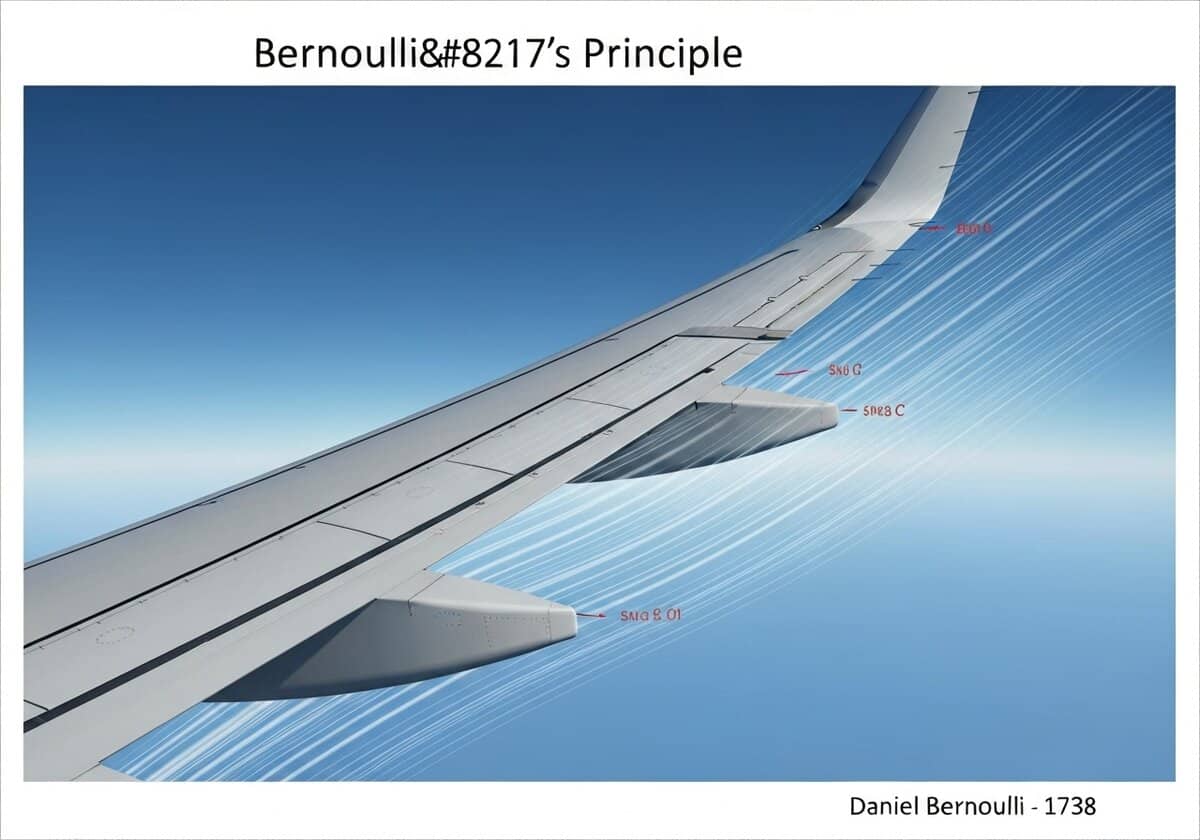
Aircraft wing demonstrating Bernoulli's principle in fluid mechanics for lift generation.

(설명을 위한 생성된 이미지입니다)

Bernoulli’s principle states that for an inviscid flow, an increase in a fluid’s speed occurs simultaneously with a decrease in pressure or a decrease in its potential energy. It is a statement of the conservation of energy for a moving fluid, commonly expressed as [latex]p + \frac{1}{2}\rho v^2 + \rho gh = \text{constant}[/latex] along a streamline.


Bernoulli’s principle is derived from the principle of 에너지 보존 applied to an ideal fluid in motion. The equation’s three terms represent different forms of energy per unit volume. The term [latex]p[/latex] is the static pressure, representing the internal energy of the fluid. The term [latex]\frac{1}{2}\rho v^2[/latex] is the 동적 압력, which is the kinetic energy of the fluid in motion. The final term, [latex]\rho gh[/latex], is the 정수압이는 중력장[latex]g[/latex] 내에서 유체의 높이[latex]h[/latex]로 인한 위치 에너지를 나타냅니다. 이 원리는 이 세 항의 합이 하나의 유선을 따라 일정하게 유지된다고 주장합니다.

It is crucial to understand the assumptions under which Bernoulli’s principle is valid: the flow must be steady (velocity at a point does not change with time), incompressible (density is constant), and inviscid (no frictional forces from viscosity). These are significant limitations, meaning the principle is an idealization. In real-world applications, viscous effects can cause energy losses that are not accounted for in the basic equation.

While often used to provide a simplified explanation for aerodynamic lift—where air traveling faster over the curved upper surface of a wing creates lower pressure compared to the flatter bottom surface—this is an incomplete picture. A full explanation of lift also requires considering Newton’s third law and the deflection of air downwards (downwash). Nevertheless, Bernoulli’s principle provides a powerful and intuitive tool for a first-order analysis of many fluid dynamics phenomena, from measuring flow rates with a Venturi meter to understanding how a perfume atomizer works.

UNESCO Nomenclature: 2210
역학

유형

추상 시스템

분열

기초적인

용법

널리 사용됨

전구체

  • 아이작 뉴턴의 운동 법칙
  • 레온하르트 오일러의 유체역학 연구
  • 에너지 보존 법칙에 대한 초기 개념
  • 에반젤리스타 토리첼리와 블레즈 파스칼의 압력 연구

응용 프로그램

  • 항공기 날개 양력 발생 (기여 요인으로서)
  • 엔진의 기화기
  • 유량 측정용 벤투리 유량계
  • 분무기 및 스프레이 건
  • 피토관은 대기 속도를 측정하는 데 사용됩니다.

특허:

NA

잠재적 혁신 아이디어

  • self-adjusting building facades that minimize wind load during storms
  • high-efficiency 관개 systems that use venturi effects for fertilizer injection
  • passive air circulation systems for large habitats in space or underground
  • new types of musical instruments based on controlled air jets
  • bladeless 에너지 수확 devices from low-speed water currents
  • micro-pumps for lab-on-a-chip devices with no moving parts
  • advanced fire suppression systems using high-speed mist atomizers
  • silent, high-speed hand dryers using pressure differential principles
관련 개념: 베르누이의 원리, 유체 역학, 에너지 보존, 압력, 속도, 비점성 흐름, 유선, 공기역학.

역사적 맥락

베르누이의 원리

1672
1687
1687
1738
1750
1757
1788
1650
1678
1687
1687
1738
1750
1785
1788

(날짜를 알 수 없거나 관련이 없는 경우, 예를 들어 "유체역학"의 경우, 주목할 만한 등장 시기를 대략적으로 추정하여 제공합니다.)

10년차 기념일

고화질 이미지 및 다운로드는 등록된 회원에게만 100% 무료로 제공됩니다.

> 로그인 <