Product Design, Manufacturing & Innovation Resources
» ベルヌーイの原理

ベルヌーイの原理

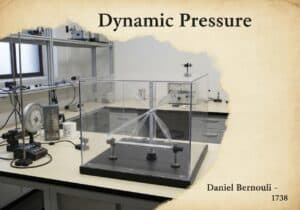
1738
  • Daniel Bernoulli
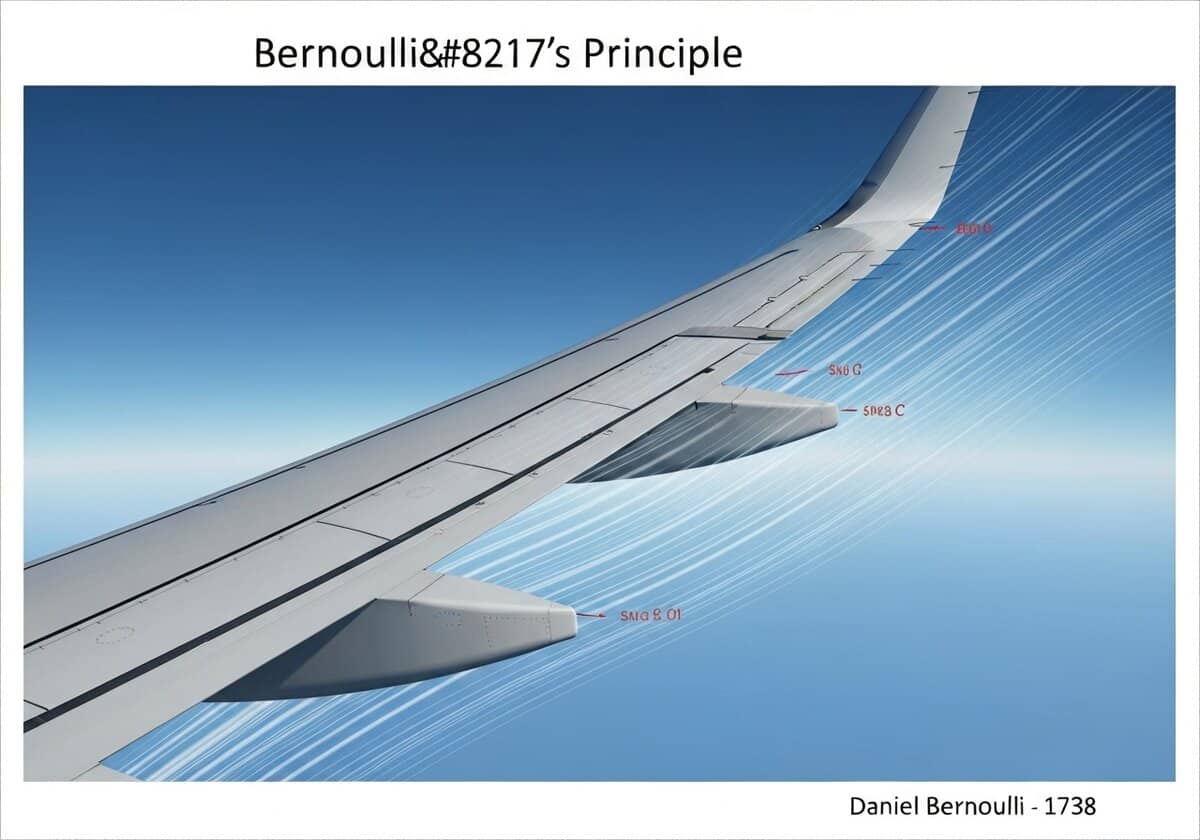
Aircraft wing demonstrating Bernoulli's principle in fluid mechanics for lift generation.

(画像はイメージです)

ベルヌーイの原理によれば、非粘性流体の場合、流体の速度の増加は、同時に粘度の減少を伴う。 プレッシャー または、その位置エネルギーの減少。これは、 エネルギー保存の法則 流体が移動する場合、流線に沿って一般的に [latex]p + frac{1}{2}rho v^2 + rho gh = text{定数}[/latex] と表されます。


Bernoulli’s principle is derived from the principle of conservation of energy applied to an ideal fluid in motion. The equation’s three terms represent different forms of energy per unit volume. The term [latex]p[/latex] is the static pressure, representing the internal energy of the fluid. The term [latex]\frac{1}{2}\rho v^2[/latex] is the dynamic pressure, which is the kinetic energy of the fluid in motion. The final term, [latex]\rho gh[/latex], is the hydrostatic pressure, representing the fluid’s potential energy due to its elevation [latex]h[/latex] in a gravitational field [latex]g[/latex]. The principle asserts that the sum of these three terms remains constant along a single streamline.

It is crucial to understand the assumptions under which Bernoulli’s principle is valid: the flow must be steady (velocity at a point does not change with time), incompressible (density is constant), and inviscid (no frictional forces from viscosity). These are significant limitations, meaning the principle is an idealization. In real-world applications, viscous effects can cause energy losses that are not accounted for in the basic equation.

While often used to provide a simplified explanation for aerodynamic lift—where air traveling faster over the curved upper surface of a wing creates lower pressure compared to the flatter bottom surface—this is an incomplete picture. A full explanation of lift also requires considering Newton’s third law and the deflection of air downwards (downwash). Nevertheless, Bernoulli’s principle provides a powerful and intuitive tool for a first-order analysis of many fluid dynamics phenomena, from measuring flow rates with a Venturi meter to understanding how a perfume atomizer works.

UNESCO Nomenclature: 2210
機械工学

タイプ

抽象システム

混乱

基礎

使用法

広く普及している

前駆物質

  • アイザック・ニュートンの運動法則
  • レオンハルト・オイラーの流体力学に関する研究
  • エネルギー保存の初期の概念
  • エヴァンジェリスタ・トリチェリとブレーズ・パスカルによる圧力の研究

アプリケーション

  • 航空機の翼の揚力発生(寄与要因として)
  • エンジンのキャブレター
  • 流量測定用ベンチュリ流量計
  • 噴霧器とスプレーガン
  • 対気速度を測定するためのピトー管

特許:

NA

潜在的なイノベーションのアイデア

ボットによるトラフィック(現在1日あたり4万件以上)を排除するため、このコンテンツはコミュニティメンバー限定となっています。
> ログイン < または > 登録 < (100%無料)でこれにアクセスできます。他のすべての制限付きコンテンツとツールも同様です。

関連:ベルヌーイの原理、流体力学、エネルギー保存則、圧力、速度、非粘性流、流線、空気力学。

歴史的背景

ベルヌーイの原理

1672
1687
1687
1738
1750
1757
1788
1650
1678
1687
1687
1738
1750
1785
1788

(日付が不明または関連性がない場合、例えば「流体力学」などでは、その注目すべき出現時期の概算値が提示されます。)

フルサイズの画像とダウンロードは、登録会員のみが100%無料で利用できます。