Product Design, Manufacturing & Innovation Resources
Heim » Impulserhaltung im Kontinuum

Impulserhaltung im Kontinuum

1827
  • Augustin-Louis Cauchy
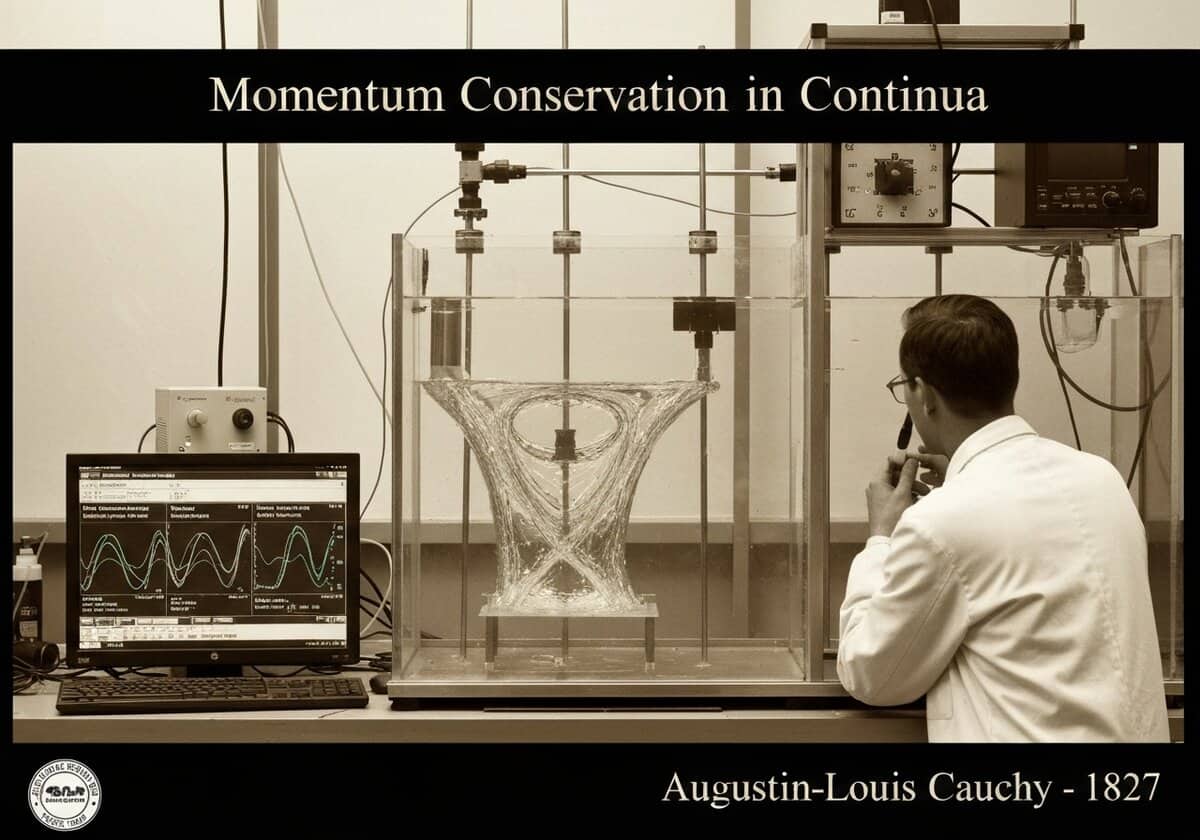
Strömungsmechanisches Experiment zur Demonstration der Prinzipien der Impulserhaltung in einer Laborumgebung.

(Abbildung dient nur zur Veranschaulichung)

For continuous systems like fluids or solids, momentum conservation is expressed in a differential form. The rate of change of momentum density [latex]\rho \vec{v}[/latex] at a point is governed by the divergence of the Cauchy-Spannungstensor [latex]\sigma[/latex] and body forces [latex]\vec{f}[/latex]. This is described by the Cauchy momentum equation: [latex]\frac{\partial (\rho \vec{v})}{\partial t} + \nabla \cdot (\rho \vec{v} \otimes \vec{v}) = \nabla \cdot \sigma + \vec{f}[/latex].


When dealing with a continuum, such as a fluid or a deformable solid, it is impractical to track individual particles. Instead, we describe the system using fields like density ([latex]\rho[/latex]), velocity ([latex]\vec{v}[/latex]), and stress ([latex]\sigma[/latex]) that vary continuously in space and time. The principle of momentum conservation is applied to an infinitesimal volume element within the continuum.

The Cauchy momentum equation is essentially Newton’s zweites Gesetz applied to this volume element. The term [latex]\frac{\partial (\rho \vec{v})}{\partial t}[/latex] represents the rate of change of momentum within the volume. The term [latex]\nabla \cdot (\rho \vec{v} \otimes \vec{v})[/latex] represents the net rate of momentum flow out of the volume (advection). The term [latex]\nabla \cdot \sigma[/latex] represents the surface forces acting on the volume element due to stress from the surrounding material. The Cauchy stress tensor [latex]\sigma[/latex] is a second-order tensor that describes the state of stress at a point. Finally, [latex]\vec{f}[/latex] represents the body forces (like gravity) acting on the volume.

This equation is a cornerstone of continuum mechanics. When combined with the continuity equation (Massenerhaltung) and an equation of state, it forms the basis for the Navier-Stokes equations, which are fundamental to fluid dynamics.

UNESCO Nomenclature: 2209
- Mechanik

Typ

Abstraktes System

Störung

Grundlegendes

Verwendung

Weitverbreitete Verwendung

Vorläufer

  • Isaac Newtons Bewegungsgesetze
  • Leonhard Euler’s work on fluid dynamics
  • Daniel Bernoulli’s principle
  • Entwicklung der Vektorrechnung und Tensoranalyse

Anwendungen

  • numerische Strömungsmechanik (CFD)
  • Luft- und Raumfahrttechnik (Flügelkonstruktion)
  • Tragwerksplanung (Spannungsanalyse)
  • Geophysik (Mantelkonvektion)
  • Meteorologie (Wettervorhersage)

Patente:

NA

Potenzielle Innovationsideen

  • Echtzeit-Wettervorhersagemodelle mit höherer Genauigkeit
  • Entwurf von geräuschlosen U-Boot-Antriebssystemen
  • Entwicklung künstlicher Herzen mit optimiertem Blutfluss
  • Simulation von Vulkanausbrüchen und Lavaströmen
  • Optimierung industrieller Mischprozesse in der chemischen Verfahrenstechnik
  • Entwicklung effizienterer Verbrennungsmotoren
  • Modellierung des Blutflusses in Arterien zur Vorhersage von Aneurysmen
  • creation of realistic special effects in movies and Videospiele
  • Analyse der Gebäudestabilität bei Erdbeben
  • Entwicklung fortschrittlicher Kühlkörper für die Elektronikkühlung
Related to: continuum mechanics, Cauchy momentum equation, stress tensor, fluid dynamics, momentum density, divergence, body force, Navier-Stokes equations, Festkörpermechanik, advection.

Historischer Kontext

Impulserhaltung im Kontinuum

1820
1822
1824
1827
1831
1831
1832
1820
1821
1822
1827
1829
1831
1831
1833

(wenn das Datum unbekannt oder nicht relevant ist, z. B. „Strömungsmechanik“, wird eine gerundete Schätzung seines bemerkenswerten Auftretens bereitgestellt)

10. Jahr Jubiläum

Bilder in voller Größe und Downloads sind nur für registrierte Mitglieder 100% kostenlos verfügbar.

> Login <