Product Design, Manufacturing & Innovation Resources
Lar » Conservação do Momento em Contínua

Conservação do Momento em Contínua

1827
  • Augustin-Louis Cauchy
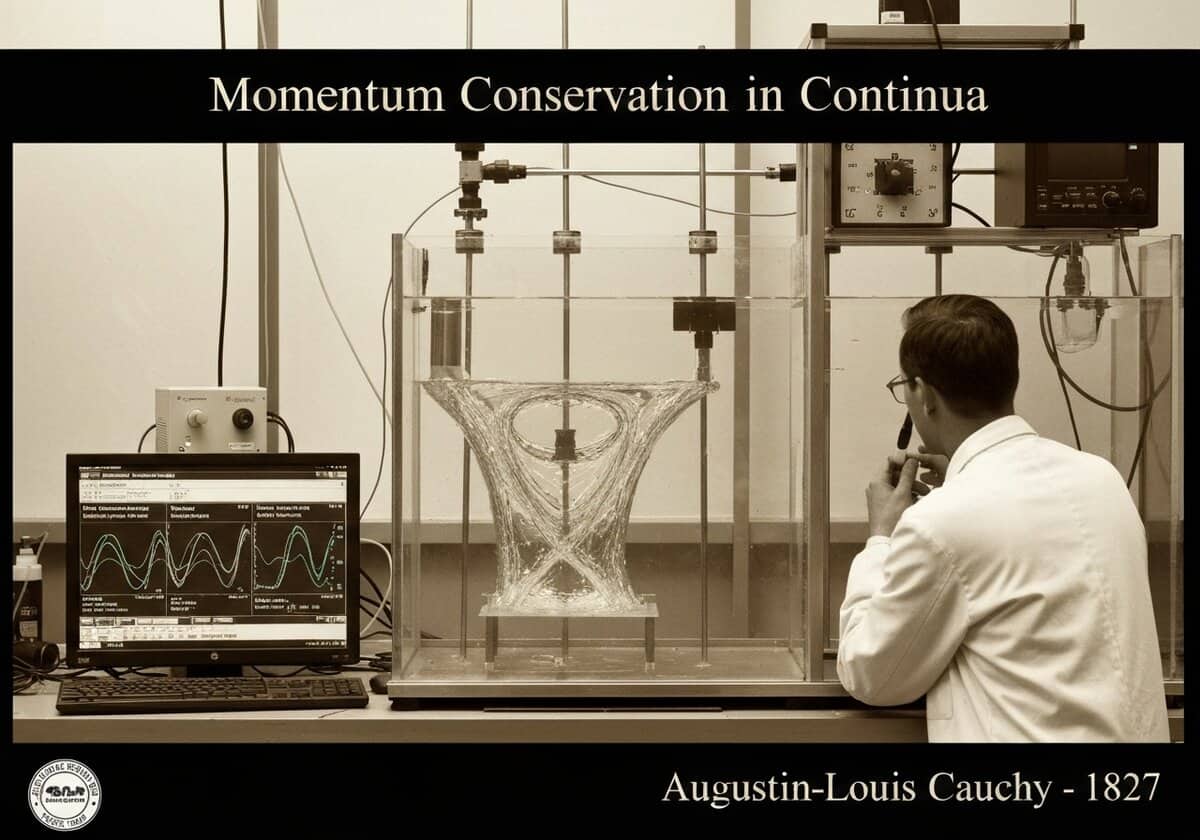
Experimento de mecânica dos fluidos que demonstra os princípios de conservação do momento em um ambiente de laboratório.

(Imagem gerada apenas para fins ilustrativos)

Este fenômeno é crucial para a autorregulação da velocidade do motor e do consumo de corrente. momentum conservation is expressed in a differential form. The rate of change of momentum density [latex]rho vec{v}[/latex] at a point is governed by the divergence of the Cauchy stress tensor [latex]sigma[/latex] and body forces [latex]vec{f}[/latex]. This is described by the Cauchy momentum equation: [latex]frac{partial (rho vec{v})}{partial t} + nabla cdot (rho vec{v} otimes vec{v}) = nabla cdot sigma + vec{f}[/latex].


When dealing with a continuum, such as a fluid or a deformable solid, it is impractical to track individual particles. Instead, we describe the system using fields like density ([latex]\rho[/latex]), velocity ([latex]\vec{v}[/latex]), and stress ([latex]\sigma[/latex]) that vary continuously in space and time. The principle of momentum conservation is applied to an infinitesimal volume element within the continuum.

The Cauchy momentum equation is essentially Newton’s segunda lei applied to this volume element. The term [latex]frac{partial (rho vec{v})}{partial t}[/latex] represents the rate of change of momentum within the volume. The term [latex]nabla cdot (rho vec{v} otimes vec{v})[/latex] represents the net rate of momentum flow out of the volume (advection). The term [latex]nabla cdot sigma[/latex] represents the surface forces acting on the volume element due to stress from the surrounding material. The Cauchy stress tensor [latex]sigma[/latex] is a second-order tensor that describes the state of stress at a point. Finally, [latex]vec{f}[/latex] represents the body forces (like gravity) acting on the volume.

This equation is a cornerstone of continuum mechanics. When combined with the continuity equation (conservation of mass) and an equation of state, it forms the basis for the Navier-Stokes equations, which are fundamental to fluid dynamics.

UNESCO Nomenclature: 2209
Mecânica

Tipo

Sistema abstrato

Interrupção

Fundamentais

Uso

Uso generalizado

Precursores

  • Leis do movimento de Isaac Newton
  • Leonhard Euler’s work on fluid dynamics
  • Daniel Bernoulli’s principle
  • Development of vector calculus and tensor analysis

Aplicações

  • computational fluid dynamics (cfd)
  • aerospace engineering (wing design)
  • structural engineering (stress analysis)
  • geophysics (mantle convection)
  • meteorology (weather prediction)

Patentes:

NA

Ideias de Inovação Potencial

  • real-time weather forecasting models with higher accuracy
  • design of silent submarine propulsion systems
  • development of artificial hearts with optimized blood flow
  • simulation of volcanic eruptions and lava flows
  • optimization of industrial mixing processes in chemical engineering
  • design of more efficient internal combustion engines
  • modeling of blood flow in arteries to predict aneurysms
  • creation of realistic special effects in movies and jogos de vídeo
  • analysis of building stability during earthquakes
  • design of advanced heat sinks for electronics cooling
Related to: continuum mechanics, Cauchy momentum equation, stress tensor, fluid dynamics, momentum density, divergence, body force, Navier-Stokes equations, mecânica dos sólidos, advection.

Contexto histórico

Conservação do Momento em Contínua

1820
1822
1824
1827
1831
1831
1832
1820
1821
1822
1827
1829
1831
1831
1833

(Caso a data seja desconhecida ou irrelevante, por exemplo, "mecânica dos fluidos", é fornecida uma estimativa aproximada de seu surgimento notável)

10º ano aniversário

Imagens em tamanho real e downloads estão disponíveis apenas, 100% gratuitos, para membros registrados.