Product Design, Manufacturing & Innovation Resources
Heim » Satz von Noether und Translationssymmetrie

Satz von Noether und Translationssymmetrie

1918
  • Emmy Noether
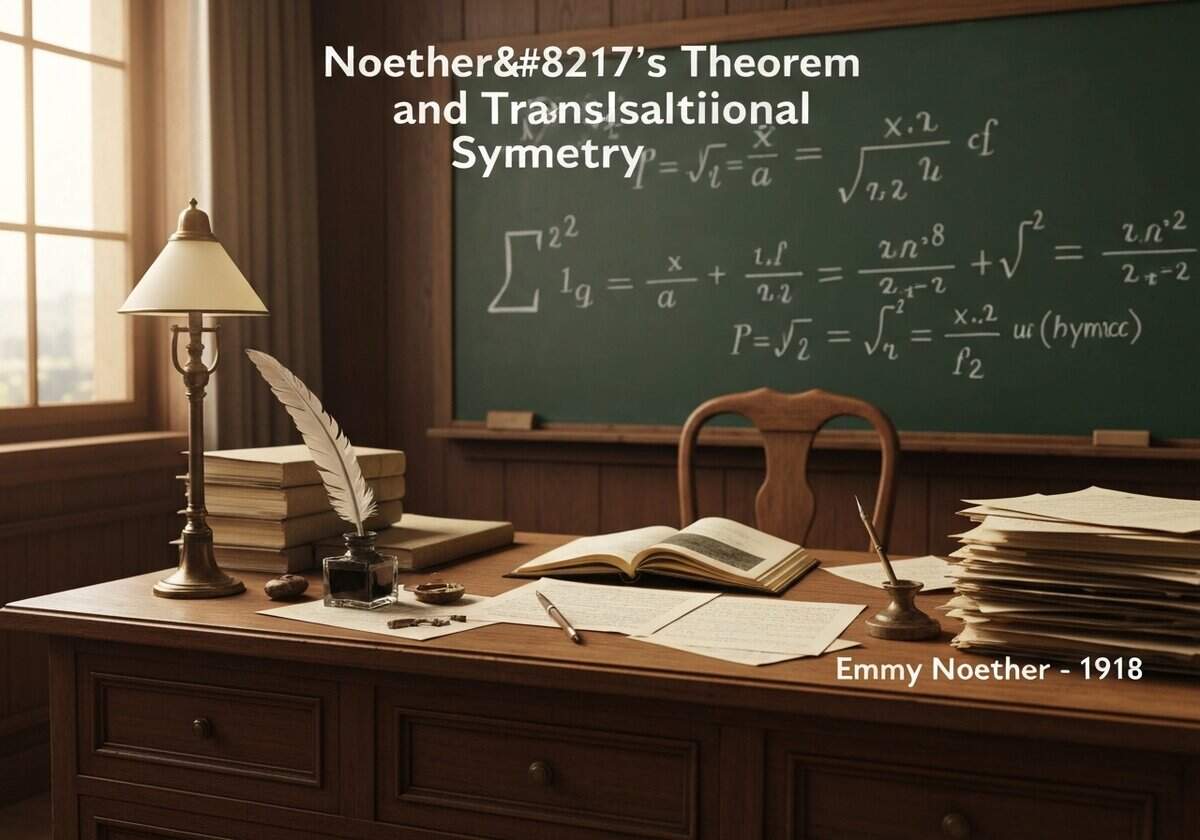
Emmy Noether's workspace illustrating translational symmetry in classical mechanics.

(Abbildung dient nur zur Veranschaulichung)

Der Impulserhaltung is a direct consequence of the homogeneity of space, meaning the laws of physics are invariant under spatial translation. This profound connection is formalized by Noether’s theorem: for every continuous symmetry of a physical system, there exists a corresponding conserved quantity. Translational symmetry implies that the Lagrange-Funktion of the system is unchanged by a shift in coordinates.

Emmy Noether’s 1918 theorem provides a deep and elegant connection between symmetries and conservation laws in physics. It is a cornerstone of modern theoretical physics. The theorem states that if a system’s action is invariant under a continuous group of transformations (a symmetry), then there is a corresponding quantity that is conserved over time.

In the context of momentum, the relevant symmetry is translational invariance. This means that if you shift the entire physical system by a constant vector, the laws governing its behavior do not change. The Lagrange-Funktion, [latex]L(q, \dot{q})[/latex], which describes the dynamics of the system, remains unchanged under such a transformation. Applying Noether’s theorem to this specific symmetry of spatial translation directly yields the law of conservation of linear momentum.

This perspective elevates the conservation of momentum from a mere consequence of Newton’s laws to a fundamental principle rooted in the structure of spacetime itself. Similarly, Noether’s theorem shows that Erhaltung der Energie arises from time-translation symmetry, and conservation of angular momentum arises from rotational symmetry. This framework is essential in fields beyond classical mechanics, including quantum mechanics and general relativity, where it provides a powerful tool for identifying conserved quantities.

UNESCO Nomenclature: 2209
- Mechanik

Typ

Abstraktes System

Störung

Revolutionär

Verwendung

Weitverbreitete Verwendung

Vorläufer

  • Prinzip der geringsten Wirkung
  • Lagrangesche Mechanik (Joseph-Louis Lagrange)
  • Hamiltonian mechanics (William Rowan Hamilton)
  • David Hilbert’s work on the foundations of physics

Anwendungen

  • grundlegend Teilchenphysik (standard model)
  • Allgemeine Relativitätstheorie
  • Quantenfeldtheorie
  • Lagrange- und Hamilton-Mechanik
  • Festkörperphysik (Kristallgitter)

Patente:

NA

Potenzielle Innovationsideen

  • Entwicklung neuer topologischer Materialien mit geschützten Oberflächenzuständen
  • Formulierung von Eichtheorien in der Teilchenphysik
  • Entwurf von Algorithmen für symbolische Berechnungen in der theoretischen Physik
  • Suche nach Verstößen gegen Erhaltungsgesetze, um neue physikalische Erkenntnisse zu gewinnen
  • Konstruktion konsistenter Theorien der Quantengravitation
  • Analyse von Symmetrien in komplexen Systemen wie neuronalen Netzwerken
  • Entwicklung von Fehlerkorrekturcodes auf der Grundlage von Symmetrieprinzipien
  • Modellierung der Kristallfehlerausbreitung in der Materialwissenschaft
  • robustere kosmologische Modelle schaffen
  • Entwicklung stabiler Plasmaeinschlusssysteme für Fusionsreaktoren
Related to: Noether’s theorem, symmetry, conservation law, translational invariance, Lagrangian mechanics, theoretical physics, spacetime, homogeneity, conserved quantity, action principle.

Historischer Kontext

Satz von Noether und Translationssymmetrie

1915
1916
1917
1918
1920
1920
1921
1915
1915-11
1916
1918
1919-05-29
1920
1920
1921

(wenn das Datum unbekannt oder nicht relevant ist, z. B. „Strömungsmechanik“, wird eine gerundete Schätzung seines bemerkenswerten Auftretens bereitgestellt)

10. Jahr Jubiläum

Bilder in voller Größe und Downloads sind nur für registrierte Mitglieder 100% kostenlos verfügbar.

> Login <