Product Design, Manufacturing & Innovation Resources
Heim » MEMS-elektrostatische Betätigung

MEMS-elektrostatische Betätigung

1990
  • William C. Tang
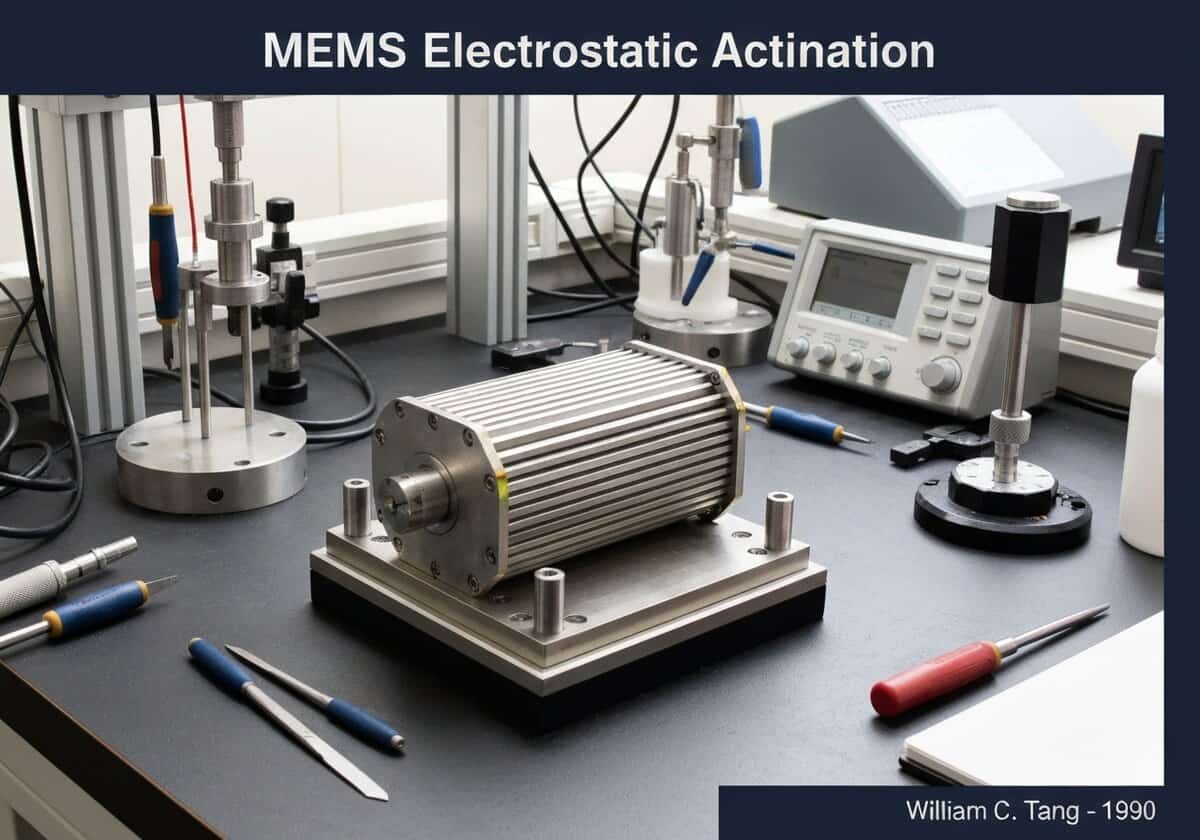
MEMS elektrostatischer Aktor mit Kammantrieb in der Elektrotechnik.

(Abbildung dient nur zur Veranschaulichung)

Electrostatic actuation is a primary method for inducing motion in MEMS. It utilizes the attractive force between two electrodes separated by a dielectric gap when a voltage is applied. The force is proportional to the square of the voltage and the capacitance gradient. Common designs include parallel-plate capacitors for out-of-plane motion and comb drives for large in-plane displacement.


Electrostatic actuation is favored in MEMS due to its low power consumption (ideally zero static power), high speed, and compatibility with standard microfabrication processes. The fundamental force [latex]F[/latex] in a parallel-plate actuator is given by [latex]F = \frac{1}{2} \frac{dC}{dx}V^2[/latex], where [latex]V[/latex] is the voltage and [latex]\frac{dC}{dx}[/latex] is the gradient of the capacitance [latex]C[/latex] with respect to displacement [latex]x[/latex]. For an ideal parallel-plate capacitor, this simplifies to [latex]F approx \frac{1}{2} \frac{\epsilon A V^2}{g^2}[/latex], where [latex]\epsilon[/latex] is the dielectric permittivity, [latex]A[/latex] is the plate area, and [latex]g[/latex] is the gap. This equation highlights a critical challenge: the force is highly non-linear with displacement. As the gap closes, the electrostatic force increases rapidly, while a typical mechanical restoring force (from a spring) increases linearly. At a certain point (typically one-third of the initial gap), the electrostatic force overwhelms the restoring force, causing the movable plate to snap unstably to the fixed plate. This phenomenon, known as ‘pull-in,’ limits the stable travel range of simple electrostatic actuators.

Um diese Einschränkung zu überwinden, wurde der Kammantriebsaktuator entwickelt. Er besteht aus zwei ineinandergreifenden, kammartigen Strukturen aus leitfähigen Fingern. Beim Anlegen einer Spannung bilden sich zwischen den Seiten der Finger elektrostatische Felder. Dadurch entsteht eine seitliche Kraft, die einen Kamm relativ zum anderen, parallel zum Substrat, bewegt. Der entscheidende Vorteil besteht darin, dass sich die Kämme beim Anlegen einer Spannung automatisch bewegen. engagieren, the number of overlapping finger pairs increases, but the gap between them remains constant. This results in a capacitance that changes linearly with displacement, producing a force that is largely independent of the position of the movable comb. This stable, long-range actuation was a revolutionary development, enabling a wide range of devices, particularly high-performance resonant Sensoren like gyroscopes and accelerometers, where precise and stable force feedback is required.

UNESCO Nomenclature: 3308
- Elektroingenieurwesen

Typ

Physikalisches Gerät

Störung

Grundlegendes

Verwendung

Weitverbreitete Verwendung

Vorläufer

  • Coulombsches Gesetz der elektrostatischen Kraft
  • the concept of the capacitor
  • semiconductor fabrication for creating precise electrode gaps
  • micromachining to create released, movable structures

Anwendungen

  • comb drive resonators in gyroscopes
  • digital micromirror devices (DMDs)
  • RF MEMS switches and varactors
  • tunable lasers and optical filters
  • atomic force microscope (AFM) scanners

Patente:

  • US5025346A

Potenzielle Innovationsideen

  • haptic feedback surfaces with arrays of electrostatic actuators
  • programmable radio frequency filters using arrays of MEMS varactors
  • large-scale optical cross-connect switches for fiber Optik networks
  • miniaturized particle sorters using electrostatic fields
  • adaptive aerodynamic surfaces for micro air vehicles
  • non-contact manipulation of micro-objects using electrostatic levitation
  • high-fidelity micromirror arrays for 3d holographic displays
  • Energiegewinnung devices that convert mechanical vibrations into electricity via variable capacitors
  • tunable Akustik Metamaterialien
  • in-situ SEM/TEM manipulators with nanometer precision
Verwandt mit: elektrostatischer Betätigung, MEMS, Kammantrieb, Aktor, Anzieheffekt, Kapazität, Mikroaktor, Spannung, Parallelplatten, Mikroelektronik.

Historischer Kontext

MEMS-elektrostatische Betätigung

1990
1990
1990
1990
1991
1992
1993
1990
1990
1990
1990
1990
1992
1992
1993-07-22

(wenn das Datum unbekannt oder nicht relevant ist, z. B. „Strömungsmechanik“, wird eine gerundete Schätzung seines bemerkenswerten Auftretens bereitgestellt)

10. Jahr Jubiläum

Bilder in voller Größe und Downloads sind ausschließlich für registrierte Mitglieder kostenlos verfügbar.

> Login <