Product Design, Manufacturing & Innovation Resources
Hogar » MEMS Electrostatic Actuation

MEMS Electrostatic Actuation

1990
  • William C. Tang
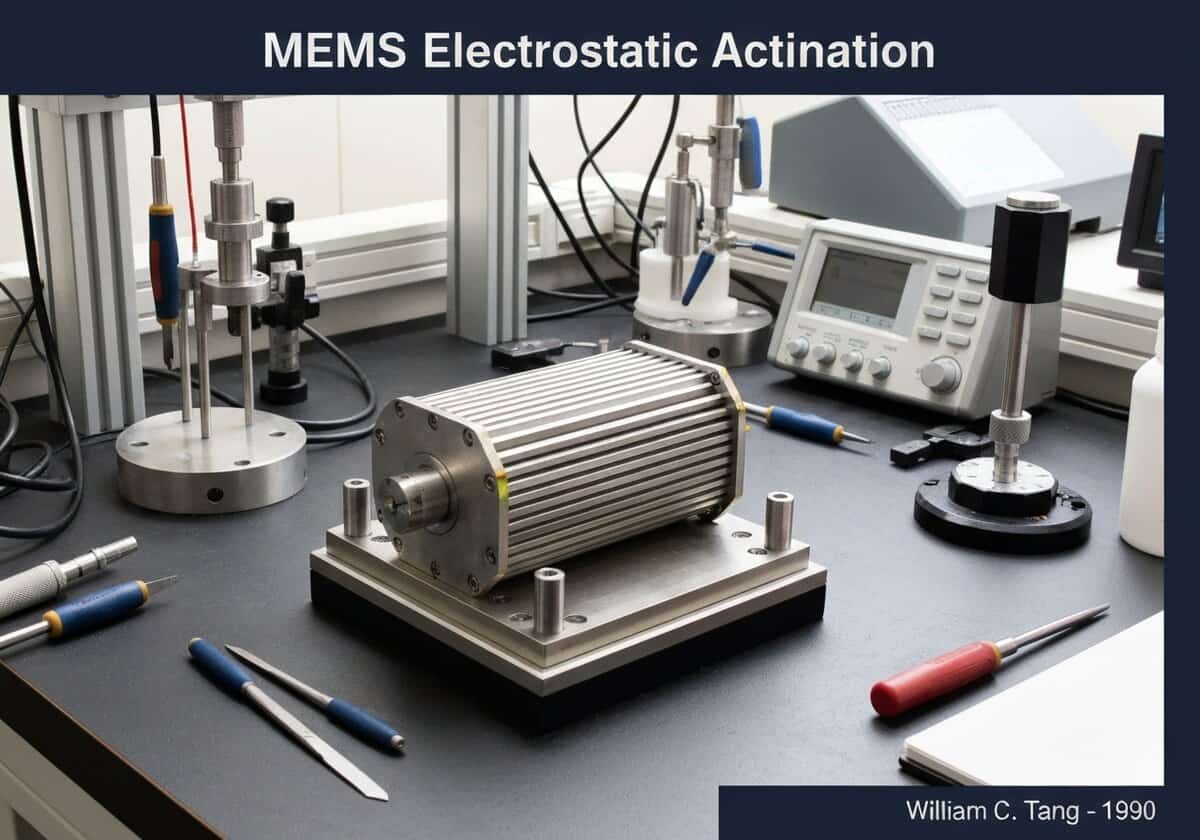
Actuador electrostático MEMS con diseño de accionamiento de peine en ingeniería eléctrica.

(Imagen generada únicamente con fines ilustrativos)

Electrostatic actuation is a primary method for inducing motion in MEMS. It utilizes the attractive force between two electrodes separated by a dielectric gap when a voltage is applied. The force is proportional to the square of the voltage and the capacitance gradient. Common designs include parallel-plate capacitors for out-of-plane motion and comb drives for large in-plane displacement.


Electrostatic actuation is favored in MEMS due to its low power consumption (ideally zero static power), high speed, and compatibility with standard microfabrication processes. The fundamental force [latex]F[/latex] in a parallel-plate actuator is given by [latex]F = \frac{1}{2} \frac{dC}{dx}V^2[/latex], where [latex]V[/latex] is the voltage and [latex]\frac{dC}{dx}[/latex] is the gradient of the capacitance [latex]C[/latex] with respect to displacement [latex]x[/latex]. For an ideal parallel-plate capacitor, this simplifies to [latex]F approx \frac{1}{2} \frac{\epsilon A V^2}{g^2}[/latex], where [latex]\epsilon[/latex] is the dielectric permittivity, [latex]A[/latex] is the plate area, and [latex]g[/latex] is the gap. This equation highlights a critical challenge: the force is highly non-linear with displacement. As the gap closes, the electrostatic force increases rapidly, while a typical mechanical restoring force (from a spring) increases linearly. At a certain point (typically one-third of the initial gap), the electrostatic force overwhelms the restoring force, causing the movable plate to snap unstably to the fixed plate. This phenomenon, known as ‘pull-in,’ limits the stable travel range of simple electrostatic actuators.

Para superar esta limitación, se inventó el actuador de peine. Consiste en dos estructuras entrelazadas en forma de peine formadas por dedos conductores. Cuando se aplica un voltaje, se forman campos electrostáticos entre los lados de los dedos. Esto genera una fuerza lateral que mueve un peine con respecto al otro, paralelamente al sustrato. La principal ventaja es que, a medida que los peines comprometer, the number of overlapping finger pairs increases, but the gap between them remains constant. This results in a capacitance that changes linearly with displacement, producing a force that is largely independent of the position of the movable comb. This stable, long-range actuation was a revolutionary development, enabling a wide range of devices, particularly high-performance resonant sensores like gyroscopes and accelerometers, where precise and stable force feedback is required.

UNESCO Nomenclature: 3308
- Ingeniería eléctrica

Tipo

Dispositivo físico

Ruptura

Fundacional

Uso

Uso generalizado

Precursores

  • Ley de Coulomb de la fuerza electrostática
  • the concept of the capacitor
  • semiconductor fabrication for creating precise electrode gaps
  • micromachining to create released, movable structures

Aplicaciones

  • comb drive resonators in gyroscopes
  • digital micromirror devices (DMDs)
  • RF MEMS switches and varactors
  • tunable lasers and optical filters
  • atomic force microscope (AFM) scanners

Patentes:

  • US5025346A

Ideas para posibles innovaciones

  • haptic feedback surfaces with arrays of electrostatic actuators
  • programmable radio frequency filters using arrays of MEMS varactors
  • large-scale optical cross-connect switches for fiber óptico networks
  • miniaturized particle sorters using electrostatic fields
  • adaptive aerodynamic surfaces for micro air vehicles
  • non-contact manipulation of micro-objects using electrostatic levitation
  • high-fidelity micromirror arrays for 3d holographic displays
  • recolección de energía devices that convert mechanical vibrations into electricity via variable capacitors
  • tunable acústico metamateriales
  • in-situ SEM/TEM manipulators with nanometer precision
Relacionado con: actuación electrostática, MEMS, accionamiento de peine, actuador, efecto de atracción, capacitancia, microactuador, voltaje, placas paralelas, microelectrónica.

Contexto histórico

MEMS Electrostatic Actuation

1990
1990
1990
1990
1991
1992
1993
1990
1990
1990
1990
1990
1992
1992
1993-07-22

(Si la fecha es desconocida o no es relevante, por ejemplo "mecánica de fluidos", se proporciona una estimación redondeada de su aparición notable)

décimo año aniversario

Las imágenes en tamaño completo y las descargas solo están disponibles, de forma totalmente gratuita, para los miembros registrados.

> Acceso <