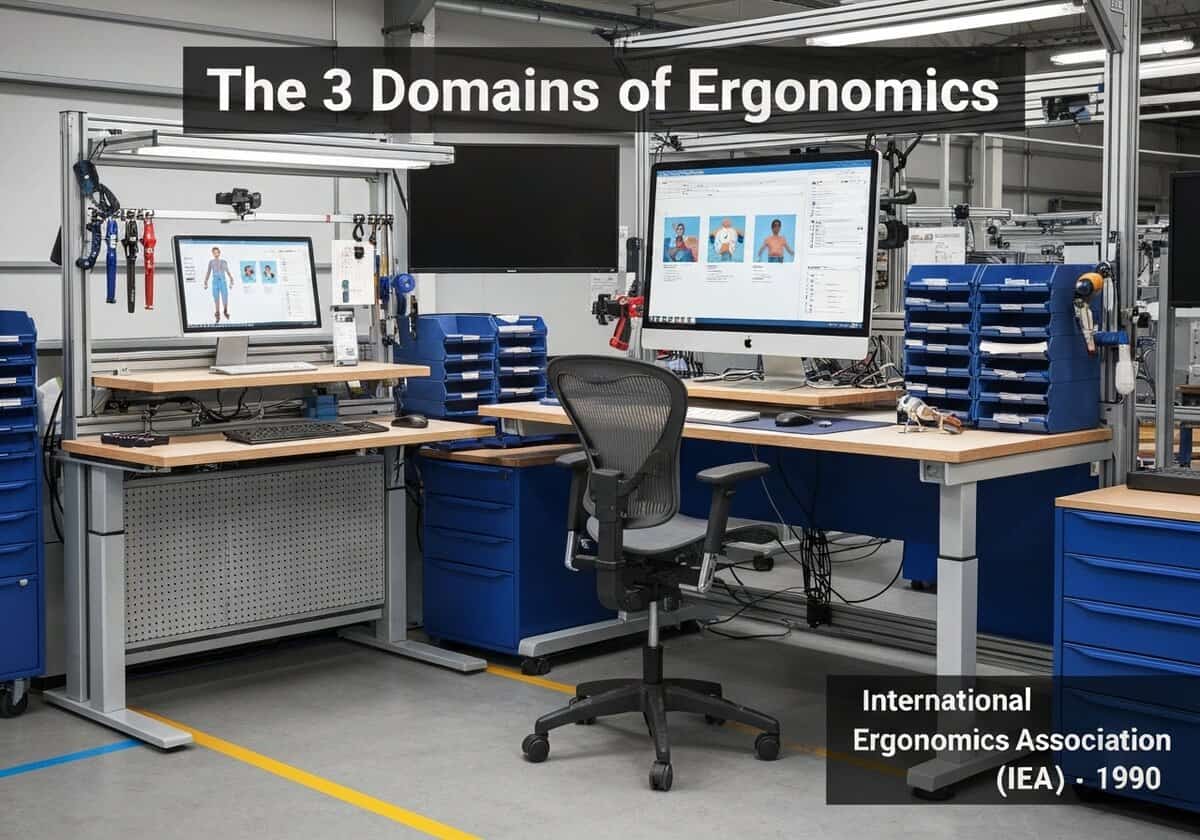
Die 3 Domänen der Ergonomie
1990
- International Ergonomics Association (IEA)
Die Internationale Ergonomie Association divides the discipline into three primary domains of specialization: physical ergonomics focuses on human anatomical, anthropometrisch, physiological, and biomechanical characteristics as they relate to physical activity, cognitive ergonomics concerns mental processes like perception, memory, and reasoning, and finally organizational ergonomics deals with the optimization of sociotechnical systems, including organizational structures, policies, and processes.
These three domains provide a framework for addressing the multifaceted nature of human-system interaction. Physical ergonomics is perhaps the most traditionally recognized domain, addressing topics like workplace layout, material handling, repetitive movements, work-related musculoskeletal disorders (MSDs), and workplace safety. It relies heavily on anthropometry (the study of human body measurements) and biomechanics to ensure that physical tasks are within the capabilities of the workforce.
Die kognitive Ergonomie, oft synonym mit Human Factors Engineering verwendet, konzentriert sich auf die mentalen Aspekte der Arbeit. Sie umfasst mentale Belastung, Entscheidungsfindung, qualifizierte Leistung, menschliche Zuverlässigkeit, Arbeitsstress und Schulungen im Zusammenhang mit der Mensch-System-Interaktion. Ein wichtiges Anwendungsgebiet ist die Mensch-Computer-Interaktion (MCI).HCl), um sicherzustellen, dass Software und Systeme intuitiv sind und die kognitiven Kapazitäten des Benutzers nicht überlasten.
Die Organisationsergonomie, auch Makroergonomie genannt, betrachtet Arbeitsabläufe aus einer umfassenderen, systemischen Perspektive. Sie zielt darauf ab, das gesamte Arbeitssystem unter Berücksichtigung von Personal, Aufgaben, Technologie und Arbeitsumgebung zu optimieren. Zu den Themen gehören Kommunikation, Crew Resource Management, Arbeitsgestaltung, Teamarbeit, partizipative Gestaltung und Qualitätsmanagement. Dieser Bereich erkennt an, dass die individuelle Leistung maßgeblich vom organisatorischen Kontext beeinflusst wird, in dem die Arbeit ausgeführt wird.
UNESCO Nomenclature: 3307
- Wirtschaftsingenieurwesen
Verwendung
Weitverbreitete Verwendung
Vorläufer
- development of industrial Psychologie in the early 20th century
- Entwicklung der Systemtheorie in der Mitte des 20. Jahrhunderts
- frühe Forschungen zum menschlichen Versagen in der Luftfahrt und in Militärsystemen
Anwendungen
- Gestaltung von Fertigungsarbeitsplätzen (physisch)
- user interface (UI) und User Experience (UX) Design für Software (kognitiv)
- implementation of quality management systems like schlanke Fertigung (organizational)
- Entwicklung von Sicherheitsprotokollen in Hochrisikobranchen (organisatorisch/physisch)
- Gestaltung von Flugzeugcockpits (kognitiv/physisch)
Potenzielle Innovationsideen
- integrierte ergonomische Plattformen, die physische, kognitive und organisatorische Daten gleichzeitig analysieren
- KI-gestützte kognitive Assistenten, die die mentale Belastung bei komplexen Entscheidungsprozessen reduzieren
- Blockchain-basierte Systeme für eine transparente und partizipative Organisationspolitik
- tragbar neuro-sensors to monitor cognitive load in real-time for pilots and surgeons
- Virtuelle Teambuilding-Übungen, die nach ergonomischen Organisationsprinzipien konzipiert wurden.
- ergonomic design of collaborative robots (‘cobots’) that considers physical safety and cognitive trust
- personalisierte Arbeitszeitpläne, die von Algorithmen generiert werden und sowohl Produktivität als auch Wohlbefinden optimieren (organisatorisch)
- Augmented Reality overlays providing ergonomic guidance during manual assembly tasks (physical/cognitive)
- Gamifizierte Organisationsstrukturen zur Verbesserung von Kommunikation und Arbeitsabläufen
- Intelligente Büroumgebungen, die Beleuchtung, Temperatur und Raumaufteilung an die Teamaktivitäten anpassen (organisatorisch/physisch).
Verwandt mit: physischer Ergonomie, kognitiver Ergonomie, Organisationsergonomie, Makroergonomie, Human Factors, soziotechnischen Systemen, Anthropometrie, Biomechanik, Mensch-Computer-Interaktion, IEA.