Product Design, Manufacturing & Innovation Resources
Heim » Gerüste für das Tissue Engineering

Gerüste für das Tissue Engineering

1990
  • Robert Langer
  • Joseph Vacanti
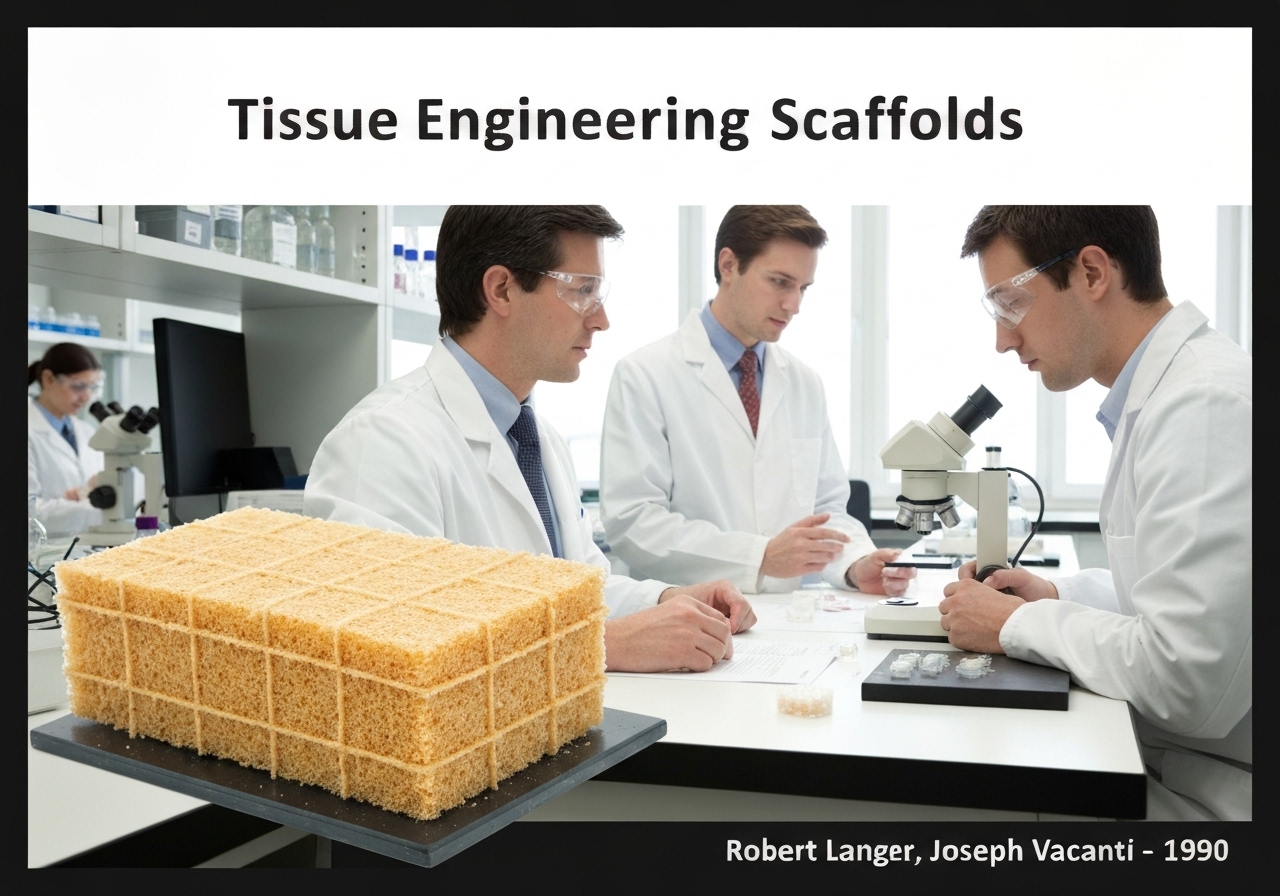
Biomaterialgerüst für die Geweberegeneration in der Medizin.

(Abbildung dient nur zur Veranschaulichung)

Ein Tissue-Engineering-Gerüst ist eine poröse, dreidimensionale Biomaterialstruktur, die als temporäre Vorlage für die Geweberegeneration dient. Es unterstützt Zellanhaftung, -migration, -proliferation und -differenzierung und steuert die Bildung neuen funktionellen Gewebes. Zu den wichtigsten Eigenschaften gehören Biokompatibilität, biologische Abbaubarkeit, ausreichende mechanische Festigkeit, hohe Porosität und ein vernetztes Porennetzwerk für den Transport von Nährstoffen und Abfallprodukten.

The design of a tissue engineering scaffold is a complex optimization problem. The material choice is critical; natural polymers like collagen and alginate offer excellent Biokompatibilität but may have poor mechanical properties, while synthetic polymers like poly(lactic-co-glycolic acid) (PLGA) and polycaprolactone (PCL) offer tunable degradation rates and mechanical strength. The scaffold’s architecture is equally important. High porosity and an interconnected pore structure are essential for cell infiltration and the diffusion of oxygen, nutrients, and metabolic waste. Pore size must be optimized for the specific cell type to facilitate adhesion and tissue formation. Advanced fabrication techniques are used to control these architectural features. For example, electrospinning uses a high voltage to draw a polymer solution into nanofibers that mimic the natural extracellular matrix (ECM). Additive Fertigung (3D printing) allows for the creation of patient-specific scaffolds with precise geometries derived from medical images like CT scans. Furthermore, scaffolds can be functionalized by incorporating growth factors, signaling molecules, or nanoparticles to actively direct cell behavior. The ideal scaffold degrades via hydrolysis or enzymatic action at a rate that matches the rate of new tissue formation, gradually transferring mechanical load to the nascent tissue until the scaffold is completely replaced by healthy, functional host tissue. Bioreactors are often used to mature these constructs in vitro by providing controlled flow and mechanical stimuli before implantation.

UNESCO Nomenclature: 3201
- Medizinische Wissenschaften

Typ

Physikalisches Gerät

Störung

Revolutionär

Verwendung

Aufstrebende Technologie

Vorläufer

  • development of biodegradable Polymere like pga and pla for sutures
  • Fortschritte in Zellkulturtechniken
  • Verständnis der Wechselwirkungen zwischen Zellen und der extrazellulären Matrix (ECM)
  • Entdeckungen von Wachstumsfaktoren und ihrer Rolle bei der Gewebeentwicklung

Anwendungen

  • Regeneration von Knochen und Knorpel
  • Entwicklung von Hauttransplantaten für Brandopfer
  • Bildung von Blutgefäßen und Herzklappen
  • Reparatur von Nervenschäden mithilfe von Führungskanälen
  • Entwicklung bio-künstlicher Organe wie Leber und Blase

Patente:

NA

Potenzielle Innovationsideen

  • 4d printed scaffolds that change shape over time in response to physiological stimuli
  • Gerüste mit eingebauten Gradienten biochemischer Signale zur Nachahmung der natürlichen Gewebekomplexität
  • vaskularisierte Gerüste, die mit Endothelzellen vorgeladen sind, um die Blutversorgung des künstlich hergestellten Gewebes sicherzustellen
  • ‘smart’ scaffolds that release therapeutic agents on demand in response to inflammation
  • dezellularisierte extrazelluläre Matrix (ECM) aus Spendergewebe, die als natürliches, komplexes Gerüst verwendet wird
  • injectable, in-situ gelling Hydrogel scaffolds for minimally invasive procedures
  • Gerüste mit integrierten Sensoren zur nicht-invasiven Überwachung von Gewebewachstum und -gesundheit
  • Organ-on-a-Chip-Plattformen mit Scaffold-Technologie für das Arzneimittelscreening
  • Hybridgerüste, die synthetische Polymere für die Festigkeit und natürliche Polymere für die Bioaktivität kombinieren
  • scaffolds designed to recruit and direct the body’s own stem cells for repair
Verwandt mit: Gewebezüchtung, scaffold, biomaterial, porous, biodegradable, cell adhesion, regeneration, 3d printing, electrospinning, plga.

Historischer Kontext

Gerüste für das Tissue Engineering

1969
1976-05-28
1980
1990
1965
1970
1980
1980
1990

(wenn das Datum unbekannt oder nicht relevant ist, z. B. „Strömungsmechanik“, wird eine gerundete Schätzung seines bemerkenswerten Auftretens bereitgestellt)

10. Jahr Jubiläum

Bilder in voller Größe und Downloads sind ausschließlich für registrierte Mitglieder kostenlos verfügbar.

> Login <