Product Design, Manufacturing & Innovation Resources
Heim » Bandlückenenergie und emittierte Wellenlänge

Bandlückenenergie und emittierte Wellenlänge

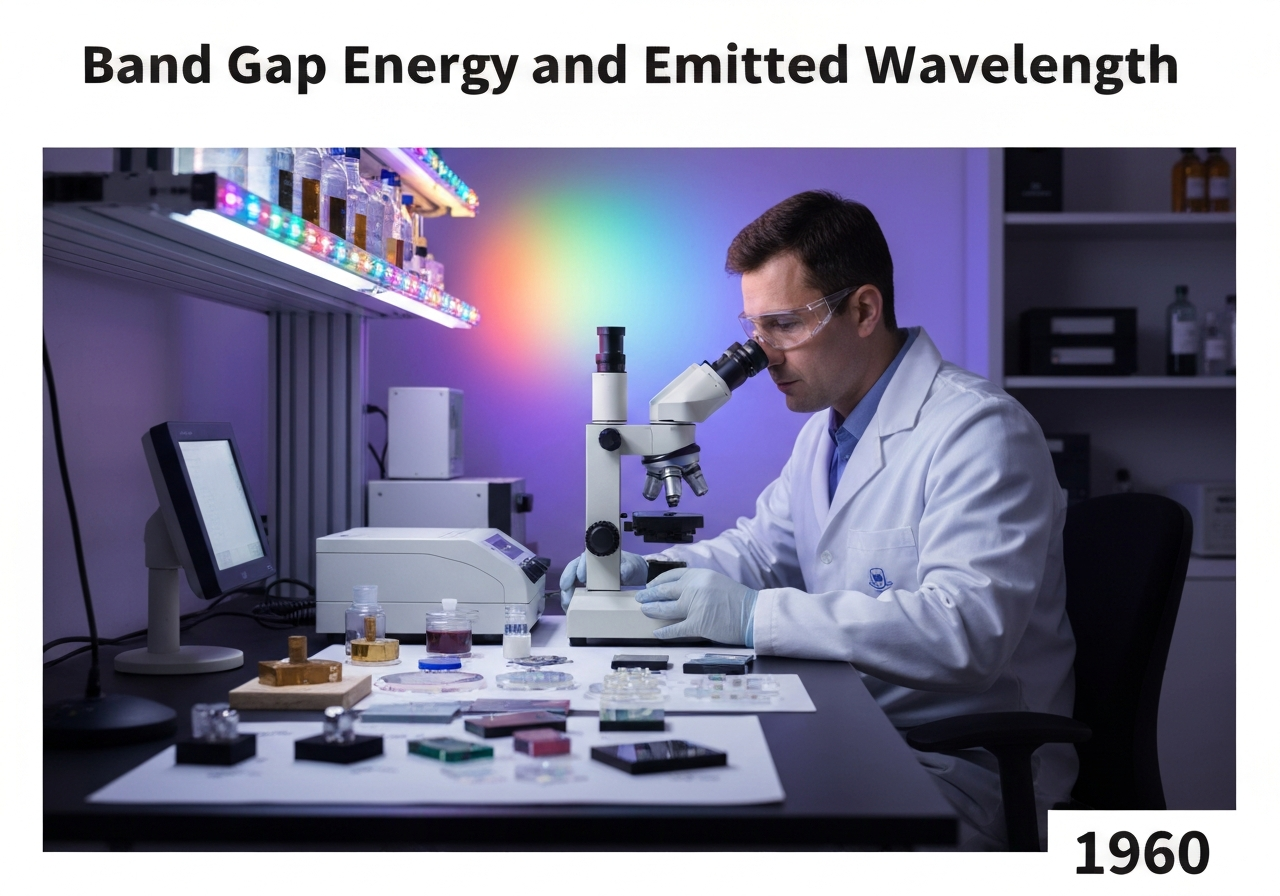
1960
Semiconductor analysis in solid state physics with LED light emission.

(Abbildung dient nur zur Veranschaulichung)

Die Farbe des von einem LED is determined by the semiconductor’s band gap energy ([latex]E_g[/latex]). The energy of the emitted photon is approximately equal to [latex]E_g[/latex]. This energy is inversely proportional to the wavelength ([latex]\lambda[/latex]) of the light, according to the Planck-Einstein relation [latex]E_g \approx hf = \frac{hc}{\lambda}[/latex]. By engineering alloys, the band gap can be precisely tuned to produce different colors.

Die Möglichkeit, die Farbe einer LED zu steuern, ist eine direkte Anwendung der Quantenmechanik und der Festkörperphysik. Die Bandlücke ist die Energiedifferenz zwischen Valenz- und Leitungsband in einem Halbleiter. Damit ein Elektron mit einem Loch rekombinieren und ein Photon emittieren kann, muss es diese Bandlücke überwinden. Die Energie des emittierten Photons ist daher fundamental mit der Größe dieser Bandlücke verknüpft.

Scientists can ‘engineer’ the band gap by creating compound semiconductor alloys. For example, in Gallium Arsenide Phosphide (GaAsP), the ratio of arsenic to phosphorus can be varied to change the band gap and thus tune the emitted color from infrared (pure GaAs) to red. Similarly, Indium Gallium Nitride (InGaN) alloys are used for blue, green, and cyan LEDs, where the indium-to-gallium ratio determines the exact color. This precise control over material composition allows for the creation of LEDs across the entire visible spectrum, as well as in the infrared and ultraviolet ranges, which was impossible with previous lighting Technologien.

UNESCO Nomenclature: 2211
– Solid state physics

Typ

Physical Property

Störung

Wesentliche

Verwendung

Weitverbreitete Verwendung

Vorläufer

  • Plancksche Beziehung (e=hf)
  • Einsteins Arbeit zum photoelektrischen Effekt
  • Entwicklung von Halbleiterkristallzüchtungstechniken wie Epitaxie
  • Die Bandtheorie der Festkörper wurde von Felix Bloch und anderen entwickelt.

Anwendungen

  • RGB-Displays für Fernseher und Monitore
  • Gartenbaulampen mit spezifischen Spektren
  • mehrfarbige Kontrollleuchten
  • Fahrzeuginnen- und Außenbeleuchtung
  • medizinische Phototherapiegeräte

Patente:

NA

Potenzielle Innovationsideen

  • tunable leds that can change color on demand for mood lighting
  • led-based chemical sensors where material interaction alters the band gap and color
  • ultra-wide bandgap leds for deep uv sterilization
  • narrow-bandgap leds for efficient infrared thermal imaging
  • leds made from novel 2d materials with electrically tunable band gaps
  • perovskite-based leds offering high efficiency and color purity
  • leds designed to emit specific wavelengths for activating photo-catalysts
  • multi-junction leds with several band gaps in one device for broad-spectrum emission
  • pressure-sensitive leds whose emission color changes with applied mechanical stress
  • leds using quantum confinement effects in nanocrystals to tune color
Related to: band gap, wavelength, photon energy, semiconductor alloy, Planck-Einstein relation, color tuning, quantum mechanics, gallium nitride, gallium arsenide, optoelectronics.

Historischer Kontext

Bandlückenenergie und emittierte Wellenlänge

1960
1960
1960
1960
1960
1961
1962
1960
1960
1960
1960
1960
1960-05-16
1962
1963

(wenn das Datum unbekannt oder nicht relevant ist, z. B. „Strömungsmechanik“, wird eine gerundete Schätzung seines bemerkenswerten Auftretens bereitgestellt)

10. Jahr Jubiläum

Bilder in voller Größe und Downloads sind ausschließlich für registrierte Mitglieder kostenlos verfügbar.

> Login <