Product Design, Manufacturing & Innovation Resources
Lar » Energia da banda proibida e comprimento de onda emitido

Energia da banda proibida e comprimento de onda emitido

1960
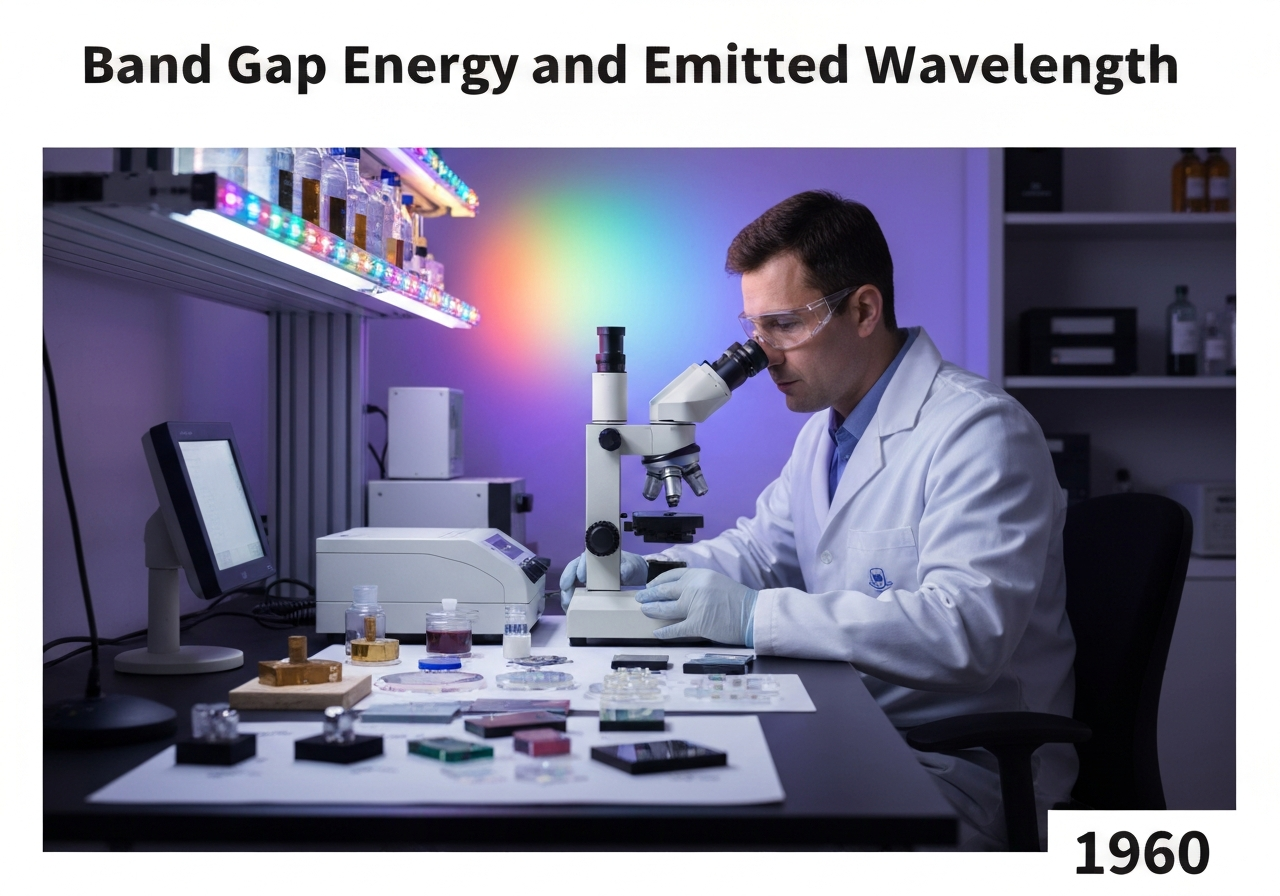
Semiconductor analysis in solid state physics with LED light emission.

(Imagem gerada apenas para fins ilustrativos)

A cor da luz emitida por um LIDERADO is determined by the semiconductor’s band gap energy ([latex]E_g[/latex]). The energy of the emitted photon is approximately equal to [latex]E_g[/latex]. This energy is inversely proportional to the wavelength ([latex]\lambda[/latex]) of the light, according to the Planck-Einstein relation [latex]E_g \approx hf = \frac{hc}{\lambda}[/latex]. By engineering alloys, the band gap can be precisely tuned to produce different colors.
A capacidade de controlar a cor de um LED é uma aplicação direta da mecânica quântica e da física do estado sólido. O "gap de banda" é a diferença de energia entre a banda de valência e a banda de condução em um semicondutor. Para que um elétron se recombine com uma lacuna e emita um fóton, ele deve atravessar esse gap. A energia do fóton emitido está, portanto, fundamentalmente ligada ao tamanho desse gap.

Scientists can ‘engineer’ the band gap by creating compound semiconductor alloys. For example, in Gallium Arsenide Phosphide (GaAsP), the ratio of arsenic to phosphorus can be varied to change the band gap and thus tune the emitted color from infrared (pure GaAs) to red. Similarly, Indium Gallium Nitride (InGaN) alloys are used for blue, green, and cyan LEDs, where the indium-to-gallium ratio determines the exact color. This precise control over material composition allows for the creation of LEDs across the entire visible spectrum, as well as in the infrared and ultravioleta ranges, which was impossible with previous lighting tecnologias.

UNESCO Nomenclature: 2211
Física do estado sólido

Tipo

Propriedade física

Interrupção

Substancial

Uso

Uso generalizado

Precursores

  • Relação de Planck (e=hf)
  • O trabalho de Einstein sobre o efeito fotoelétrico
  • desenvolvimento de técnicas de crescimento de cristais semicondutores, como a epitaxia
  • Teoria de bandas de sólidos desenvolvida por Felix Bloch e outros

Aplicações

  • Telas RGB para televisores e monitores
  • luzes de cultivo hortícola com espectros específicos
  • luzes indicadoras multicoloridas
  • Iluminação interna e externa automotiva
  • dispositivos médicos de fototerapia

Patentes:

NA

Ideias de Inovação Potencial

  • tunable leds that can change color on demand for mood lighting
  • led-based chemical sensors where material interaction alters the band gap and color
  • ultra-wide bandgap leds for deep uv sterilization
  • narrow-bandgap leds for efficient infrared thermal imaging
  • leds made from novel 2d materials with electrically tunable band gaps
  • perovskite-based leds offering high efficiency and color purity
  • leds designed to emit specific wavelengths for activating photo-catalysts
  • multi-junction leds with several band gaps in one device for broad-spectrum emission
  • pressure-sensitive leds whose emission color changes with applied mechanical stress
  • leds using quantum confinement effects in nanocrystals to tune color
Related to: band gap, wavelength, photon energy, semiconductor liga, Planck-Einstein relation, color tuning, quantum mechanics, gallium nitride, gallium arsenide, optoelectronics.

Contexto histórico

Energia da banda proibida e comprimento de onda emitido

1960
1960
1960
1960
1960
1961
1962
1960
1960
1960
1960
1960
1960-05-16
1962
1963

(Caso a data seja desconhecida ou irrelevante, por exemplo, "mecânica dos fluidos", é fornecida uma estimativa aproximada de seu surgimento notável)

10º ano aniversário

Imagens em tamanho real e downloads estão disponíveis apenas, 100% gratuitos, para membros registrados.