Product Design, Manufacturing & Innovation Resources
Maison » Énergie de la bande interdite et longueur d'onde émise

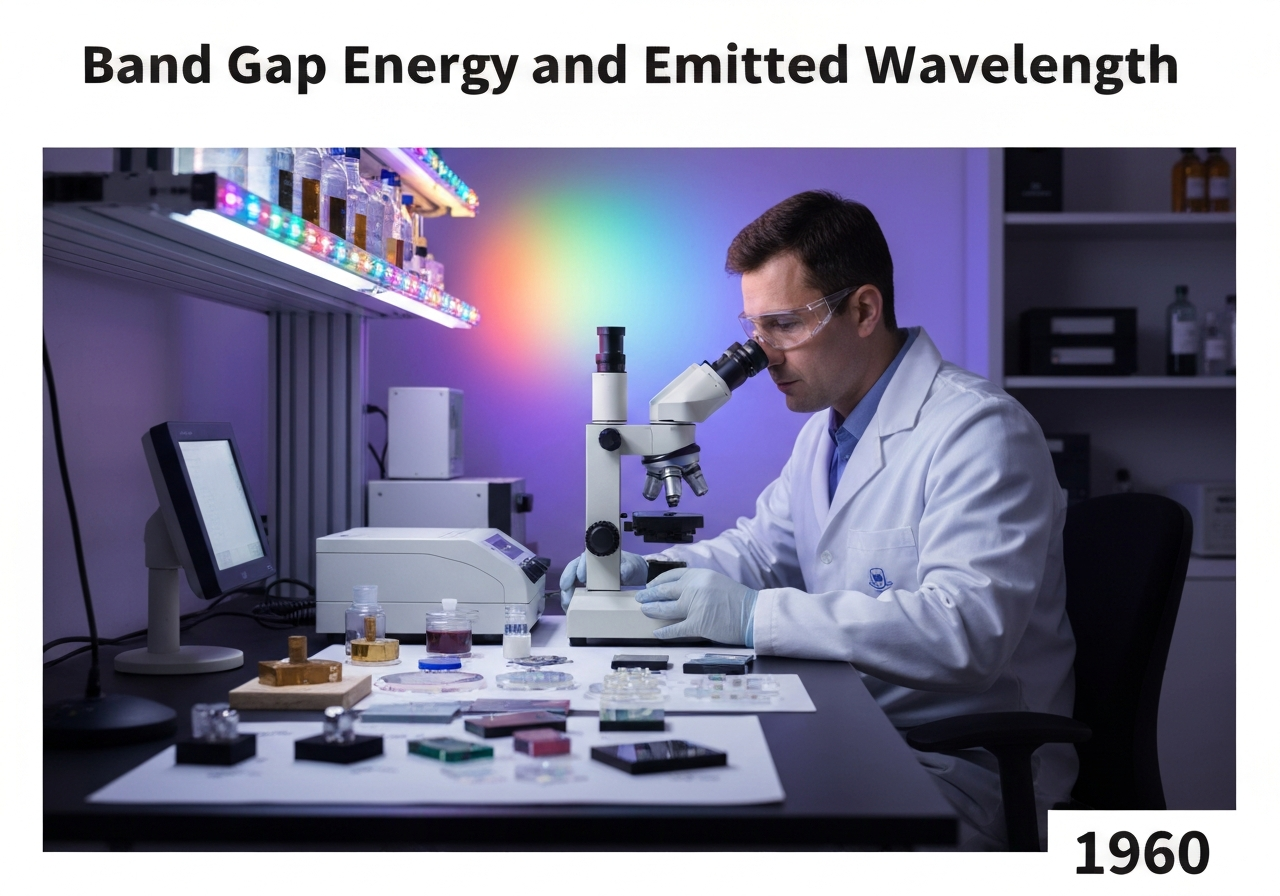
Énergie de la bande interdite et longueur d'onde émise

1960
Semiconductor analysis in solid state physics with LED light emission.

(Image générée à titre d'illustration uniquement)

La couleur de la lumière émise par un DIRIGÉ is determined by the semiconductor’s band gap energy ([latex]E_g[/latex]). The energy of the emitted photon is approximately equal to [latex]E_g[/latex]. This energy is inversely proportional to the wavelength ([latex]\lambda[/latex]) of the light, according to the Planck-Einstein relation [latex]E_g \approx hf = \frac{hc}{\lambda}[/latex]. By engineering alloys, the band gap can be precisely tuned to produce different colors.
La possibilité de contrôler la couleur d'une LED est une application directe de la mécanique quantique et de la physique du solide. La « bande interdite » correspond à la différence d'énergie entre la bande de valence et la bande de conduction d'un semi-conducteur. Pour qu'un électron se recombine avec un trou et émette un photon, il doit franchir cette bande interdite. L'énergie du photon émis est donc fondamentalement liée à la largeur de cette bande interdite.

Scientists can ‘engineer’ the band gap by creating compound semiconductor alloys. For example, in Gallium Arsenide Phosphide (GaAsP), the ratio of arsenic to phosphorus can be varied to change the band gap and thus tune the emitted color from infrared (pure GaAs) to red. Similarly, Indium Gallium Nitride (InGaN) alloys are used for blue, green, and cyan LEDs, where the indium-to-gallium ratio determines the exact color. This precise control over material composition allows for the creation of LEDs across the entire visible spectrum, as well as in the infrared and ultra-violet ranges, which was impossible with previous lighting technologies.

UNESCO Nomenclature: 2211
– Solid state physics

Taper

Physical Property

Perturbation

Substantiel

Usage

Utilisation généralisée

Précurseurs

  • La relation de Planck (e=hf)
  • Les travaux d'Einstein sur l'effet photoélectrique
  • développement de techniques de croissance de cristaux semi-conducteurs comme l'épitaxie
  • La théorie des bandes des solides a été développée par Félix Bloch et d'autres.

Applications

  • Écrans RGB pour téléviseurs et moniteurs
  • lampes de croissance horticoles à spectres spécifiques
  • voyants multicolores
  • Éclairage intérieur et extérieur automobile
  • dispositifs de photothérapie médicale

Brevets:

NA

Idées d'innovations potentielles

  • tunable leds that can change color on demand for mood lighting
  • led-based chemical sensors where material interaction alters the band gap and color
  • ultra-wide bandgap leds for deep uv sterilization
  • narrow-bandgap leds for efficient infrared thermal imaging
  • leds made from novel 2d materials with electrically tunable band gaps
  • perovskite-based leds offering high efficiency and color purity
  • leds designed to emit specific wavelengths for activating photo-catalysts
  • multi-junction leds with several band gaps in one device for broad-spectrum emission
  • pressure-sensitive leds whose emission color changes with applied mechanical stress
  • leds using quantum confinement effects in nanocrystals to tune color
Related to: band gap, wavelength, photon energy, semiconductor alloy, Planck-Einstein relation, color tuning, quantum mechanics, gallium nitride, gallium arsenide, optoelectronics.

Contexte historique

Énergie de la bande interdite et longueur d'onde émise

1960
1960
1960
1960
1960
1961
1962
1960
1960
1960
1960
1960
1960-05-16
1962
1963

(si la date est inconnue ou non pertinente, par exemple « mécanique des fluides », une estimation arrondie de son émergence notable est fournie)

10e année anniversaire

Les images en pleine résolution et les téléchargements sont uniquement disponibles, et 100% gratuits, pour les membres inscrits.