Product Design, Manufacturing & Innovation Resources
Hogar » Energía de banda prohibida y longitud de onda emitida

Energía de banda prohibida y longitud de onda emitida

1960
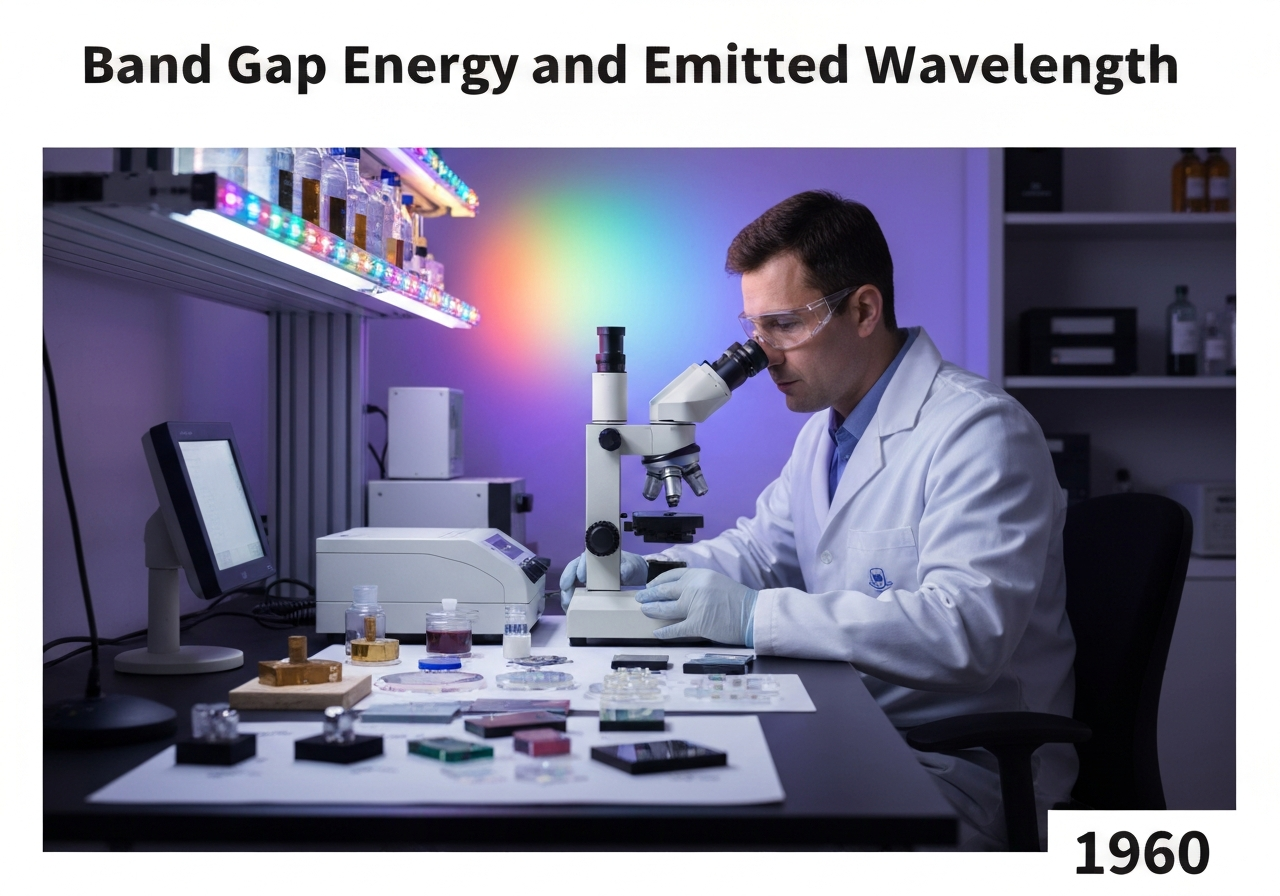
Semiconductor analysis in solid state physics with LED light emission.

(Imagen generada únicamente con fines ilustrativos)

El color de la luz emitida por un CONDUJO is determined by the semiconductor’s band gap energy ([latex]E_g[/latex]). The energy of the emitted photon is approximately equal to [latex]E_g[/latex]. This energy is inversely proportional to the wavelength ([latex]\lambda[/latex]) of the light, according to the Planck-Einstein relation [latex]E_g \approx hf = \frac{hc}{\lambda}[/latex]. By engineering alloys, the band gap can be precisely tuned to produce different colors.
La capacidad de controlar el color de un LED es una aplicación directa de la mecánica cuántica y la física del estado sólido. La «banda prohibida» es la diferencia de energía entre la banda de valencia y la banda de conducción en un semiconductor. Para que un electrón se recombine con un hueco y emita un fotón, debe atravesar esta banda prohibida. Por lo tanto, la energía del fotón emitido está intrínsecamente ligada al tamaño de esta banda prohibida.

Scientists can ‘engineer’ the band gap by creating compound semiconductor alloys. For example, in Gallium Arsenide Phosphide (GaAsP), the ratio of arsenic to phosphorus can be varied to change the band gap and thus tune the emitted color from infrared (pure GaAs) to red. Similarly, Indium Gallium Nitride (InGaN) alloys are used for blue, green, and cyan LEDs, where the indium-to-gallium ratio determines the exact color. This precise control over material composition allows for the creation of LEDs across the entire visible spectrum, as well as in the infrared and ultravioleta ranges, which was impossible with previous lighting tecnologías.

UNESCO Nomenclature: 2211
– Solid state physics

Tipo

Physical Property

Ruptura

Sustancial

Uso

Uso generalizado

Precursores

  • Relación de Planck (e=hf)
  • El trabajo de Einstein sobre el efecto fotoeléctrico
  • desarrollo de técnicas de crecimiento de cristales semiconductores como la epitaxia
  • teoría de bandas de sólidos desarrollada por Felix Bloch y otros

Aplicaciones

  • Pantallas RGB para televisores y monitores
  • Lámparas de cultivo hortícola con espectros específicos
  • luces indicadoras multicolor
  • Iluminación interior y exterior de automóviles
  • dispositivos de fototerapia médica

Patentes:

NA

Ideas para posibles innovaciones

  • tunable leds that can change color on demand for mood lighting
  • led-based chemical sensors where material interaction alters the band gap and color
  • ultra-wide bandgap leds for deep uv sterilization
  • narrow-bandgap leds for efficient infrared thermal imaging
  • leds made from novel 2d materials with electrically tunable band gaps
  • perovskite-based leds offering high efficiency and color purity
  • leds designed to emit specific wavelengths for activating photo-catalysts
  • multi-junction leds with several band gaps in one device for broad-spectrum emission
  • pressure-sensitive leds whose emission color changes with applied mechanical stress
  • leds using quantum confinement effects in nanocrystals to tune color
Related to: band gap, wavelength, photon energy, semiconductor alloy, Planck-Einstein relation, color tuning, quantum mechanics, gallium nitride, gallium arsenide, optoelectronics.

Contexto histórico

Energía de banda prohibida y longitud de onda emitida

1960
1960
1960
1960
1960
1961
1962
1960
1960
1960
1960
1960
1960-05-16
1962
1963

(Si la fecha es desconocida o no es relevante, por ejemplo "mecánica de fluidos", se proporciona una estimación redondeada de su aparición notable)

décimo año aniversario

Las imágenes en tamaño completo y las descargas solo están disponibles, de forma totalmente gratuita, para los miembros registrados.

> Acceso <