Product Design, Manufacturing & Innovation Resources
Home » Band Gap Energy and Emitted Wavelength

Band Gap Energy and Emitted Wavelength

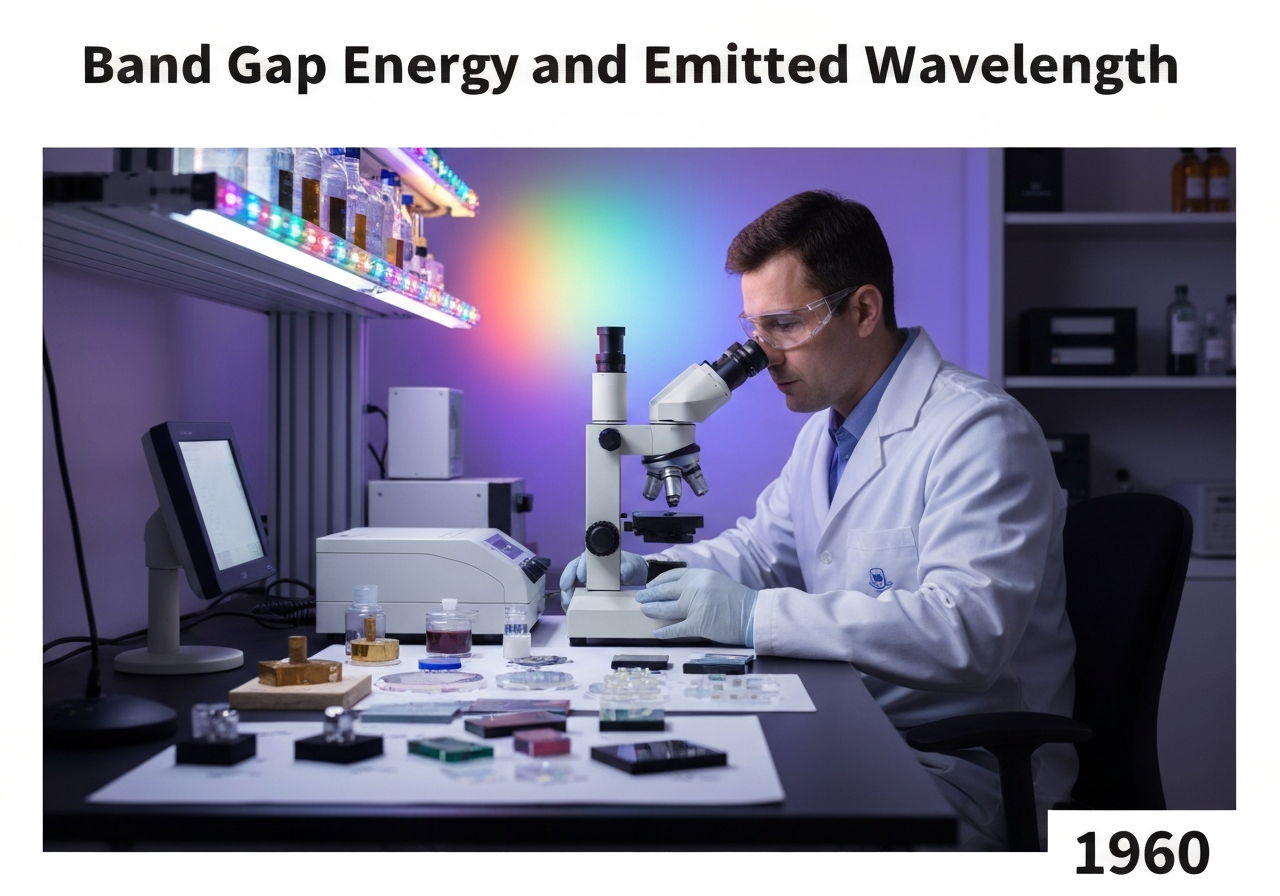
1960
Semiconductor analysis in solid state physics with LED light emission.

(generated image for illustration only)

The color of light emitted by an LED is determined by the semiconductor’s band gap energy (\(E_g\)). The energy of the emitted photon is approximately equal to \(E_g\). This energy is inversely proportional to the wavelength (\(\lambda\)) of the light, according to the Planck-Einstein relation \(E_g \approx hf = \frac{hc}{\lambda}\). By engineering alloys, the band gap can be precisely tuned to produce different colors.

The ability to control the color of an LED is a direct application of quantum mechanics and solid-state physics. The ‘band gap’ is the energy difference between the valence band and the conduction band in a semiconductor. For an electron to recombine with a hole and emit a photon, it must transition across this gap. The energy of the emitted photon is therefore fundamentally linked to the size of this gap.

Scientists can ‘engineer’ the band gap by creating compound semiconductor alloys. For example, in Gallium Arsenide Phosphide (GaAsP), the ratio of arsenic to phosphorus can be varied to change the band gap and thus tune the emitted color from infrared (pure GaAs) to red. Similarly, Indium Gallium Nitride (InGaN) alloys are used for blue, green, and cyan LEDs, where the indium-to-gallium ratio determines the exact color. This precise control over material composition allows for the creation of LEDs across the entire visible spectrum, as well as in the infrared and ultraviolet ranges, which was impossible with previous lighting technologies.

UNESCO Nomenclature: 2211
– Solid state physics

Type

Physical Property

Disruption

Substantial

Usage

Widespread Use

Precursors

  • Planck’s relation (e=hf)
  • Einstein’s work on the photoelectric effect
  • development of semiconductor crystal growth techniques like epitaxy
  • band theory of solids developed by Felix Bloch and others

Applications

  • RGB displays for televisions and monitors
  • horticultural grow lights with specific spectra
  • multi-color indicator lights
  • automotive interior and exterior lighting
  • medical phototherapy devices

Patents:

NA

Potential Innovations Ideas

Due to scrapping bot traffic, currently more than 40k per day, this content is reserved to community members.
> Login < or > Register < (100% free) to access this, so as all other restricted content and tools.

Related to: band gap, wavelength, photon energy, semiconductor alloy, Planck-Einstein relation, color tuning, quantum mechanics, gallium nitride, gallium arsenide, optoelectronics.

Historical Context

Band Gap Energy and Emitted Wavelength

1960
1960
1960
1960
1960
1961
1962
1960
1960
1960
1960
1960
1960-05-16
1962
1963

(if date is unknown or not relevant, e.g. "fluid mechanics", a rounded estimation of its notable emergence is provided)

Full size images and downloads are only available, 100% free, for registered members.

> Login <