Product Design, Manufacturing & Innovation Resources
Heim » The Ruby Laser

The Ruby Laser

1960-05-16
  • Theodore H. Maiman
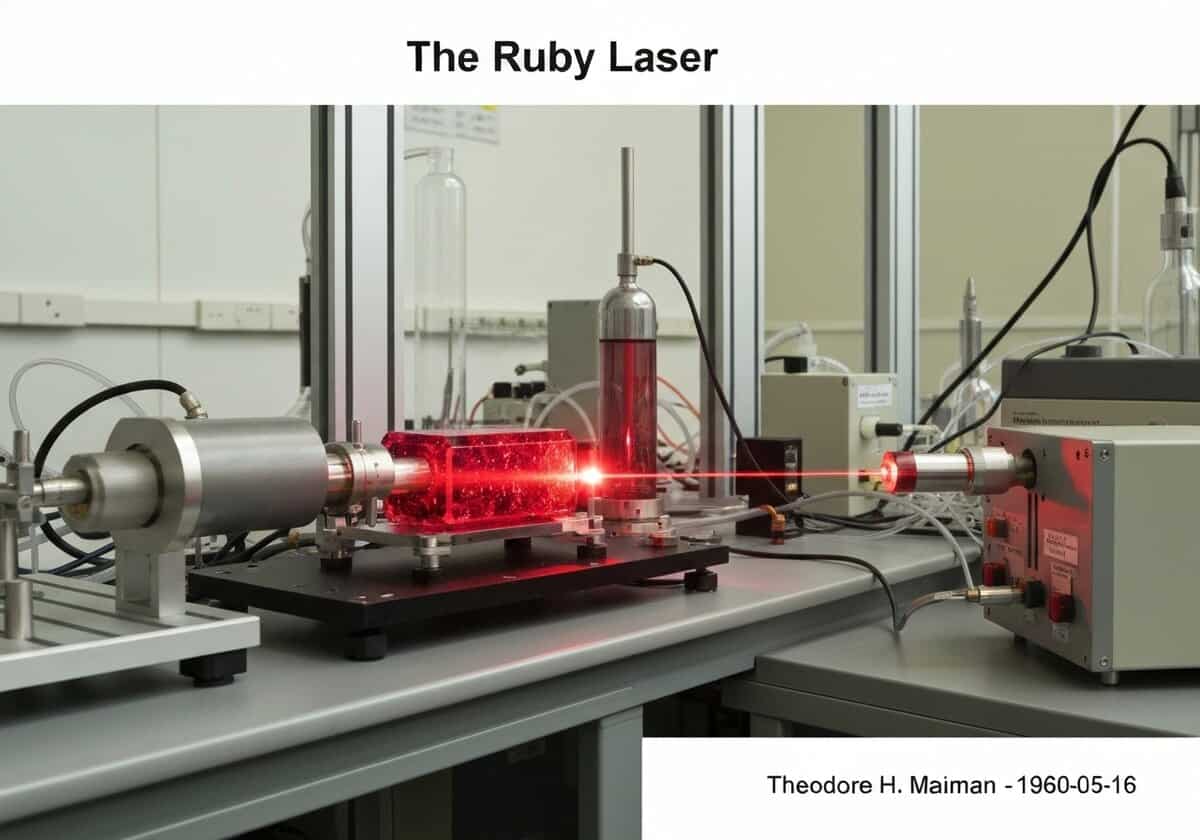
Rubinlaserapparatur mit synthetischem Rubinkristall und Xenon-Blitzröhre in einer Laborumgebung.

(Abbildung dient nur zur Veranschaulichung)

The first functional laser was the ruby laser, demonstrated in 1960. It is a solid-state laser that uses a synthetic ruby crystal (chromium-doped aluminum oxide) as its gain medium. The ruby is optically pumped by a powerful xenon flashtube, creating a population inversion in the chromium ions and producing a deep red beam of light at a wavelength of 694.3 nanometers.

Theodore Maimans erfolgreiche Demonstration des Rubinlasers in den Hughes Research Laboratories markierte den Beginn des Laserzeitalters. Sein Gerät war erstaunlich einfach: ein fingergroßer Rubinstab, dessen Enden planpoliert und silberbeschichtet waren, um einen Fabry-Pérot-Resonator zu bilden. Ein Ende war vollständig, das andere nur teilweise beschichtet und diente als Auskoppler. Der Stab befand sich in einer spiralförmigen Xenon-Blitzlampe, ähnlich den in der Fotografie verwendeten. Beim Blitzen der Lampe wurde der Rubinkristall durch den intensiven Lichtimpuls optisch angeregt.

The ruby laser operates on a three-level energy system. The flashlamp’s light excites the chromium ions ([latex]Cr^{3+}[/latex]) to a broad absorption band (the pump band). From there, they quickly decay non-radiatively to a metastable energy level. Because this metastable level has a relatively long lifetime (a few milliseconds), a large population of ions can accumulate there, creating a population inversion relative to the ground state. When lasing begins, the ions transition from this metastable level back to the ground state, emitting 694.3 nm photons. Because it is a three-level system where the lower laser level is the ground state, it requires very intense pumping to achieve population inversion, making it relatively inefficient. The output is typically a series of short pulses for as long as the flashlamp is active.

UNESCO Nomenclature: 2211
- Festkörperphysik

Typ

Physikalisches Gerät

Störung

Revolutionär

Verwendung

Nische/Spezialisiert

Vorläufer

  • the maser (microwave amplification by stimulated emission of radiation)
  • theoretical proposal for an optical maser (laser) by Schawlow and Townes
  • development of synthetic ruby crystals
  • high-intensity flashlamp technology

Anwendungen

  • holography (early experiments)
  • tattoo and hair removal
  • industrial drilling and welding
  • scientific research (historical significance)
  • range finding

Patente:

NA

Potenzielle Innovationsideen

Aufgrund des hohen Datenverkehrs durch Web-Scraping-Bots, der derzeit mehr als 40.000 Anfragen pro Tag umfasst, ist dieser Inhalt ausschließlich Community-Mitgliedern vorbehalten.
> Anmelden < oder > Registrieren < (100% kostenlos) Zugriff darauf sowie auf alle anderen eingeschränkten Inhalte und Tools.

Verwandt mit: Rubinlaser, Theodore Maiman, erster Laser, Festkörperlaser, Chrom, optisches Pumpen, Drei-Niveau-Laser, 694,3 nm, Hughes Forschungslaboratorien, Blitzlampe.

Historischer Kontext

The Ruby Laser

1960
1960
1960
1960-05-16
1962
1963
1964
1960
1960
1960
1960
1961
1962
1963
1965

(wenn das Datum unbekannt oder nicht relevant ist, z. B. „Strömungsmechanik“, wird eine gerundete Schätzung seines bemerkenswerten Auftretens bereitgestellt)

Bilder in voller Größe und Downloads sind nur für registrierte Mitglieder 100% kostenlos verfügbar.

> Login <