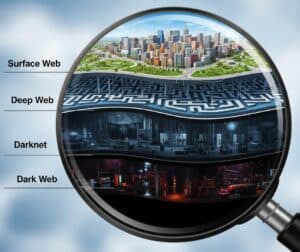
The terms “dark web,” “darknet,” and “deep web” are often used interchangeably, but they describe distinct layers and components of the internet: while the deep web encompasses all web content not indexed by search engines, including benign things like online banking and paywalled sites, the deep web is all non-indexed content. A darknet is the technical infrastructure (an overlay network like Tor or I2P) that provides anonymity. The dark web is the content that resides on these darknets. The World Wide Web (surface web) is the publicly indexed content.
The Deep Web

The deep web represents the largest part of the internet, encompassing all content that is not indexed by standard search engines like Google or Bing. This includes a vast amount of benign and routine information that is protected or located behind a query. Access to deep web content does not require special software, only direct knowledge of the URL or, more commonly, authentication. This part of the internet is a daily tool for most users.
Examples of deep web content include online banking portals, webmail inboxes, private social media profiles, subscription-based academic journals, cloud storage drives, and corporate intranets.
The defining characteristic is not secrecy but rather inaccessibility to web crawlers.
A page may be unindexed because it is behind a paywall, requires a password, is dynamically generated in response to a database query, or its owner has explicitly used a “noindex” tag. The content itself is hosted on standard server infrastructure and accessed over the conventional internet protocol.
The Darknet
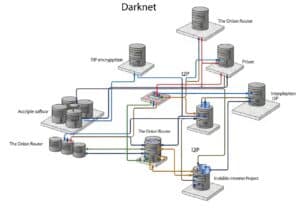
A darknet is a specific type of overlay network that is layered on top of the existing internet and requires specialized software or configurations to access.
These networks are engineered to provide a high degree of anonymity for their users by encrypting traffic and routing it through multiple servers, which obscures the user’s IP address and location.
The most prominent technology for enabling access to a darknet is The Onion Router (Tor), but others like the Invisible Internet Project (I2P) also exist. These networks are the technical infrastructure, the “roads” built to be private and untraceable.
The purpose of a darknet is to facilitate anonymous communication and hosting. This infrastructure can be used by various actors for different reasons, from journalists and political dissidents in oppressive regimes who need to protect their identity, to individuals who simply wish to maintain their privacy from corporations and governments. While the network itself is content-neutral, its architecture of high anonymity makes it a suitable environment for hosting services where privacy is paramount. See our detailed article for Darknet tools for engineering and science:

The rest of this article is reserved for members
To limit scraping bots (currently 40,000 hits per day!),
we had to restrict access to full articles and tools to registered members only.
to access all the rest.