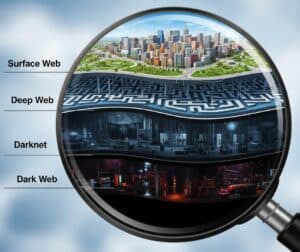
'다크 웹', '다크넷', '딥 웹'이라는 용어는 종종 혼용되지만, 인터넷의 서로 다른 계층과 구성 요소를 설명합니다. 딥 웹은 온라인 뱅킹이나 유료 사이트와 같은 일반적인 콘텐츠를 포함하여 검색 엔진에 의해 색인되지 않은 모든 웹 콘텐츠를 포괄하는 반면, 다크 웹은 검색 엔진에 색인되지 않은 모든 콘텐츠를 의미합니다. 다크넷 기술적 인프라(Tor와 같은 오버레이 네트워크) 아이2피익명성을 제공하는 다크넷을 말합니다. 다크웹은 이러한 다크넷에 저장된 콘텐츠를 의미합니다. 월드 와이드 웹(서피스 웹)은 공개적으로 색인화된 콘텐츠를 말합니다.
딥웹

The deep web represents the largest part of the internet, encompassing all content that is not indexed by standard search engines like Google or Bing. This includes a vast amount of benign and routine information that is protected or located behind a query. Access to deep web content does not require special 소프트웨어, only direct knowledge of the URL or, more commonly, authentication. This part of the internet is a daily tool for most users.
딥 웹 콘텐츠의 예로는 온라인 뱅킹 포털, 웹메일 사서함, 개인 소셜 미디어 프로필, 구독 기반 학술 저널, 클라우드 스토리지 드라이브 및 기업 인트라넷 등이 있습니다.
결정적인 특징은 비밀성이 아니라 웹 크롤러가 접근할 수 없다는 점입니다.
페이지가 색인되지 않는 이유는 유료 콘텐츠이거나, 비밀번호가 필요하거나, 데이터베이스 쿼리에 대한 응답으로 동적으로 생성되거나, 소유자가 명시적으로 'noindex' 태그를 사용했기 때문일 수 있습니다. 콘텐츠 자체는 표준 서버 인프라에 호스팅되며 일반적인 경로를 통해 액세스됩니다. 인터넷 프로토콜.
다크넷
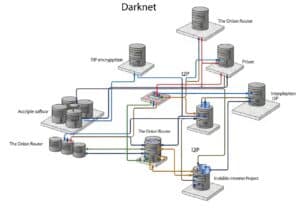
다크넷은 기존 인터넷 위에 덧씌워진 특수한 유형의 네트워크로, 접속하려면 특수 소프트웨어나 설정이 필요합니다.
이러한 네트워크는 트래픽을 암호화하고 여러 서버를 통해 라우팅함으로써 사용자의 IP 주소와 위치를 숨겨 높은 수준의 익명성을 제공하도록 설계되었습니다.
다크넷 접속을 가능하게 하는 가장 대표적인 기술은 다음과 같습니다. 양파 Tor 라우터 외에도 I2P(Invisible Internet Project)와 같은 다른 네트워크도 존재합니다. 이러한 네트워크는 기술적 인프라, 즉 사생활 보호와 추적 불가능성을 위해 구축된 '도로'와 같습니다.
다크넷의 목적은 익명 통신과 호스팅을 용이하게 하는 것입니다. 이러한 인프라는 신원 보호가 필요한 억압적인 정권 하의 언론인이나 정치적 반체제 인사부터 기업이나 정부로부터 사생활을 보호하고자 하는 개인에 이르기까지 다양한 주체들이 각기 다른 이유로 활용할 수 있습니다. 다크넷 네트워크 자체는 콘텐츠 중립적이지만, 높은 익명성을 제공하는 구조 덕분에 개인 정보 보호가 최우선인 서비스를 호스팅하기에 적합한 환경입니다. 공학 및 과학 분야의 다크넷 도구에 대한 자세한 내용은 관련 기사를 참조하십시오.
The Dark Web

The dark web refers to the collection of websites and services that are hosted on and accessed via a darknet.
While the darknet is the infrastructure, the dark web is the content itself—the “places” you can go using those private roads.
These websites are not reachable with standard web browsers and their URLs typically end in a special top-level domain, such as “.onion” for services on the Tor network. Because of the strong anonymity provided by the underlying darknet, the dark web has become known for hosting both legitimate and illicit activities.
While the dark web contains legitimate uses, such as secure whistle-blowing platforms and privacy-advocacy groups, it is more notoriously associated with black markets. These marketplaces facilitate the trade of illegal goods and services, including narcotics, stolen financial data, malware, and counterfeit documents. The anonymity of the network makes it difficult for law enforcement to identify and locate the individuals operating these sites. It is important to recognize that the dark web constitutes a very small fraction of the much larger deep web.

메모: the figures above have now to be taken for relative comparison only, as the number of sites has sky rocketed since, including surface web (www)
Comparison, Including the WWW
In orange below our key takeaways for each:
| 매개변수 | World Wide Web (Surface Web) | Deep Web | Darknet | Dark Web |
|---|---|---|---|---|
| Core Concept Analogy | The public, indexed books in a library’s main reading room. | The library’s entire collection, including private archives and membership-only sections. | The secure, anonymous pneumatic tube system used to request and deliver books from the archives. | The specific, uncatalogued books and documents found only within the library’s most secure archives. |
| 정의 | Publicly indexed web pages accessible by standard search engines. | All web content not indexed by search engines. | The overlay network infrastructure providing anonymity (e.g., Tor, I2P). | Websites and services (“hidden services”) hosted on darknets. |
| Size & Scale | Billions of pages, but estimated to be less than 5% of the total web. | The vast majority of the internet, estimated at over 95% of all online content. | A global, distributed network infrastructure. Size measured by nodes (Tor has thousands of relays). | A small, fluctuating subset of the deep web. Estimated in the tens of thousands of active sites at any time. |
| Access 방법 | Standard web browsers (Chrome, Edge, Firefox). No special configuration needed. | Standard web browsers, but access requires login credentials, a direct URL, or passing a paywall/CAPTCHA. | Requires specific software (e.g., Tor 브라우저, I2P router) to connect to the network. | Accessed using specific software (like the Tor Browser) to connect to the darknet first. |
| URL Structure | Standard domains (e.g., .com, .org, .gov) resolved by public DNS. | Standard domains, often with long, dynamically generated URLs containing query strings. | Not applicable. It is a network protocol, not a destination with a URL. | Special, non-standard domains (e.g., “.onion”, “.i2p”) resolved within the darknet. |
| Anonymity Level | Low. User IP address is visible to websites, ISPs, and network monitors. | Low. Access is typically tied to a known identity (username, account number). | High. Designed to obscure the user’s IP address from the destination service via multi-layer 암호화 and relays. | High for both users and hosts. Anonymity is the default and a core feature of the environment. |
| Primary Intent | Public information dissemination, commerce, and communication. | Secure access to private or protected information and services. | To provide an anonymous, censorship-resistant communication channel. | To host services and disseminate information without revealing the identity of the host or users. |
| Typical Content | News, e-commerce, blogs, government portals, social media, 마케팅 content. | Email inboxes, cloud storage, banking portals, medical records, academic journals, corporate intranets. | Content-neutral network traffic (encrypted data packets). | Black markets, political dissident forums, secure whistleblower dropboxes, privacy blogs, illicit file sharing. |
| Legality of Content | Overwhelmingly legal, though it can link to or describe illegal acts. | Overwhelmingly legal and mundane. | The network technology itself is legal and used for legitimate purposes. | Highly mixed. Contains both legal (e.g., privacy advocacy) and a significant amount of illegal content. |
| Typical User Profile | General public. | Authenticated individuals (e.g., bank customers, employees, students). | Privacy advocates, journalists, law enforcement, political dissidents, security-conscious individuals. | A wide spectrum including criminals, activists, whistleblowers, researchers, and the curious. |
| Hosting Method | Hosted on publicly addressable web servers in data centers. | Hosted on standard web servers, but behind application-level security controls. | A network of volunteer-run nodes (relays) that pass traffic. | Hosted as “hidden services” on servers whose location and identity are obscured by the darknet. |
| Associated Risks | Malware, phishing, tracking cookies, scams, data collection by corporations. | Data breaches of the service provider, phishing attacks targeting login credentials. | Potential for deanonymization through network analysis or software vulnerabilities. Risk of connecting to malicious exit nodes. | Extreme content, sophisticated scams, malware, interacting with law enforcement operations, high risk of financial loss. |
External Links on Internet Laws
국제 표준
(링크 위에 마우스를 올려놓으면 콘텐츠에 대한 설명을 볼 수 있습니다.)