Product Design, Manufacturing & Innovation Resources
집 » 자외선 살균 조사(UVGI)

자외선 살균 조사(UVGI)

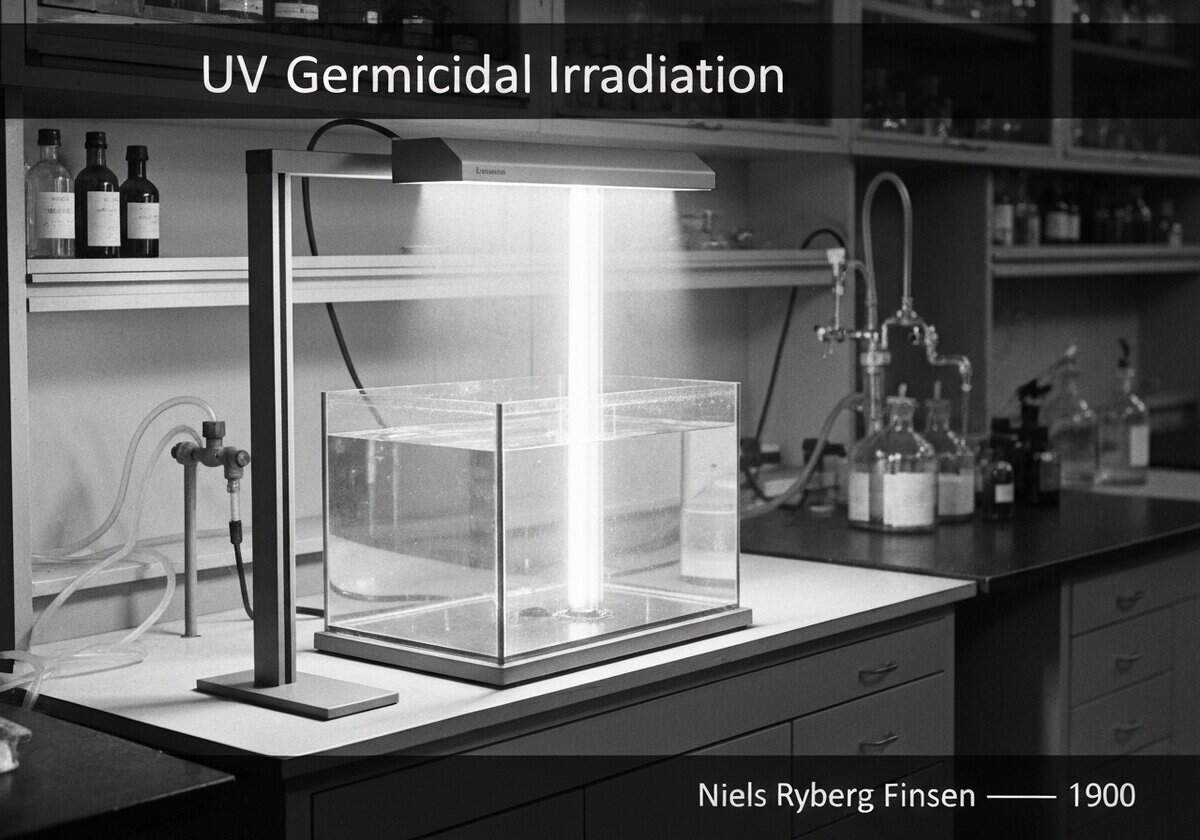
1900
  • Niels Ryberg Finsen
UV Germicidal Irradiation system in a laboratory for microbial disinfection.

(설명을 위한 생성된 이미지입니다)

UV 살균 조사(UVGI)는 단파장을 이용합니다. 자외선 C(UVC) radiation, typically at 254 nm, to kill or inactivate microorganisms. UVC light disrupts the nucleic acids (DNA and RNA) of bacteria, viruses, and other pathogens, destroying their ability to replicate and cause disease. This non-chemical disinfection method is used for air, water, and surface sterilization.
The germicidal properties of UVC radiation are centered around its ability to be absorbed by the nucleic acids of microorganisms. The peak germicidal effectiveness occurs at a wavelength of approximately 265 nm, which corresponds to the peak absorption wavelength of DNA. Commercially available low-pressure mercury vapor lamps, which are the most common source for UVGI, emit monochromatically at 253.7 nm, which is very close to this peak and highly effective. When a UVC photon is absorbed by a DNA or RNA molecule, it can induce the formation of pyrimidine dimers, most commonly thymine dimers. These dimers are covalent bonds between adjacent pyrimidine bases (thymine or cytosine) on the same DNA strand. This structural damage prevents the DNA from being correctly read during replication or transcription, effectively rendering the microorganism sterile and unable to reproduce. While microorganisms have cellular mechanisms to repair such DNA damage, the high intensity of UVGI overwhelms these repair systems. UVGI is a physical process, not a chemical one, meaning it does not introduce toxins or residues. Its effectiveness depends on the UV dose, which is a product of intensity and exposure time, as well as factors like humidity, temperature, and the microorganism’s susceptibility. Its primary limitation is that it is a line-of-sight technology; UV light cannot disinfect areas in shadow.

UNESCO Nomenclature: 2415
미생물학

유형

물리적 과정

분열

상당한

용법

널리 사용됨

전구체

  • 루이 파스퇴르의 질병의 세균설
  • 자외선 스펙트럼의 일부로서 UVC 복사선의 발견
  • 수은 증기 램프의 개발
  • Downes와 Blunt의 연구(1877년)는 햇빛이 박테리아의 성장을 억제한다는 것을 보여주었습니다.

응용 프로그램

  • 병원 내 공기 및 표면 소독
  • 도시 상수 처리
  • HVAC 공기 정화 시스템
  • 식품 및 음료 가공
  • 실험실 멸균
  • 폐수 처리

특허:

NA

잠재적 혁신 아이디어

  • portable, battery-powered uvc wands for sanitizing personal items like phones and keyboards
  • uvc-leds integrated into escalator handrails for continuous disinfection
  • autonomous robots that map and disinfect rooms in hospitals and airports overnight
  • uvc-enabled hvac systems that actively sterilize air as it circulates through a building
  • uvc treatment systems for ballast water in ships to prevent the spread of invasive aquatic species
  • smart water bottles with a uvc-led in the cap to purify water from any source
  • uvc-coated high-touch surfaces (e.g., door handles) that are self-disinfecting
  • integration of uvc emitters into 3d printers to sterilize 의료용 임플란트 during fabrication
  • uvc drones for disinfecting large outdoor public spaces or agricultural fields
  • uvc light fixtures for public restrooms that activate when the room is unoccupied
관련 용어: UVGi, UVC, 살균, 소독, 멸균, DNA 손상, 티민 이량체, 미생물학, 수처리, 공기 정화.

역사적 맥락

자외선 살균 조사(UVGI)

1800
1800-05-02
1880
1900
1910
1921
1930
1930
1800
1834-01-01
1880
1902
1920
1928
1930

(날짜를 알 수 없거나 관련이 없는 경우, 예를 들어 "유체역학"의 경우, 주목할 만한 등장 시기를 대략적으로 추정하여 제공합니다.)

10년차 기념일

고화질 이미지 및 다운로드는 등록된 회원에게만 100% 무료로 제공됩니다.

> 로그인 <