Product Design, Manufacturing & Innovation Resources
家 » 库塔-儒可夫斯基定理

库塔-儒可夫斯基定理

1902
  • Martin Kutta
  • Nikolai Zhukovsky (Joukowski)
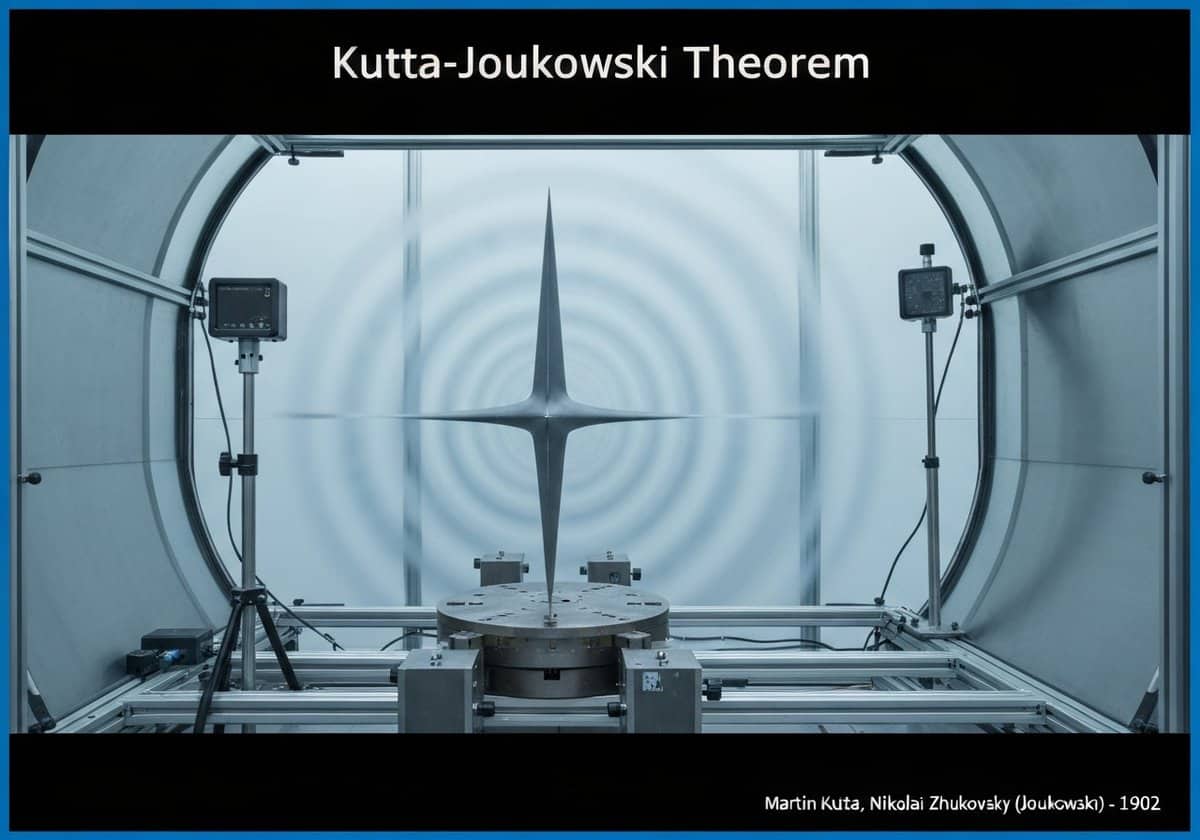
Airfoil in wind tunnel demonstrating Kutta-Joukowski theorem and lift generation.

(图片仅供参考)

The Kutta-Joukowski theorem quantifies the lift force generated by an airfoil. It states that the lift per unit span ([latex]L'[/latex]) is directly proportional to the fluid density ([latex]\rho[/latex]), the free-stream velocity ([latex]V[/latex]), and the circulation ([latex]\Gamma[/latex]) around the body: [latex]L’ = \rho V \Gamma[/latex]. This links the abstract concept of circulation to the physical force of lift.

The Kutta-Joukowski theorem provides the essential mathematical link between the abstract concept of circulation and the physical force of lift. Circulation ([latex]\Gamma[/latex]) is a measure of the macroscopic rotation of a fluid in a given area. For an airfoil, circulation is generated because the air travels faster over the top surface than the bottom. This velocity difference, integrated around a closed loop enclosing the airfoil, results in a net non-zero circulation.
The theorem elegantly shows that to generate lift, there must be circulation. This resolved a major issue in early aerodynamic theory. However, the theorem itself does not explain how an airfoil of a specific shape generates the required amount of circulation. This is where the Kutta condition comes in. Proposed by Martin Kutta, the condition states that for an airfoil with a sharp trailing edge, the flow must leave the trailing edge smoothly. It cannot wrap around the sharp edge. This physical condition uniquely determines the exact amount of circulation ([latex]\Gamma[/latex]) for a given airfoil shape, angle of attack, and airspeed. By combining the Kutta-Joukowski theorem with the Kutta condition, one can theoretically calculate the lift on a 2D airfoil, a cornerstone of wing design.

The theorem also perfectly explains the Magnus effect, where a spinning object moving through a fluid experiences a force perpendicular to its motion. The spinning surface drags the fluid around with it due to 粘度, creating circulation. This circulation, combined with the forward velocity, generates a lift force according to the theorem, causing the object to curve.

UNESCO Nomenclature: 2210
– Mechanics

类型

Theorem

中断

Foundational

用法

广泛使用

前体

  • Helmholtz’s theorems on vortices
  • Lord Kelvin’s circulation theorem
  • 势流理论
  • 黎曼等人开发的共形映射技术

应用程序

  • 翼型升力的理论计算
  • 解释马格努斯效应对旋转球的影响(例如棒球、高尔夫、网球)
  • 船舶推进用弗莱特纳转子的设计
  • 先进螺旋桨和涡轮叶片型材的开发
  • 了解涡流产生的升力

专利:

NA

潜在创新理念

  • 使用旋转气缸代替机翼升力的无人机,可以在强风中垂直起降和悬停
  • 基于弗莱特纳转子的动态船舶稳定器
  • 高尔夫球的表面纹理设计可最大程度促进血液循环
  • 主动控制叶尖循环以降低噪音并提高效率的风力涡轮机
  • 水下航行器的循环升降系统,可实现安静、灵活的操纵
  • 基于人工智能的翼型设计,可直接优化特定飞行目标的循环分布
  • 从河流或气流的涡流中提取能量的发电系统
  • 投射旋转空气涡环的非致命人群控制装置
Related to: kutta-joukowski, lift, circulation, airfoil, magnus effect, kutta condition, fluid dynamics, potential flow.

历史背景

库塔-儒可夫斯基定理

1900
1900
1900
1902
1902
1907
1909
1900
1900
1900
1900-12-14
1902
1904
1907
1909

(如果日期未知或不相关,例如“流体力学”,则提供其显著出现的近似估计)

第十年 周年纪念日

只有注册会员才能免费获取完整尺寸的图片和下载内容。

> 登录 <