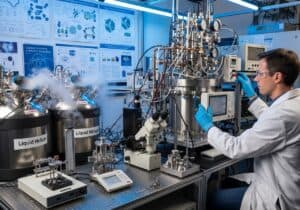
Die Kryotechnik untersucht das Verhalten von Materialien und Systemen bei Temperaturen unter −150 °C und konzentriert sich auf die Erzeugung, Aufrechterhaltung und Anwendung extrem niedriger Temperaturen. Sie umfasst den Einsatz kryogener Fluide wie flüssiges Helium und flüssiger Stickstoff, spezielle Kühltechniken und Isolationsmethoden, um kryogene Bedingungen zu erreichen und aufrechtzuerhalten. Anwendungsgebiete sind Supraleitung, Raumfahrttechnik, medizinische Konservierung und Gasverflüssigung. Dieses Forschungsgebiet integriert Thermodynamik, Fluiddynamik und Materialwissenschaften, um Phänomene zu verstehen, die für kryogene Umgebungen charakteristisch sind. Die folgende Sammlung fasst die neuesten Veröffentlichungen und Patente zusammen, die Innovationen in kryogenen Geräten, Prozessen, Materialien und Instrumenten detailliert beschreiben.
Dies ist unsere neueste Auswahl an weltweiten Veröffentlichungen und Patenten in englischer Sprache zum Thema Kryotechnik, die in vielen wissenschaftlichen Online-Zeitschriften zu den Themen Kryo-Flüssigkeit, flüssiges Helium, flüssiger Stickstoff, Kryokühler, Supraleitfähigkeit, Kryo-Isolator, Kryostat, adiabatischer Demagnet, Kryo-Pumpe, Kryo-Ventile, Kryo-Speicher, Kryo-Technik, Kryo-Kälte, Kryo-Vakuum, Kryo-Verflüssigung, Kryo-Materialien und Kryo-Destillation.
Thermoregulated cryostat device for ellipsometric studies
Patent published on the 2026-06-10 in UA under Ref UA163246U by INST OF PHYSICS OF THE NATIONAL ACADEMY OF SCIENCES OF UKRAINE [UA] (Yastrubchak Oksana Romanivna [ua], Selivanov Oleksandr Viktorovych [ua], Khodunov Volodymyr Oleksandrovych [ua], Safronov Vitalii Viktorovych [ua], Mamykin Serhii Vasylovych [ua], Zharkov Ivan Pavlovych [ua], Pohoretskyi Petro Petrovych [ua], Solonetskyi )
Abstract: Thermoregulated cryostat device for ellipsometric studies is a double-circuit, vertical structure with a vacuumed cryostat housing located below in the form of a cryogen feeder tank with a cryogen collection and supply tube with a bottom of a heat exchange chamber mounted on top of the feeder tank, which is a working chamber, and a test sample holder with a heater is installed on it, which is fixed in the feeder tank in such a way that the bottom of the chamber has direct contact with the cryoge[...]
Our summary: The device is a thermoregulated cryostat designed for ellipsometric studies. It features a double-circuit structure with a vacuumed housing and a cryogen feeder tank. The system includes optical channels for precise measurement and a heat exchange chamber for temperature control.
cryostat, thermoregulation, ellipsometry, heat exchange
Patent
Continuous thermochemical sources of AlF molecules
Published on 2026-06-09 by Pulkit Kukreja, Priyansh Agarwal, Maximilian Doppelbauer, Jionghao Cai, Xiangyue Liu, Eduardo Padilla, Sebastian Kray, Henrik Haak, Russell Thomas, Stefan Truppe, Boris G Sartakov, Gerard Meijer and Sid Wright @IOP SCIENCE
Abstract: The AlF molecule, currently subject to laser cooling and trapping efforts, has the advantage that it can be efficiently produced in a thermochemical reaction between sublimated aluminum trifluoride and aluminum metal. Here we present a series of experiments with continuous molecular beam sources of AlF, utilizing this reaction. We demonstrate a compact AlF molecular beam oven whose total far-field brightness is molecules per steradian per second at 923 K, just below the melting temperature of al[...]
Our summary: This study presents continuous thermochemical sources for AlF molecules using a reaction between aluminum trifluoride and aluminum metal. A compact molecular beam oven is demonstrated, achieving high brightness and excellent signal-to-noise ratios in spectroscopy experiments. The output is further optimized by cooling the beam in a cryogenic Ne buffer gas cell, enabling potential applications in molecular magneto-optical traps.
AlF molecules, thermochemical reaction, molecular beam sources, laser cooling
Publication
Distribution station and method for transferring a fluid via such a station
Patent published on the 2026-06-04 in WO under Ref WO2026114551 by LAIR LIQUIDE SA POUR LETUDE ET LEXPLOITATION DES PROCEDES GEORGES CLAUDE [FR] (Le Gendre Erwann [fr], Fairy Vincent [fr])
Abstract: The invention relates to a station for distributing a pressurised fluid such as hydrogen, comprising a transfer line (TL) connecting in this order a source of a cryogenic fluid, a system for compressing the cryogenic fluid, and a distributor configured to distribute the cryogenic fluid to a tank to be filled, the transfer line (TL) comprising a first circuit (L1) configured to ensure a flow of a gaseous stream of the cryogenic fluid from a first area of the source to a first region of the compre[...]
Our summary: The invention describes a distribution station for pressurized cryogenic fluids like hydrogen. It features a transfer line with multiple circuits for gaseous and liquid streams. A bypass line allows the system to circumvent the compression stage when necessary.
fluid distribution, cryogenic fluid, compression system, bypass line
Patent
Method for the production of a densified liquid oxygen product
Patent published on the 2026-05-28 in WO under Ref WO2026111794 by PRAXAIR TECH INC [US] (Howard Henry [us])
Abstract: A method for the liquefaction and densification of oxygen for use as a fuel in space vehicle launch applications that subcools and densifies a liquid oxygen stream to a temperature at or below 60 K using a liquid refrigerant that has an oxygen concentration in a range of 20% to 77% by mole fraction. The liquid refrigerant preferably comprises a mixture of liquid oxygen with liquid air or a mixture of liquid oxygen with liquid nitrogen with the liquid oxygen, liquid air, and/or liquid nitrogen so[...]
Our summary: This method produces a densified liquid oxygen product for space vehicle fuel. It involves subcooling and densifying oxygen to temperatures at or below 60 K. The process utilizes a liquid refrigerant with an oxygen concentration between 20% and 77% by mole fraction.
liquid oxygen, densification, liquefaction, refrigerant
Patent
Ambient and low temperature interconnect
Patent published on the 2026-05-28 in WO under Ref WO2026112122 by SAMTEC INC [US] (Josephson Andrew [us], Ram Aaron [us], Moss James A [us], Holland Troy B [us], Dabrowski Shane [us])
Abstract: An ambient and low-temperature, cryogenic interconnect and cable assembly can be made from materials that do not create unwanted parasitic heat transfer, particularly at transition temperatures at or around twenty degrees Kelvin. Because these materials are not generally solderable, ways of attaching electrically conductive wires or cable conductors to electrical conductors is also disclosed herein. In some embodiments, a cryogenic interconnect may include a housing, and at least one or more sup[...]
Our summary: The content discusses a cryogenic interconnect designed to minimize unwanted heat transfer at low temperatures. It highlights the use of non-solderable materials for electrical connections. Additionally, it mentions the inclusion of superconducting capable conductors in the assembly.
Cryogenic interconnect, Low temperature, Parasitic heat transfer, Superconducting conductors
Patent
A cryogenic heat transfer fluid comprising cis-1 -chloro-3,3,3-trifluoropropene
Patent published on the 2026-05-28 in WO under Ref WO2026111880 by ILLINOIS TOOL WORKS INC [US] (Blair Paul M [us], Ye Zhihong [us], Dressel Alexander A [us])
Abstract: The present disclosure relates generally to azeotropic and non-azeotropic hydrofluoro olefin formulations, particularly formulations including cis-1-Chloro-3,3,3-trifluoropropene, also known as HFO-1233zd(Z), for cryogenic heat transfer.[...]
Our summary: The document discusses a cryogenic heat transfer fluid containing cis-1-chloro-3,3,3-trifluoropropene. It focuses on azeotropic and non-azeotropic hydrofluoro olefin formulations. The formulation is specifically designed for efficient cryogenic heat transfer applications.
cryogenic, heat transfer, fluid, HFO-1233zd(Z)
Patent
Systems and methods for detecting and documenting cryogenic therapy of a patient
Patent published on the 2026-05-28 in US under Ref US20260148842 by KATHERINE BAO SHIAN LEE MD APC [US] (Lee Katherine [us])
Abstract: The present invention is directed to more efficient and effective systems and methods for a medical provider to more efficiently and accurately notate a patient s electronic medical record with documentation of cryotherapy treatment of skin lesions or other abnormalities. The systems and methods uniquely utilize composite imaging of thermal and visible spectra, which can be analyzed to determine treatment areas. This analysis can then be used to update the patient s electronic medical record, pr[...]
Our summary: This invention improves the documentation of cryogenic therapy in patient records. It uses composite imaging of thermal and visible spectra for accurate treatment area analysis. The system aims for automatic updates to electronic medical records.
cryogenic therapy, electronic medical record, composite imaging, treatment documentation
Patent
Numerical analysis of superconductivity in quasi-one-dimensional A2Mo3As3 (A = K, Rb, Cs)
Published on 2026-04-07 by Lin Wu, Yating Hu and Xiangang Wan @IOP SCIENCE
Abstract: Recent experiments have discovered superconductivity in the ternary molybdenum pnictide materials A2Mo3As3 (A = K, Rb, Cs). In this work, we investigate the superconducting properties of the A2Mo3As3 family based on an effective five-band Hubbard model and using the fluctuation exchange approximation. By solving the linearized Eliashberg equation for various interaction parameters, we find that the spin-singlet and spin-triplet pairings dominate as the leading pairing symmetries in the weak and [...]
Our summary: This study analyzes superconductivity in A2Mo3As3 materials using a five-band Hubbard model. The research identifies spin-singlet and spin-triplet pairings as dominant pairing symmetries under varying electron interactions. Findings align well with recent experimental observations.
Superconductivity, Quasi-one-dimensional, Hubbard model, Eliashberg equation
Publication