Product Design, Manufacturing & Innovation Resources
Heim » Das Claude-Verfahren zur Verflüssigung

Das Claude-Verfahren zur Verflüssigung

1902
  • Georges Claude
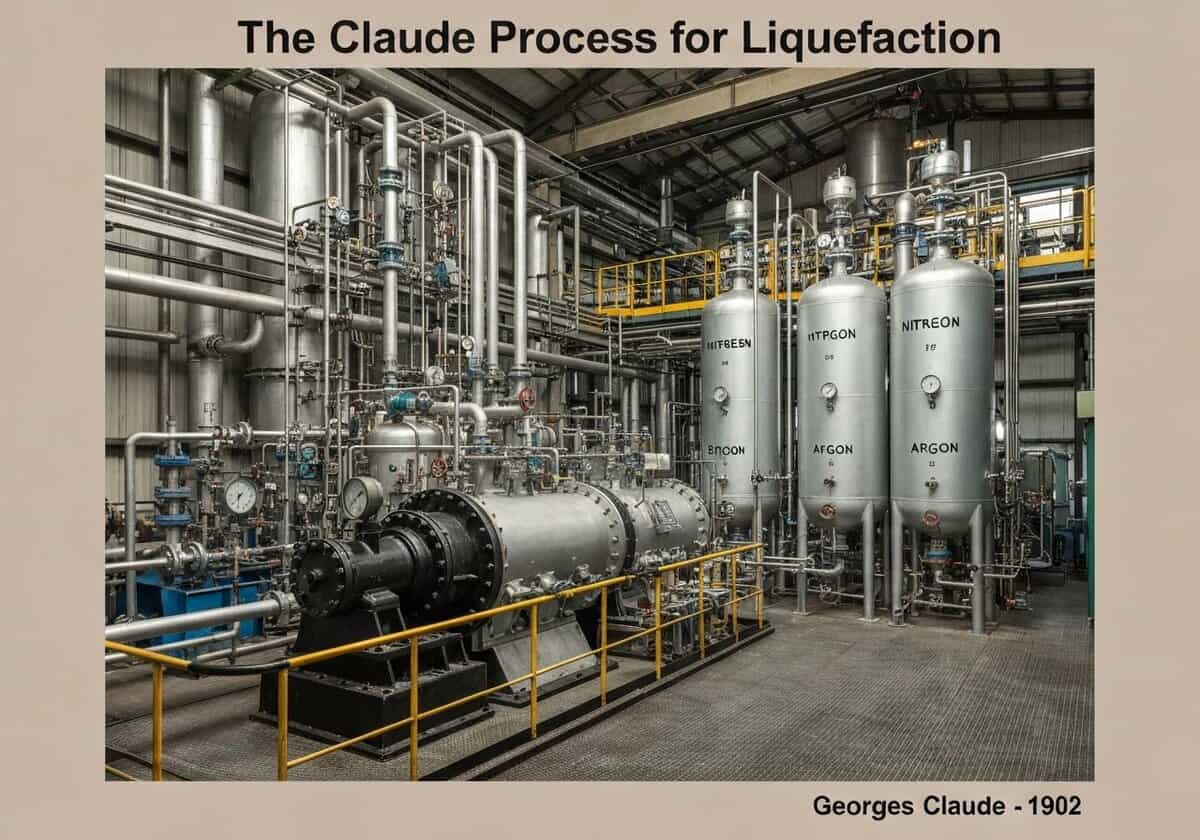
Gasverflüssigungsanlage, die das Claude-Verfahren für industrielle Anwendungen nutzt.

(Abbildung dient nur zur Veranschaulichung)

Das Claude-Verfahren verbessert das Hampson-Linde-Zyklus by incorporating an expansion engine or turbine. A portion of the compressed gas does work in an expander, causing a much larger temperature drop (nearly isentropic expansion) than Joule-Thomson expansion alone. This provides more efficient cooling, making it the dominant method for large-scale gas liquefaction and separation today.

Georges Claude erkannte die thermodynamische Ineffizienz, sich ausschließlich auf die Isenthalpie zu verlassen. Joule-Thomson-Effekt. He reasoned that making the gas perform external work during expansion would extract more energy and thus produce a greater cooling effect. In his system, the main stream of high-pressure gas is split. One part goes to an expansion engine, where it cools significantly while producing work. This extremely cold gas is then used to pre-cool the other part of the high-pressure stream in a heat exchanger. This second stream then undergoes a final Joule-Thomson expansion to produce the liquid. By combining the bulk cooling from the expander with the final-stage liquefaction from the J-T valve, the Claude cycle achieves higher efficiency and can operate at lower initial pressures than the Linde cycle. The work produced by the expander can also be recovered to help power the initial compressor, further improving overall efficiency. This principle is fundamental to virtually all modern large-scale cryogenic plants.

UNESCO Nomenclature: 2212
- Thermodynamik

Typ

Thermodynamischer Zyklus

Störung

Inkremental

Verwendung

Weitverbreitete Verwendung

Vorläufer

  • Hampson-Linde Cycle
  • Brayton-Zyklus (thermodynamisch Grundlage für die Expansionsmaschine)
  • Joule-Thomson-Effekt
  • Entwicklung zuverlässiger Hochgeschwindigkeits-Expansionsmaschinen und -Turbinen

Anwendungen

  • großtechnische Industrie Luftzerlegung Einheiten (ASUs)
  • Produktion von flüssigem Stickstoff, Sauerstoff und Argon
  • Helium- und Wasserstoffverflüssigungsanlagen
  • liquefied natural gas (LNG) production
  • Turboexpander in der Erdgasaufbereitung

Patente:

  • FR324949A

Potenzielle Innovationsideen

  • Turboexpander für die geothermische Stromerzeugung
  • kryogen Kohlenstoffabscheidung technologies using the claude cycle principle
  • integrierte Verflüssigungs- und Stromerzeugungszyklen für LNG-Anlagen
  • Kryokühler mit geschlossenem Brayton-Kreislauf für Weltraumanwendungen
  • fortschrittliche Wasserstoffverflüssiger für Tankstellen und Transport
  • kleine, hocheffiziente Heliumverflüssiger für MRT-Magnete
  • kryogene Energiespeichersysteme unter Verwendung der Prinzipien des Claude-Zyklus
  • Mit erneuerbaren Energiequellen betriebene Luftzerlegungsanlagen
  • LNG-Prozesse der nächsten Generation mit Mixed-Fluid-Kaskaden- und Claude-Zyklen
  • mobile Stickstoffanlagen für die Wartung von Öl- und Gasquellen
Related to: Claude process, expansion engine, liquefaction, Kryogenik, air separation, Georges Claude, isentropic expansion, thermodynamics, efficiency, LNG.

Historischer Kontext

Das Claude-Verfahren zur Verflüssigung

1900
1900
1902
1902
1907
1909
1910
1900
1900
1900-12-14
1902
1904
1907
1909
1910

(wenn das Datum unbekannt oder nicht relevant ist, z. B. „Strömungsmechanik“, wird eine gerundete Schätzung seines bemerkenswerten Auftretens bereitgestellt)

10. Jahr Jubiläum

Bilder in voller Größe und Downloads sind nur für registrierte Mitglieder 100% kostenlos verfügbar.

> Login <