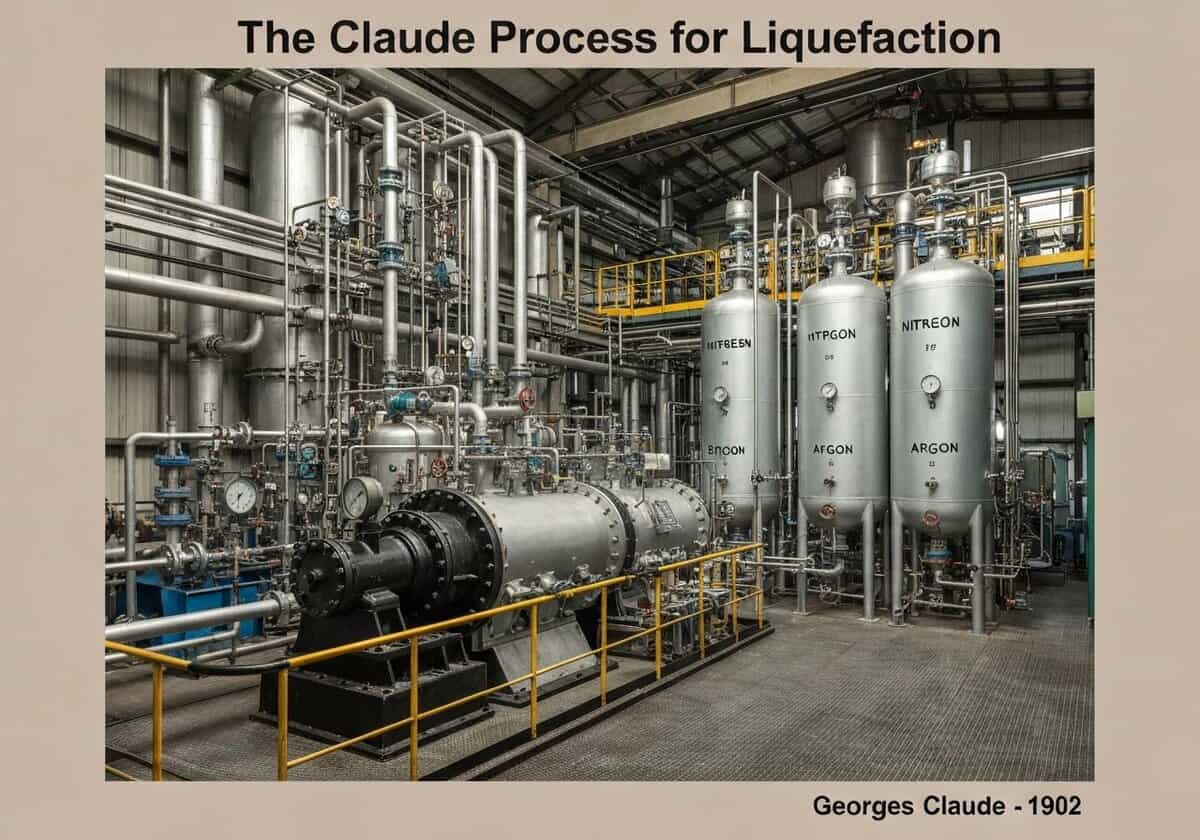
클로드 공정은 팽창 엔진 또는 터빈을 통합하여 햄프슨-린데 사이클을 개선한 방식입니다. 압축된 가스의 일부가 팽창기에서 일을 하여 줄-톰슨 팽창만으로는 얻을 수 없는 훨씬 큰 온도 강하(거의 등엔트로피 팽창)를 일으킵니다. 이러한 특성으로 인해 냉각 효율이 향상되어 오늘날 대규모 가스 액화 및 분리 공정에서 널리 사용되고 있습니다.

(설명을 위한 생성된 이미지입니다)
클로드 공정은 팽창 엔진 또는 터빈을 통합하여 햄프슨-린데 사이클을 개선한 방식입니다. 압축된 가스의 일부가 팽창기에서 일을 하여 줄-톰슨 팽창만으로는 얻을 수 없는 훨씬 큰 온도 강하(거의 등엔트로피 팽창)를 일으킵니다. 이러한 특성으로 인해 냉각 효율이 향상되어 오늘날 대규모 가스 액화 및 분리 공정에서 널리 사용되고 있습니다.

Georges Claude recognized the thermodynamic inefficiency of relying solely on the isenthalpic 줄-톰슨 효과. He reasoned that making the gas perform external work during expansion would extract more energy and thus produce a greater cooling effect. In his system, the main stream of high-pressure gas is split. One part goes to an expansion engine, where it cools significantly while producing work. This extremely cold gas is then used to pre-cool the other part of the high-pressure stream in a heat exchanger. This second stream then undergoes a final 줄-톰슨 expansion to produce the liquid. By combining the bulk cooling from the expander with the final-stage liquefaction from the J-T valve, the Claude cycle achieves higher efficiency and can operate at lower initial pressures than the Linde cycle. The work produced by the expander can also be recovered to help power the initial compressor, further improving overall efficiency. This principle is fundamental to virtually all modern large-scale cryogenic plants.
액상화를 위한 클로드 공정
(날짜를 알 수 없거나 관련이 없는 경우, 예를 들어 "유체역학"의 경우, 주목할 만한 등장 시기를 대략적으로 추정하여 제공합니다.)

고화질 이미지 및 다운로드는 등록된 회원에게만 100% 무료로 제공됩니다.
> 로그인 <