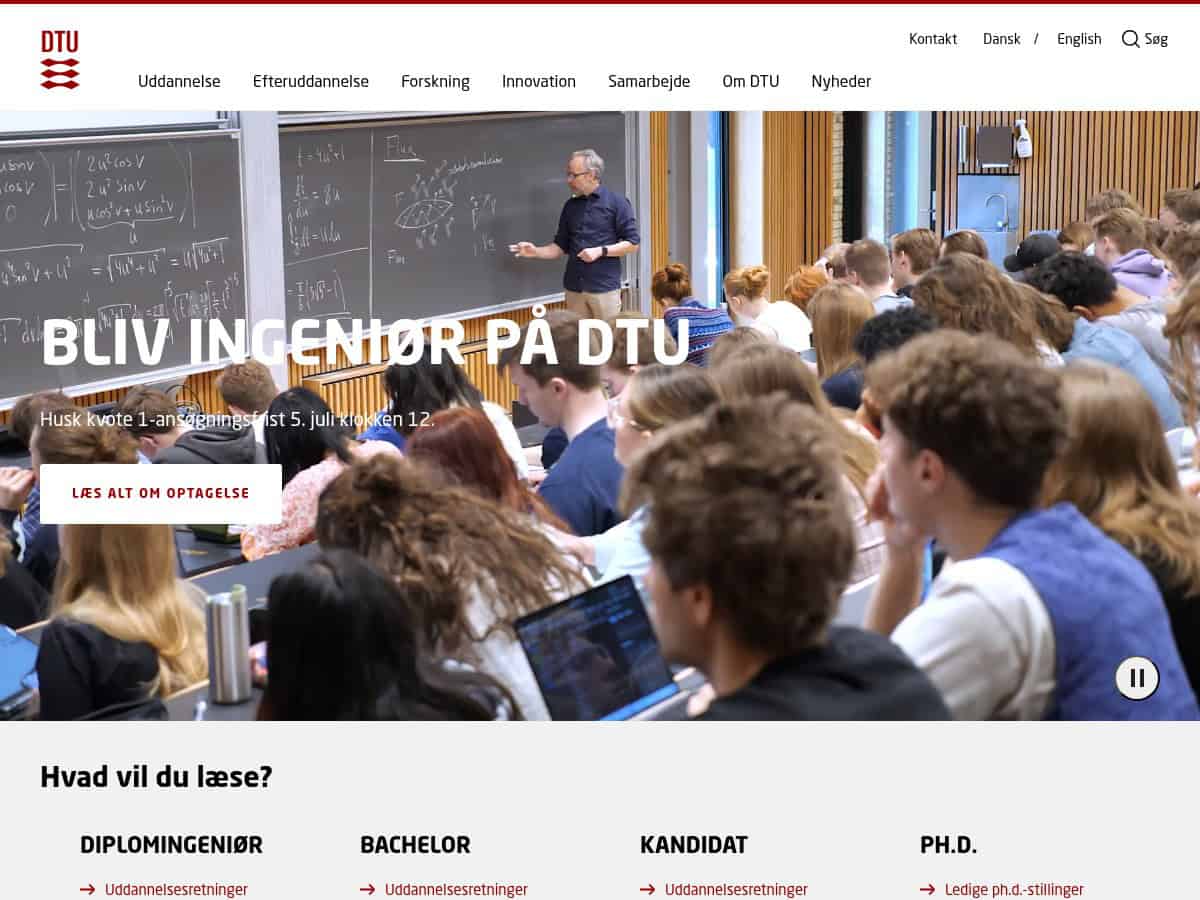
Founded in 1829, DTU is an elite international technical university. It is at the forefront of the technical and natural sciences, known for its research-based education, innovation, and industry partnerships.
DTU, the Technical University of Denmark, is the country’s main engineering university, with about 13,400 students, 6,000 staff and a foreign student share near 20 percent. The main campus lies in Lyngby, north of Copenhagen, among forests and lakes, and the Risø campus near Roskilde, a former nuclear research site, houses much of the work on wind and sustainable energy. The staff figure is high because research scientists and technicians make up a large part of it.
The institution was founded in 1829 by Hans Christian Ørsted as the Polytechnic College, and its first mission was to train engineers for the industrial revolution in Denmark. Wind energy is the most visible specialty today: DTU Wind and Energy Systems works with turbine manufacturers on blade design, offshore foundations and grid integration, and it tests rotor blades and components at Risø. Danish companies such as Vestas and Ørsted use DTU graduates in large numbers.
Biotechnology is the other pillar. The Novo Nordisk Foundation Center for Biosustainability develops microbial cell factories, and DTU also covers chemical engineering, food technology, photonics and space research, where DTU Space builds instruments for satellites and planetary missions. The university has many partnerships with industry, and master’s students usually write their thesis in cooperation with a company.
Tuition is free for EU, EEA and Swiss students, and non-EU students pay fees that depend on the programme. Bachelor degrees are mostly taught in Danish, with a small number in English, while the master’s degrees are almost all in English. Admission to master’s programmes is competitive and based on the first degree and relevant subjects.
Lyngby is a suburb about 20 minutes from central Copenhagen by train, so many students live in the city and commute, although housing is scarce and should be arranged early. About 60,000 people have graduated from DTU, and its alumni work in Danish industry and in international engineering firms.
Domains taught:
AI and Machine Learning, Bioengineering, Civil Engineering, Ecology and Sustainability, Electrical and Electronics, Engineering, Mechanical Engineering
Diplomas*:
Bachelor, Doctor, Master
Status:
Public
Partnerships:
DTU is a member of the EuroTech Universities Alliance and has strategic partnerships with leading global companies like Ørsted, Novo Nordisk, and Microsoft, fostering extensive research and innovation collaborations.
Research:
Research is focused on sustainability and digitalization, with key areas in energy technologies, life sciences, and artificial intelligence. DTU hosts numerous national research centers and has a strong track record in EU-funded research.
Famous Alumnis:
Henrik Pontoppidan, Ove Arup, Craig R. Barrett, Jakob Nielsen
International recognition**:
Number of staff***:
6000
Current students***:
13400
Foreign students***:
20%
Cumulative former students***:
60000
Pros
World-class research facilities, strong international reputation and rankings, and very close ties to industry, leading to high graduate employability.
Cons
The academic environment is highly demanding and competitive. Its main campus is located in Lyngby, outside of Copenhagen’s city center, which can mean a longer commute.
Best For
Students aiming for a top-tier, research-intensive engineering and technology education with a focus on creating sustainable solutions.
University of Southern Denmark offers a comparable education in ecology and sustainability, AI and machine learning and engineering: it teaches at the same levels, namely bachelor's, master's and doctoral, and covers robotics and materials as well.
Also strong in numerous, centers and intensive, University of Copenhagen makes a sensible second look at home; it covers bioinformatics and nanotechnologies as well, and is larger, enrolling about 37,500 students against roughly 13,400 here.
On content, Aarhus University and this university are close, as both teach bioengineering; it is larger, enrolling about 38,000 students against roughly 13,400 here, and is also a public institution.
Aalborg University is the closest domestic counterpart for ecology and sustainability, AI and machine learning and engineering; it is also a public institution, and teaches at the same levels, namely bachelor's, master's and doctoral.
VIA University College follows much the same lines as this university, with civil engineering, mechanical engineering and engineering as common ground, and it covers industrial design and structural engineering as well, and is slightly larger, at about 18,500 students against roughly 13,400 here.
Most Similar Schools Abroad
Looking internationally, Norwegian University of Science and Technology in Norway is where civil engineering, mechanical engineering and electrical and electronics get a comparable treatment; it is far larger, with about 43,550 students against roughly 13,400 here, and is also a public institution.
Abroad, Royal Institute of Technology (Sweden) covers civil engineering, bioengineering and mechanical engineering in a comparable way, and it has almost the same size, at about 13,955 students, and is also a public institution.
The closest overseas parallel on civil engineering, mechanical engineering and electrical and electronics is Lviv Polytechnic National University, located in Ukraine; it teaches at the same levels, namely bachelor's, master's and doctoral, and covers geotechnics and chemistry as well.
In Belgium, Vrije Universiteit Brussel teaches much the same core subjects, civil engineering, bioengineering and mechanical engineering, and it covers bioinformatics and nanotechnologies as well, and is slightly larger, at about 20,000 students against roughly 13,400 here.
Korea Advanced Institute of Science and Technology (South Korea) works on the same fields as this institution, chiefly electrical and electronics, AI and machine learning and engineering; it covers chemistry and robotics as well, and has almost the same size, at about 12,348 students.
*our own picks (our criteria: a mix between domains, diploma delivered, reputation and size), but obviously too many criteria for an apple-to-apple ranking.
FAQ
Where is DTU?
The main campus is at Anker Engelunds Vej 1 in Kongens Lyngby, north of Copenhagen.
How large is DTU?
About 13,400 students and 6,000 staff, including many research scientists and technicians.
When was DTU founded?
In 1829 by Hans Christian Ørsted, as the Polytechnic College.
What is DTU known for?
Engineering, wind energy, biotechnology, chemical engineering, food technology and space research.
Is there a link to the wind industry?
Yes. DTU Wind and Energy Systems works with turbine manufacturers on blades, offshore foundations and grid integration, and tests components at the Risø campus.
What is the Center for Biosustainability?
It is a research centre funded by the Novo Nordisk Foundation, working on microbial cell factories for sustainable production.
What language is used for teaching?
Most bachelor degrees are in Danish and master's degrees are mostly in English.
Is tuition free?
Yes for students from the EU, EEA and Switzerland. Students from other countries pay fees that depend on the programme.
How close is Lyngby to Copenhagen?
About 20 minutes by train from the centre of Copenhagen.
Do students work with companies?
Yes. Master's students often write their thesis in cooperation with a company, and the university has many industry partnerships.
Artificial Intelligence (AI), Engineering, Innovation, Life Cycle Assessment (LCA), Renewable Energy, Research and Development, Sustainable Development
*: without any judgment of the quality, readers are strongly encouraged to check the official status of the exact diploma envisioned as many universities have a mix of recognized diplomas, not recognized, “co-delivered,” “equivalent to”, “some pathways” (…), can change over time, and can be named differently from one country to another.
**: international reputation: is based on some criteria that do not mean much in some domains or specialties (number of researchers, of scientific publications, on budget ….). Our approximate 1-4 scale:
known locally
known locally and internationally
is listed in some of the world university’s classifications
is listed among the 20 firsts in some of world university’s classifications
***: estimated numbers, based on online sources and/or feedbacks. The numbers can vary greatly depending on school organisation (ex.: school is part of a group, it employs internal staff or external consultants or has public staff without employing them …). Refer to all the links provided to have accurate and updated numbers.
Innovation.world is not affiliated with this school/university. We recommend to contact them directly on their website for any special request.
To complete or correct any information here or share your opinion, please comment below or > send us a direct message <.