Information Technology, Civil Engineering, Mechanical Engineering
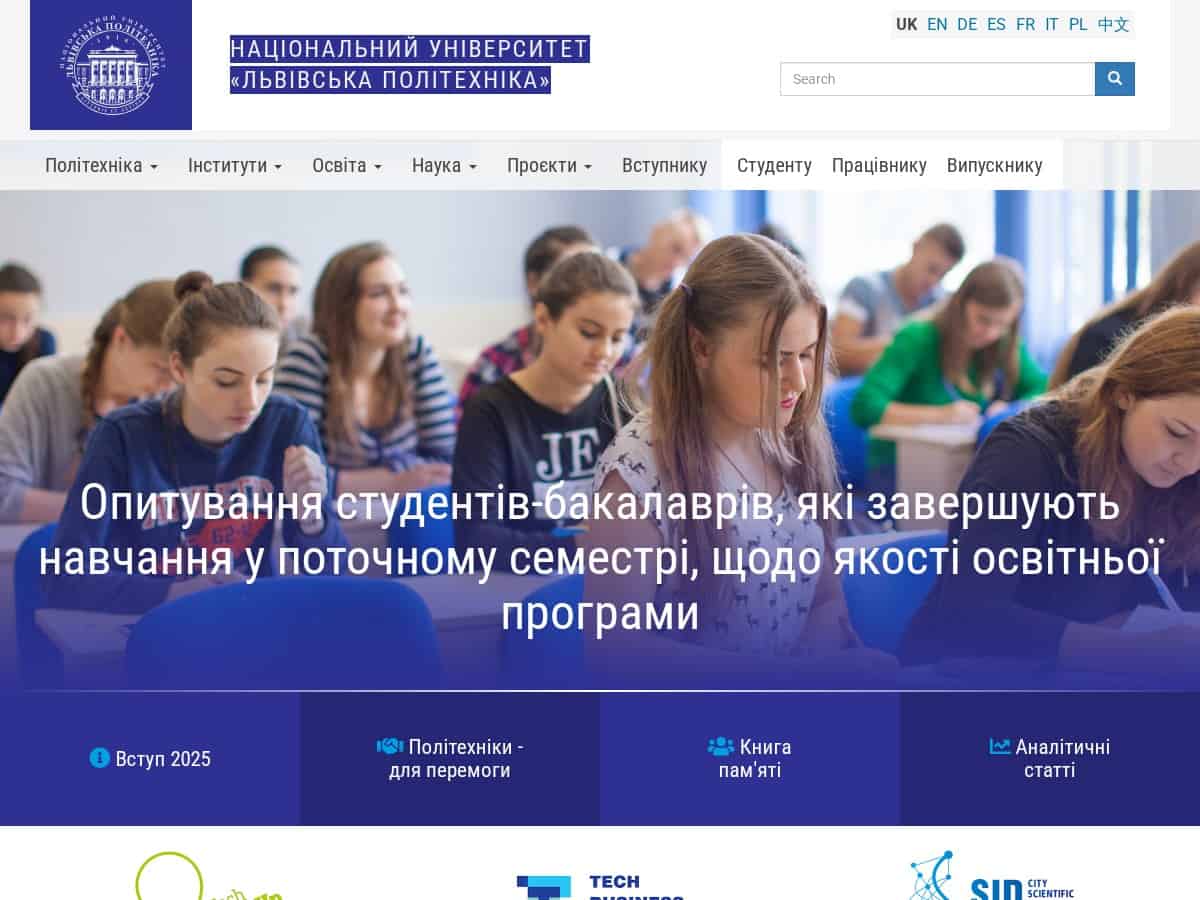
Established in 1816, Lviv Polytechnic is one of the oldest technical universities in Eastern Europe and the largest in Western Ukraine. It offers a broad spectrum of engineering, IT, and architectural programs.
Lviv Polytechnic National University is one of the oldest technical universities in Eastern Europe. It started in 1816 as a Real School of trade and technology, became the Technical Academy in 1844, and received the name Polytechnic School in 1877 under the Austrian Empire. It has about 30,000 students and 4,000 staff. The main building, on Stepan Bandera Street in the centre of Lviv, was finished in the 1870s and is a large historicist structure with an interior courtyard and a monumental staircase.
During the interwar period the school was a Polish institution, and its professors included the chemist Ignacy Moscicki, who later became President of Poland. The mathematician Stefan Banach studied and worked in Lviv, and the Scottish Cafe, where Banach and his colleagues wrote problems in a notebook, became a legend of mathematics. After the Second World War the polytechnic became a Soviet institution, and since 1991 it has been a Ukrainian national university. In 2000 it obtained the status of a national university.
The polytechnic is organised in institutes for architecture, civil engineering, chemistry and chemical technology, computer science and information technology, telecommunications, electrical engineering, mechanical engineering, geodesy, administration and economics, humanities and applied mathematics. It has been a major source of engineers and programmers for Western Ukraine, and the IT industry of Lviv, which employs tens of thousands of people, recruits many of its graduates.
Ukrainian applicants enter through the national multi-subject test and compete for state-funded places or pay contract fees. Foreign students normally pay a contract fee, and many begin with a preparatory year in Ukrainian. Fees vary by programme, so check the current tariff. Teaching is in Ukrainian, with a number of programmes in English. Since 2022, teaching has been adapted to wartime conditions, with a mix of online and in-person classes, so check the current situation before applying.
Lviv is a historic city, listed as a UNESCO World Heritage Site, with cafes, theatres and a lively student life. Living costs are lower than in Kyiv, and dormitories are available.
Extensive international collaborations with over 200 universities from 30+ countries; participates in Erasmus+, Horizon 2020, and other international projects.
Research:
Research focus on computer science, geodesy, architecture, new materials, energy efficiency, and chemical technologies. Numerous research institutes and centers.
Famous Alumnis:
Stepan Banach, Kazimierz Bartel, Ignacy Mościcki
International recognition**:
Number of staff***:
4000
Current students***:
30000
Foreign students***:
0%
Cumulative former students***:
250000
Pros
Historic and reputable institution, strong academic traditions, wide range of programs, located in a major cultural center.
Cons
Some older infrastructure, can be competitive for popular programs.
National Technical University Kharkiv Polytechnic Institute overlaps with this institution on mechanical engineering, electrical and electronics and software engineering, so the two are easy to compare, and it covers chemical engineering and thermodynamics as well, and is smaller, enrolling about 20,000 students against roughly 30,000 here.
National University Yuri Kondratyuk Poltava Polytechnic sits close to this institution on geotechnics, civil engineering and electrical and electronics; it is far smaller, with about 7,000 students against roughly 30,000 here, and is also a public institution.
Dnipro University of Technology overlaps with this university on geotechnics, mechanical engineering and electrical and electronics, so the two are easy to compare, and it is smaller, enrolling about 12,000 students against roughly 30,000 here, and is also a public institution.
On content, Odesa National Polytechnic University and this university are close, as both teach mechanical engineering, electrical and electronics and software engineering; it is also a public institution, and teaches at the same levels, namely bachelor's, master's and doctoral.
Most Similar Schools Abroad
Abroad, TU Wien (Austria) covers civil engineering, chemistry and mechanical engineering in a comparable way, and it covers physics and mathematics as well, and has almost the same size, at about 26,654 students.
A foreign alternative with a similar emphasis on civil engineering, mechanical engineering and electrical and electronics is Peter the Great St. Petersburg Polytechnic University in Russia, and it teaches at the same levels, namely bachelor's, master's and doctoral, and covers physics and materials as well.
For civil engineering, chemistry and software engineering outside the home country, Guangzhou University in China is a natural reference; it teaches at the same levels, namely bachelor's, master's and doctoral, and covers mathematics and data analytics as well.
Seen from abroad, University of Oslo (Norway) is a close relative on subject matter, since geotechnics, chemistry and software engineering are central to both, and it is also a public institution, and runs the same bachelor's, master's and doctoral programmes.
On content, Ural Federal University in Russia and this institution are close, as both teach chemistry, mechanical engineering and electrical and electronics; it covers physics and materials as well, and is slightly larger, at about 36,000 students against roughly 30,000 here.
*our own picks (our criteria: a mix between domains, diploma delivered, reputation and size), but obviously too many criteria for an apple-to-apple ranking.
FAQ
Where is Lviv Polytechnic?
At 12 Stepan Bandera Street in Lviv, Ukraine.
When was it founded?
In 1816, as a Real School of trade and technology. It became the Technical Academy in 1844 and the Polytechnic School in 1877.
How large is it?
About 30,000 students and 4,000 staff.
Who is linked to it?
The chemist Ignacy Moscicki, later President of Poland, was a professor, and the mathematician Stefan Banach studied and worked in Lviv.
What was the Scottish Cafe?
A Lviv cafe where Banach and his colleagues wrote problems in a notebook, which became a legend of mathematics.
Yes. The IT industry of Lviv recruits many of its graduates.
How do foreign students enter?
They normally pay a contract fee, and many begin with a preparatory year in Ukrainian. Check the current tariff.
In which language are courses taught?
Mainly in Ukrainian, with a number of programmes in English.
How has the war affected teaching?
Since 2022, teaching has been adapted with a mix of online and in-person classes. Check the current situation before applying.
Architecture, Civil Engineering, Engineering, Environmental Engineering, Information Technology (IT), Innovation, Mechanical Engineering, Research and Development, Sustainable Development
*: without any judgment of the quality, readers are strongly encouraged to check the official status of the exact diploma envisioned as many universities have a mix of recognized diplomas, not recognized, “co-delivered,” “equivalent to”, “some pathways” (…), can change over time, and can be named differently from one country to another.
**: international reputation: is based on some criteria that do not mean much in some domains or specialties (number of researchers, of scientific publications, on budget ….). Our approximate 1-4 scale:
known locally
known locally and internationally
is listed in some of the world university’s classifications
is listed among the 20 firsts in some of world university’s classifications
***: estimated numbers, based on online sources and/or feedbacks. The numbers can vary greatly depending on school organisation (ex.: school is part of a group, it employs internal staff or external consultants or has public staff without employing them …). Refer to all the links provided to have accurate and updated numbers.
Innovation.world is not affiliated with this school/university. We recommend to contact them directly on their website for any special request.
To complete or correct any information here or share your opinion, please comment below or > send us a direct message <.