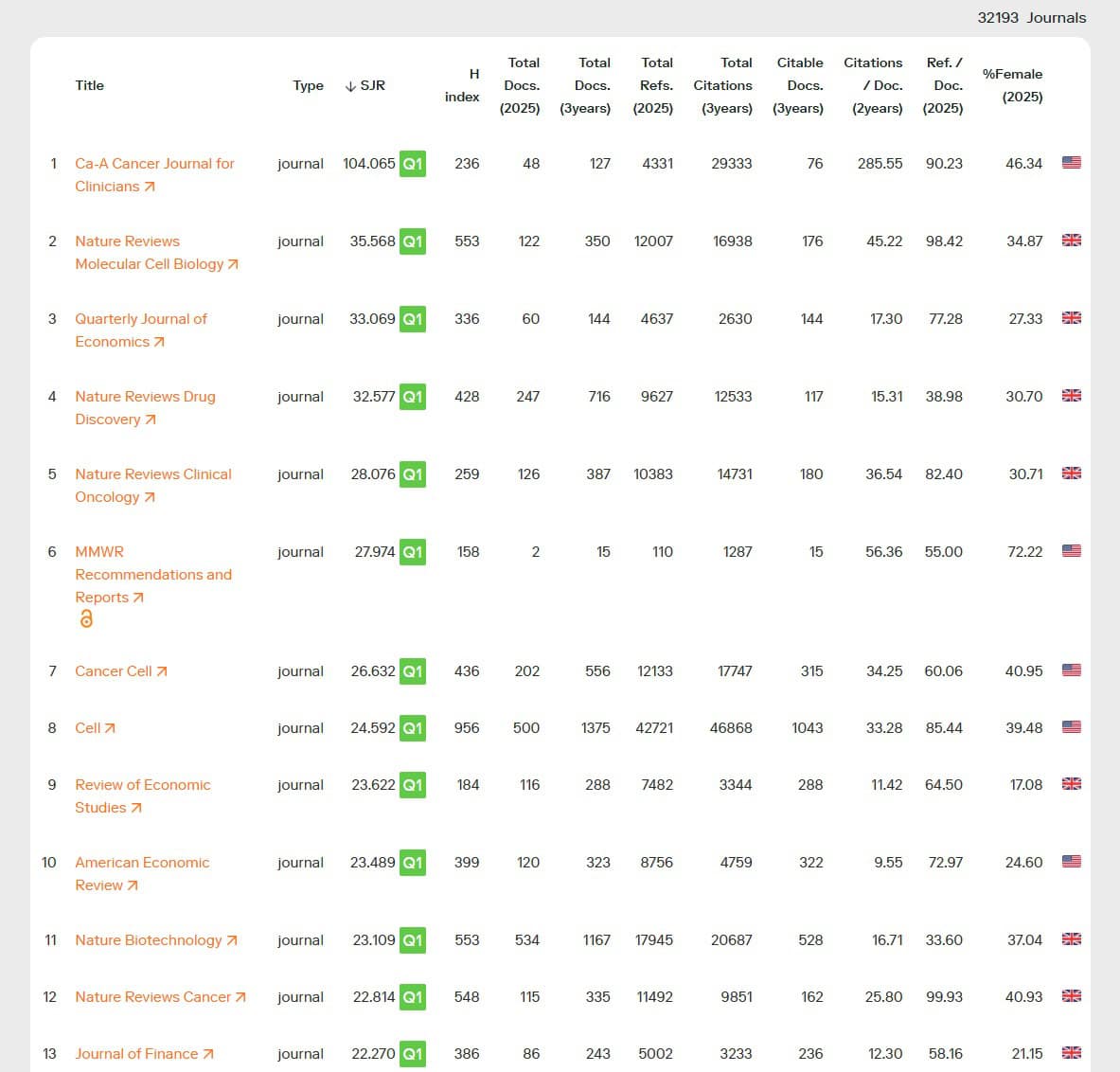
Scimago Journal Rank compared with Clarivate JCR, Scopus CiteScore and Google Scholar Metrics| Scimago Journal Rank (SJR) | Clarivate JCR | Scopus CiteScore | Google Scholar Metrics |
|---|
| Data source: SJR is calculated from Scopus data. Citations are weighted by the prestige of the citing journal, so it is a network measure and not a raw count. | Data source: JCR draws on the Web of Science Core Collection. Journals must pass an editorial evaluation by Clarivate before they are indexed. | Data source: CiteScore is also calculated by Scopus, so it shares its source database with SJR. | Data source: Citations come from all articles Google Scholar has indexed, including articles that are not themselves covered by the metrics. |
| Metric and window: SJR is the average weighted citations received in a selected year per document published in the previous three years. An iterative, PageRank-like algorithm redistributes prestige until values stabilize. | Metric and window: The Journal Impact Factor counts citations in the JCR year to articles and reviews from the two previous years. The Journal Citation Indicator uses three years and is normalized by category. | Metric and window: CiteScore is the ratio of citations to documents. Elsevier states that the four years up to and including the calculation year are included, and that it is calculated once a year. | Metric and window: The h5-index is the largest h such that h articles from the last five complete years were each cited at least h times. The h5-median is the median citation count of that top set. |
| Coverage and inclusion: SJR ranks journals and also countries. Thematic closeness between citing and cited journals is considered in the weighting. | Coverage and inclusion: Coverage is limited to journals that pass Clarivate's evaluation. Elsevier states that CiteScore covers about 13,000 more titles than receive an impact factor. | Coverage and inclusion: CiteScore covers all serial titles, not only journals, and counts peer-reviewed document types such as articles, reviews and conference papers. | Coverage and inclusion: A publication needs at least 100 articles from 2020 to 2024 to be included. Books, patents, dissertations and court opinions are excluded. |
| Access: The portal describes SJR as a free journal metric. A related two-year indicator, Cites per Doc., is offered alongside it. | Access: The underlying dataset and methodology are largely closed to most users, according to a 2021 Scholarly Kitchen analysis of the Journal Citation Indicator. | Access: CiteScore, SNIP and SJR are listed as free at scopus.com/sources, and no Scopus subscription is required to view them. | |