MIT OpenCourseWare compared with Coursera, edX and Udemy| MIT OpenCourseWare | Coursera | edX | Udemy |
|---|
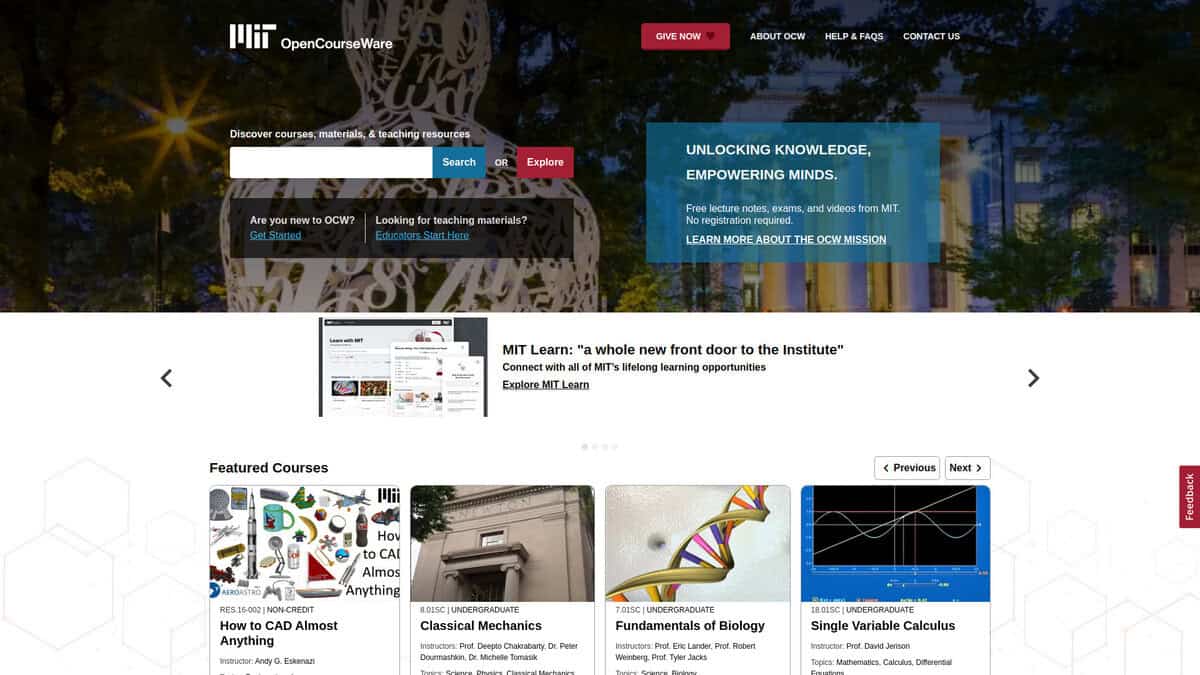
| Source of the content: Materials come from MIT courses, and the site says it covers the entire MIT curriculum with more than 2,500 courses. | Source of the content: Courses are MOOCs from partner universities worldwide, with pre-recorded lectures, forums, assignments and quizzes or exams. | Source of the content: edX was founded by MIT and Harvard and works with university and industry partners. It offers courses, professional certificates, executive education, MicroBachelors, MicroMasters and degree programs. | Source of the content: A marketplace in which subject experts create and teach courses. Topics include programming, design, languages and finance. |
| Cost model: Free. No enrollment or account is needed, and there are no start or end dates. | Cost model: Freemium: courses can generally be audited for free, while certificates, subscriptions and degrees are paid. Financial aid exists for certificates. | Cost model: Freemium: auditing is free with limited access, no graded assignments and no certificate. The verified track with graded assignments and a certificate is paid. | Cost model: Paid: courses can be bought one at a time with lifetime access to those courses, or accessed through a Personal Plan subscription. Business plans exist for organizations. |
| Credit and certification: MIT does not offer credit or certification to users of OCW. | Credit and certification: Course certificates require payment. Specializations, Professional Certificates and degrees are also offered. | Credit and certification: Verified certificates are issued on the paid track. MicroBachelors may provide transferable undergraduate credit. | |
| Reuse and licensing: Materials are published under a Creative Commons BY-NC-SA 4.0 licence, which allows modifying, remixing and reuse with citation of MIT OpenCourseWare. | | Reuse and licensing: The edX platform software was open sourced in 2013 as Open edX, with the source code on GitHub. | |
| Offline and self-paced use: Materials can be browsed or downloaded. A YouTube channel, mirror sites and OCW To Go provide offline mobile access to selected courses. | Offline and self-paced use: Lectures can be watched on a weekly schedule or whenever suits the learner. | Offline and self-paced use: Auditors lose access to course materials after the course ends. | |