
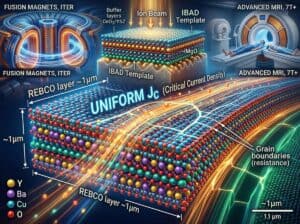
उच्च तापमान वाले सुपरकंडक्टर्स, पारंपरिक धात्विक सुपरकंडक्टर्स की तुलना में कहीं अधिक तापमान पर बिना डीसी प्रतिरोध के चालकता प्रदर्शित करते हैं, जिनमें REBCO का क्रांतिक तापमान लगभग 90 K होता है। व्यावसायिक रूप से उपलब्ध कंडक्टर मुख्य रूप से REBCO लेपित कंडक्टर टेप और BSCCO तार होते हैं। क्रांतिक धारा घनत्व, क्रांतिक क्षेत्र और तनाव सहनशीलता इनकी उपयोगिता निर्धारित करते हैं। इनके अनुप्रयोगों में फ्यूजन मैग्नेट, MRI और NMR सिस्टम, पवन जनरेटर, इलेक्ट्रिक विमान मोटर और पावर केबल शामिल हैं।
उत्पादन और सुरक्षा सबसे कठिन पहलू हैं। आयन बीम असिस्टेड डिपोजिशन और रासायनिक विधियों द्वारा लंबी टेपों के उत्पादन में एकसमान क्रिटिकल करंट बनाए रखना आवश्यक है। किलोएम्पीयर-मीटर की लागत बाजार की वृद्धि को सीमित करती है। चुंबक डिज़ाइनर क्वेंच डिटेक्शन, बिना इन्सुलेशन वाली वाइंडिंग, स्क्रीनिंग करंट और जॉइंट रेजिस्टेंस जैसी समस्याओं का समाधान करते हैं, क्योंकि ये कॉइल कम आयतन में बड़ी मात्रा में ऊर्जा संग्रहित करते हैं। हाइड्राइड, लौह-आधारित और निकेलेट सुपरकंडक्टर्स अनुसंधान के क्षेत्र को व्यापक बनाते हैं। नीचे सूचीबद्ध प्रकाशन और पेटेंट कंडक्टर, चुंबक, केबल, फॉल्ट करंट लिमिटर, क्रायोजेनिक एकीकरण और नए सुपरकंडक्टिंग पदार्थों से संबंधित हैं।
एचटीएस तार तरल नाइट्रोजन के तापमान पर बिना किसी प्रतिरोध के करंट प्रवाहित करते हैं। शीतलन चालू है। अत्यंत निम्न तापमान विज्ञानभौतिकी पर संघनित पदार्थ भौतिकीबड़े उपयोगकर्ता हैं विलय चुंबक और कण त्वरकग्रिड केबल इससे जुड़ते हैं स्मार्ट ग्रिड.
यह उच्च-तापमान सुपरकंडक्टर्स (HTS) पर अंग्रेजी में प्रकाशित विश्वव्यापी प्रकाशनों और पेटेंटों का हमारा नवीनतम संकलन है, जिसमें कई वैज्ञानिक ऑनलाइन जर्नल शामिल हैं, जिन्हें उच्च-तापमान सुपरकंडक्टर, REBCO, YBCO, BSCCO, लेपित कंडक्टर, सुपरकंडक्टिंग टेप, HTS चुंबक, क्रांतिक धारा घनत्व, सुपरकंडक्टिंग केबल, फॉल्ट करंट लिमिटर, सुपरकंडक्टिंग चुंबकीय ऊर्जा भंडारण, बिना इन्सुलेशन वाली कॉइल, क्वेंच प्रोटेक्शन, फ्लक्स पिनिंग, लौह-आधारित सुपरकंडक्टर, हाइड्राइड सुपरकंडक्टर, निकेलेट सुपरकंडक्टर, क्यूप्रेट, सुपरकंडक्टिंग मोटर और सुपरकंडक्टिंग जॉइंट पर वर्गीकृत और केंद्रित किया गया है।
A reduced diameter cryostat component and superconducting cable assembly employing same
Patent published on the 2026-11-04 in EP under Ref EP4835919 by SUPERNODE LTD [IE] (Acin Marcos [ie], Carlisle Andrew [ie], Stringer Peter [ie], O Donovan Daniel [ie])
Abstract: [0001] The present invention provides a cryostat component comprising an elongate cylindrical tubular sidewall formed from fibre reinforced thermoplastic and having an inner diameter of less than 50mm; wherein the fibre reinforcement is optimised to provide the cryostat component with a coefficient of thermal expansion in an axial direction of +/- 15ppm/°C, in addition to a superconducting cable assembly comprising one or more of the cryostat components, in particular for use as a former for on[...]
Our summary: The invention features a cryostat component with a cylindrical sidewall made from fibre reinforced thermoplastic. It has an inner diameter of less than 50mm and a thermal expansion coefficient of +/- 15ppm/°C. The component is designed to serve as a former for superconductors in a cable assembly.
cryostat, superconducting cable, fibre reinforced thermoplastic, thermal expansion
Patent
Critical photoinduced reflectivity relaxation dynamics in single-layer Bi-based cuprates near the pseudogap end point
Published on 2026-09-02 by T Shimizu, R Tobise, T Kurosawa, S Tsuchiya, M Oda, Y Toda, V V Kabanov, D Mihailovic and T Mertelj @IOP SCIENCE
Abstract: A comprehensive study of photoinduced transient reflectivity dynamics in heavily overdoped single-layer cuprate (Bi,Pb) Sr CuO (Pb-Bi-2201) across the end points of the pseudogap (PG) and superconducting phases was conducted using optical ultrafast time-resolved pump-probe spectroscopy. In the Pb-Bi-2201 near the proposed PG end-point doping (PGED), the transient reflectivity dynamics above resemble the PG response observed in the optimally doped La-Bi-2201. With decreasing temperature, however,[...]
Our summary: This study investigates the transient reflectivity dynamics in single-layer Bi-based cuprates near the pseudogap end point. It reveals a power-law divergence in relaxation time consistent with quantum critical behavior as temperature decreases. The findings show similarities in dynamics between heavily overdoped Pb-Bi-2201 and optimally doped La-Bi-2201.
photoinduced reflectivity, cuprates, pseudogap, ultrafast spectroscopy
Publication
Grooved, nested-cylinder, layer-wound superconducting magnets and related construction techniques
Patent published on the 2026-07-09 in WO under Ref WO2026147855 by MASSACHUSETTS INST OF TECHNOLOGY [US] (Mouratidis Theodore [us], Labombard Brian [us], Austin Samuel [us])
Abstract: Described is a no-insulation superconducting magnet design that utilizes high temperature superconducting tapes arranged in a layer-wound configuration. The design is compact, modular and utilizes a fabrication methodology that scales well for commercialization. Embodiments described herein may find use in a wide variety of applications including, but not limited to solenoidal magnets in general, including devices operating at very high magnetic field strength and also in plasma thrusters for [...]
Our summary: The content discusses a no-insulation superconducting magnet design using high temperature superconducting tapes. It emphasizes a compact and modular design suitable for commercialization. Applications include solenoidal magnets and plasma thrusters for spacecraft propulsion.
superconducting magnets, high temperature superconductors, layer-wound configuration, plasma thrusters
Patent
Modelling, Optimisation, and Construction of a High-Temperature Superconducting Maglev Demonstrator
Published on 2026-01-16 by Chenxuan Zhang, Qian Dong, Hongye Zhang, Markus Mueller @MDPI
Abstract: To achieve global carbon-neutrality goals, magnetic levitation (maglev) technologies offer a promising pathway toward sustainable, energy-efficient transportation systems. In this study, a comprehensive methodology was developed to analyse and optimise the levitation performance of high-temperature superconducting (HTS) maglev systems. Several permanent magnet guideway (PMG) configurations were compared, and an optimised PMG Halbach array design was identified that enhances flux concentration an[...]
Our summary: This study develops a methodology to optimise the levitation performance of high-temperature superconducting maglev systems. An optimised PMG Halbach array design enhances flux concentration and improves levitation performance. The 3D finite element model accurately predicts levitation forces, confirming the model s reliability for HTS maglev systems.
Superconductivity, Maglev, Finite Element Analysis, Optimisation
Publication