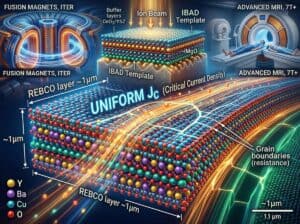
Les supraconducteurs à haute température critique conduisent sans résistance en courant continu à des températures bien supérieures à celles des supraconducteurs métalliques conventionnels, avec des températures critiques proches de 90 K pour le REBCO. Les conducteurs commerciaux sont principalement des rubans conducteurs revêtus de REBCO et des fils BSCCO. Leur utilité est déterminée par la densité de courant critique, le champ critique et la tolérance à la déformation. Parmi leurs applications, on trouve les aimants de fusion, les systèmes d'IRM et de RMN, les éoliennes, les moteurs électriques d'avions et les câbles d'alimentation.
La fabrication et la protection constituent les aspects les plus complexes. La production de rubans de grande longueur par dépôt assisté par faisceau d'ions et par voie chimique doit garantir un courant critique uniforme. Le coût par kiloampère-mètre limite la croissance du marché. Les concepteurs d'aimants doivent gérer la détection des transitions supraconductrices, l'enroulement sans isolation, les courants de blindage et la résistance des jonctions, car ces bobines stockent une grande quantité d'énergie dans de petits volumes. Les supraconducteurs à base d'hydrures, de fer et de nickelates repoussent les frontières de la recherche. Les publications et brevets répertoriés ci-dessous couvrent les conducteurs, les aimants, les câbles, les limiteurs de courant de défaut, l'intégration cryogénique et les nouveaux matériaux supraconducteurs.
Les fils supraconducteurs à haute température (HTS) conduisent le courant sans résistance à des températures que l'azote liquide peut atteindre. Le refroidissement est activé. cryogénie, la physique sur physique de la matière condenséeLes gros utilisateurs sont fusion aimants et accélérateurs de particulesLes câbles du réseau se connectent à réseaux intelligents.
Voici notre dernière sélection de publications et de brevets internationaux en anglais sur les supraconducteurs à haute température (HTS), issus de nombreuses revues scientifiques en ligne, classés et axés sur les supraconducteurs à haute température, REBCO, YBCO, BSCCO, les conducteurs revêtus, les rubans supraconducteurs, les aimants HTS, la densité de courant critique, les câbles supraconducteurs, les limiteurs de courant de défaut, le stockage d'énergie magnétique supraconducteur, les bobines sans isolation, la protection contre les transitions, le piégeage de flux, les supraconducteurs à base de fer, les supraconducteurs hydrures, les supraconducteurs nickelates, les cuprates, les moteurs supraconducteurs et les joints supraconducteurs.
A reduced diameter cryostat component and superconducting cable assembly employing same
Patent published on the 2026-11-04 in EP under Ref EP4835919 by SUPERNODE LTD [IE] (Acin Marcos [ie], Carlisle Andrew [ie], Stringer Peter [ie], O Donovan Daniel [ie])
Abstract: [0001] The present invention provides a cryostat component comprising an elongate cylindrical tubular sidewall formed from fibre reinforced thermoplastic and having an inner diameter of less than 50mm; wherein the fibre reinforcement is optimised to provide the cryostat component with a coefficient of thermal expansion in an axial direction of +/- 15ppm/°C, in addition to a superconducting cable assembly comprising one or more of the cryostat components, in particular for use as a former for on[...]
Our summary: The invention features a cryostat component with a cylindrical sidewall made from fibre reinforced thermoplastic. It has an inner diameter of less than 50mm and a thermal expansion coefficient of +/- 15ppm/°C. The component is designed to serve as a former for superconductors in a cable assembly.
cryostat, superconducting cable, fibre reinforced thermoplastic, thermal expansion
Patent
Critical photoinduced reflectivity relaxation dynamics in single-layer Bi-based cuprates near the pseudogap end point
Published on 2026-09-02 by T Shimizu, R Tobise, T Kurosawa, S Tsuchiya, M Oda, Y Toda, V V Kabanov, D Mihailovic and T Mertelj @IOP SCIENCE
Abstract: A comprehensive study of photoinduced transient reflectivity dynamics in heavily overdoped single-layer cuprate (Bi,Pb) Sr CuO (Pb-Bi-2201) across the end points of the pseudogap (PG) and superconducting phases was conducted using optical ultrafast time-resolved pump-probe spectroscopy. In the Pb-Bi-2201 near the proposed PG end-point doping (PGED), the transient reflectivity dynamics above resemble the PG response observed in the optimally doped La-Bi-2201. With decreasing temperature, however,[...]
Our summary: This study investigates the transient reflectivity dynamics in single-layer Bi-based cuprates near the pseudogap end point. It reveals a power-law divergence in relaxation time consistent with quantum critical behavior as temperature decreases. The findings show similarities in dynamics between heavily overdoped Pb-Bi-2201 and optimally doped La-Bi-2201.
photoinduced reflectivity, cuprates, pseudogap, ultrafast spectroscopy
Publication
Grooved, nested-cylinder, layer-wound superconducting magnets and related construction techniques
Patent published on the 2026-07-09 in WO under Ref WO2026147855 by MASSACHUSETTS INST OF TECHNOLOGY [US] (Mouratidis Theodore [us], Labombard Brian [us], Austin Samuel [us])
Abstract: Described is a no-insulation superconducting magnet design that utilizes high temperature superconducting tapes arranged in a layer-wound configuration. The design is compact, modular and utilizes a fabrication methodology that scales well for commercialization. Embodiments described herein may find use in a wide variety of applications including, but not limited to solenoidal magnets in general, including devices operating at very high magnetic field strength and also in plasma thrusters for [...]
Our summary: The content discusses a no-insulation superconducting magnet design using high temperature superconducting tapes. It emphasizes a compact and modular design suitable for commercialization. Applications include solenoidal magnets and plasma thrusters for spacecraft propulsion.
superconducting magnets, high temperature superconductors, layer-wound configuration, plasma thrusters
Patent
Modelling, Optimisation, and Construction of a High-Temperature Superconducting Maglev Demonstrator
Published on 2026-01-16 by Chenxuan Zhang, Qian Dong, Hongye Zhang, Markus Mueller @MDPI
Abstract: To achieve global carbon-neutrality goals, magnetic levitation (maglev) technologies offer a promising pathway toward sustainable, energy-efficient transportation systems. In this study, a comprehensive methodology was developed to analyse and optimise the levitation performance of high-temperature superconducting (HTS) maglev systems. Several permanent magnet guideway (PMG) configurations were compared, and an optimised PMG Halbach array design was identified that enhances flux concentration an[...]
Our summary: This study develops a methodology to optimise the levitation performance of high-temperature superconducting maglev systems. An optimised PMG Halbach array design enhances flux concentration and improves levitation performance. The 3D finite element model accurately predicts levitation forces, confirming the model s reliability for HTS maglev systems.
Superconductivity, Maglev, Finite Element Analysis, Optimisation
Publication