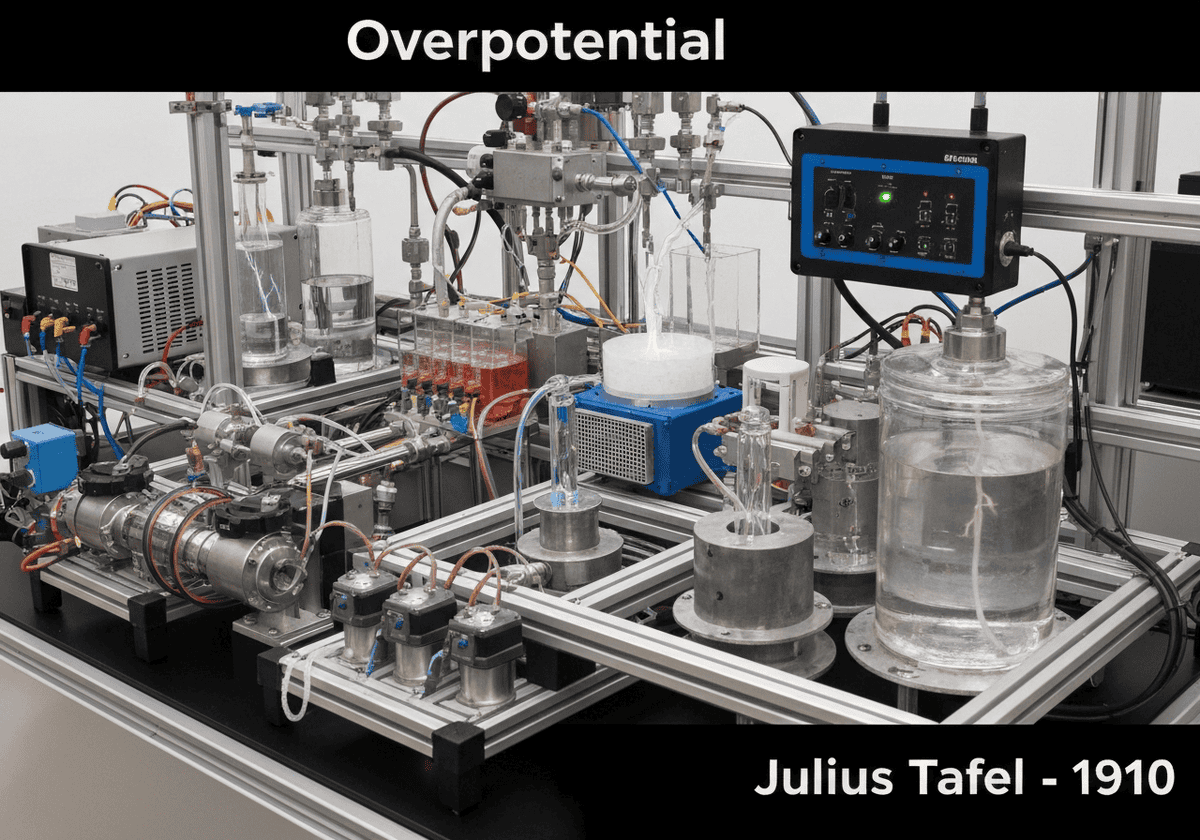
과전압은 반쪽 반응의 열역학적으로 결정된 환원 전위와 산화환원 반응이 실험적으로 관찰되는 전위 사이의 전위차(전압)입니다. 이는 전극 반응이 상당한 속도로 진행하기 위해 활성화 장벽을 극복하는 데 필요한 추가 에너지를 나타냅니다. 과전압은 모든 전기분해 공정의 에너지 효율을 결정하는 핵심 요소입니다.
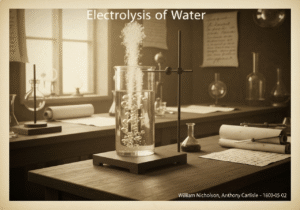

(설명을 위한 생성된 이미지입니다)
과전압은 반쪽 반응의 열역학적으로 결정된 환원 전위와 산화환원 반응이 실험적으로 관찰되는 전위 사이의 전위차(전압)입니다. 이는 전극 반응이 상당한 속도로 진행하기 위해 활성화 장벽을 극복하는 데 필요한 추가 에너지를 나타냅니다. 과전압은 모든 전기분해 공정의 에너지 효율을 결정하는 핵심 요소입니다.
In an ideal electrolytic cell, the applied voltage needed to drive a reaction would be exactly equal to the cell’s standard electrode potential ([latex]E^0_{cell}[/latex]). However, in reality, a significantly higher voltage is almost always required. This excess voltage is the overpotential ([latex]\eta[/latex]). The total cell potential ([latex]E_{cell}[/latex]) is the sum of the equilibrium potential, the overpotentials at both electrodes, and the ohmic drop (IR drop) across the electrolyte: [latex]E_{cell} = E^0_{cell} + \eta_{anode} + \eta_{cathode} + IR_{drop}[/latex].
과전압은 여러 원인에서 발생합니다. 활성화 과전압은 반응 속도와 관련이 있습니다. 전자 전달 전극 표면 자체에서 발생하는 단계적 반응입니다. 수소 또는 산소 기체 발생과 같은 일부 반응은 본질적으로 반응 속도가 느리기 때문에 큰 활성화 과전압이 필요합니다. 농도 과전압은 느린 확산으로 인해 전극 표면의 반응물 농도가 전체 농도와 다를 때 발생합니다. 저항 과전압은 전해질 또는 전극 표면의 막의 저항으로 인해 발생합니다.
The relationship between current density (j) and activation overpotential is often described by the Tafel equation: [latex]\eta = a + b \log(j)[/latex], where ‘a’ and ‘b’ are constants (Tafel parameters) specific to the electrode reaction and material. This equation shows that to get a higher reaction rate (higher current density), a larger overpotential is required. The primary goal in designing efficient electrochemical systems is to minimize overpotential, which is typically achieved by using electrocatalysts (materials that lower the activation energy), increasing the operating temperature, or optimizing the electrode structure to enhance mass transport.
과전압(화학)
(날짜를 알 수 없거나 관련이 없는 경우, 예를 들어 "유체역학"의 경우, 주목할 만한 등장 시기를 대략적으로 추정하여 제공합니다.)

고화질 이미지 및 다운로드는 등록된 회원에게만 100% 무료로 제공됩니다.
> 로그인 <