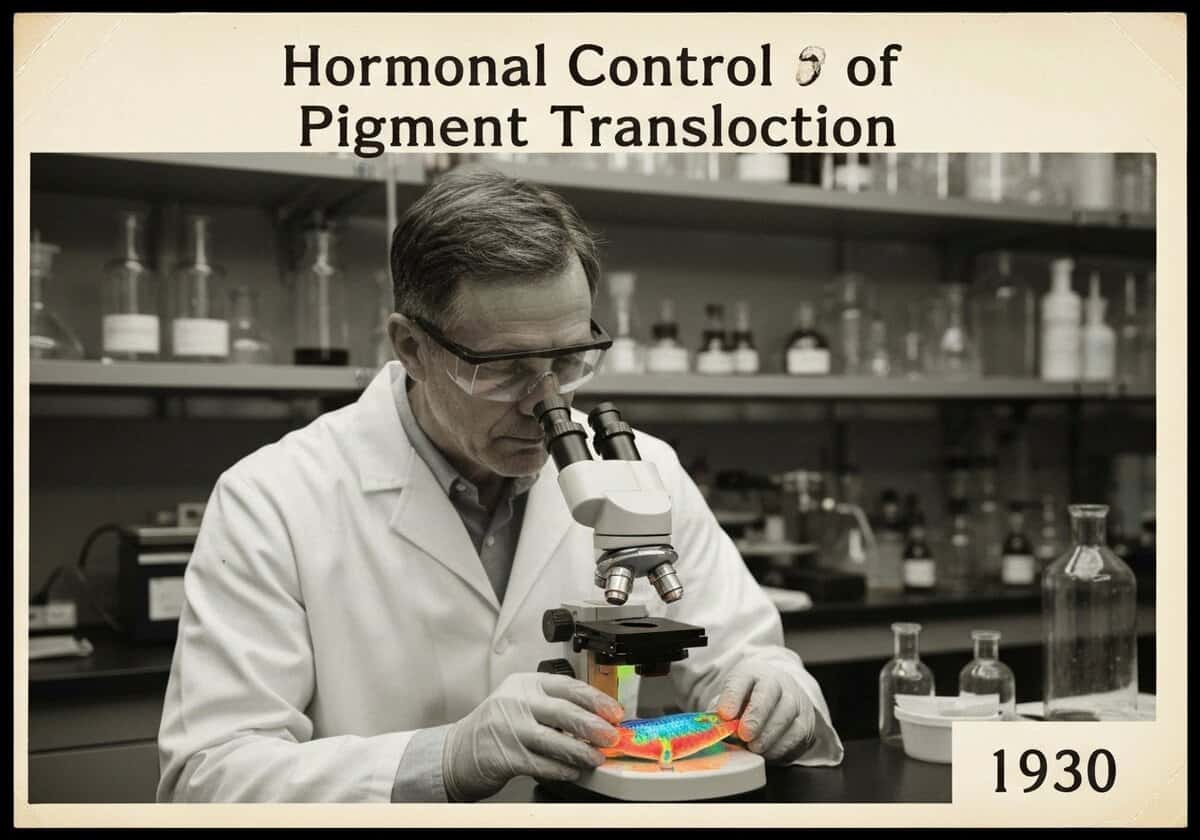
어류나 양서류와 같은 많은 변온 척추동물에서 색깔 변화는 호르몬에 의해 조절되는 느린 생리적 과정입니다. 색소 세포 내의 색소 과립은 미세소관 세포골격을 따라 이동합니다. 멜라닌세포 자극 호르몬(MSH)과 같은 호르몬은 색소 분산(어두워짐)을 유발하는 반면, 멜라토닌이나 멜라닌세포 농축 호르몬(MCH)은 색소 응집(밝아짐)을 유발하여 동물의 색깔이 수분에서 수시간에 걸쳐 주변 환경에 적응하게 합니다.

(설명을 위한 생성된 이미지입니다)
어류나 양서류와 같은 많은 변온 척추동물에서 색깔 변화는 호르몬에 의해 조절되는 느린 생리적 과정입니다. 색소 세포 내의 색소 과립은 미세소관 세포골격을 따라 이동합니다. 멜라닌세포 자극 호르몬(MSH)과 같은 호르몬은 색소 분산(어두워짐)을 유발하는 반면, 멜라토닌이나 멜라닌세포 농축 호르몬(MCH)은 색소 응집(밝아짐)을 유발하여 동물의 색깔이 수분에서 수시간에 걸쳐 주변 환경에 적응하게 합니다.
This mechanism, known as physiological color change, relies on the movement of pigment-containing organelles (melanosomes in melanophores) within the cell’s cytoplasm. The cell itself does not change shape. Instead, a complex network of cytoskeletal tracks, primarily microtubules, guides the transport of these organelles. Motor proteins, such as dynein and kinesin, act as the engines for this transport. Hormonal signals, received by G-protein coupled receptors on the chromatophore’s surface, initiate a signaling cascade. For example, melanocyte-stimulating hormone (MSH) binding leads to an increase in intracellular cyclic AMP (cAMP). Elevated cAMP activates protein kinase A (PKA), which in turn phosphorylates motor proteins, leading to the dispersion of pigment granules from the cell center to the periphery, thus darkening the skin. Conversely, melanocyte-concentrating hormone (MCH) or melatonin binding leads to a decrease in cAMP, causing the motor proteins to reverse direction and aggregate the pigments in the center of the cell, lightening the skin. This entire process is reversible and allows the animal to adapt its coloration to the background, light levels, or social signals, albeit on a much slower timescale (minutes to hours) compared to the neuromuscular control in cephalopods.
현재 하루 4만 건이 넘는 봇 트래픽을 차단하기 위해 이 콘텐츠는 커뮤니티 회원만 이용할 수 있습니다.
> 로그인 < 또는 >등록 < 이 콘텐츠를 비롯한 모든 제한된 콘텐츠와 도구는 (100% 무료로) 이용할 수 있습니다.
색소 이동의 호르몬 조절
(날짜를 알 수 없거나 관련이 없는 경우, 예를 들어 "유체역학"의 경우, 주목할 만한 등장 시기를 대략적으로 추정하여 제공합니다.)

고화질 이미지 및 다운로드는 등록된 회원에게만 100% 무료로 제공됩니다.
> 로그인 <