Product Design, Manufacturing & Innovation Resources
घर » रासायनिक विद्युतप्रेरक बल

रासायनिक विद्युतप्रेरक बल

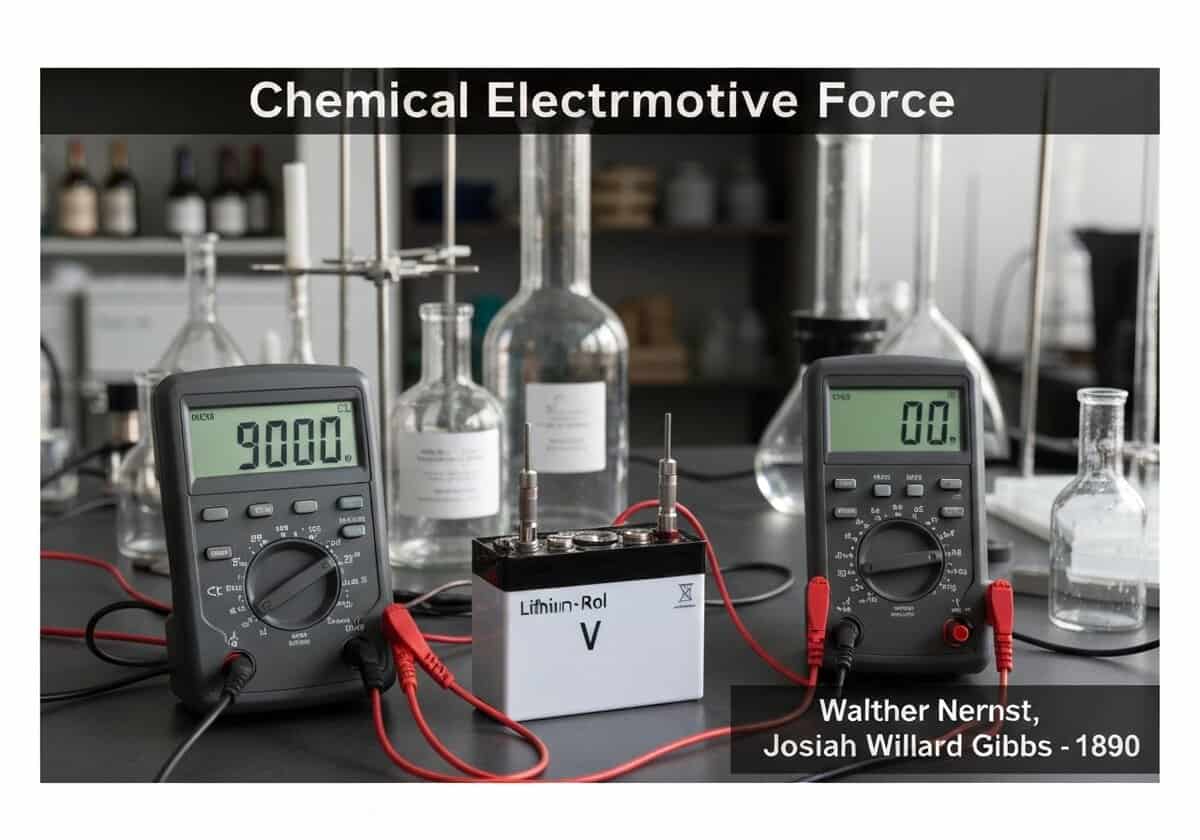
1890
  • Walther Nernst
  • Josiah Willard Gibbs
Lithium-ion battery testing in electrochemistry laboratory.

(यह छवि केवल उदाहरण के लिए बनाई गई है)

बैटरी और ईंधन सेल जैसी विद्युत रासायनिक कोशिकाओं में, ईएमएफ विद्युत आवेश (ईएमएफ) रासायनिक अभिक्रियाओं द्वारा उत्पन्न होता है। आवेश का पृथक्करण दो अलग-अलग इलेक्ट्रोडों पर होने वाली ऑक्सीकरण और अपचयन अभिक्रियाओं द्वारा संचालित होता है। किसी सेल का अधिकतम विद्युत आवेश (ईएमएफ) अभिक्रिया की गिब्स मुक्त ऊर्जा (ΔG) में परिवर्तन से इस प्रकार संबंधित है: [ΔG = -ΔG/nF}, जहाँ n इलेक्ट्रॉनों के मोल हैं और F फैराडे स्थिरांक है।


द वैद्युतवाहक बल in a chemical source arises from the potential energy difference of electrons in different chemical species. In a galvanic cell, two dissimilar metals (electrodes) are placed in an electrolyte, creating two half-cells. At one electrode (the anode), an oxidation reaction occurs, releasing electrons. At the other electrode (the cathode), a reduction reaction occurs, consuming electrons. This creates an electrical potential difference between the electrodes. The chemical reactions effectively act as a “charge pump,” doing work on the electrons to move them from a lower potential energy state to a higher one, thus establishing the EMF.

The theoretical maximum EMF is determined by the thermodynamics of the reaction, specifically the change in Gibbs free energy ([latex]\Delta G[/latex]), which represents the maximum non-expansion work that can be extracted from a thermodynamically closed system. The नर्न्स्ट equation further refines this by relating the EMF to the standard electrode potential and the concentrations (or activities) of the reactants and products, showing how the cell’s voltage changes as the reaction proceeds and concentrations vary. This thermodynamic basis is fundamental to designing batteries with specific voltage outputs and energy densities, and for understanding processes like electrolysis, where an external EMF is used to drive a non-spontaneous chemical reaction.

UNESCO Nomenclature: 2203
विद्युत रसायन विज्ञान

Type

रासायनिक प्रक्रिया

व्यवधान

क्रांतिकारी

उपयोग

व्यापक उपयोग

शगुन

  • लुइगी गैलवानी के मेंढक के पैरों पर किए गए प्रयोग
  • एलेसेंड्रो वोल्टा के आविष्कार वोल्टाइक ढेर
  • Michael Faraday’s laws of इलेक्ट्रोलीज़
  • जोशिया विलार्ड गिब्स द्वारा रासायनिक ऊष्मागतिकी का विकास

आवेदन

पेटेंट:

NA

संभावित नवाचार विचार

  • solid-state batteries using ceramic electrolytes for enhanced safety and energy density
  • तरल रासायनिक अभिकारकों का उपयोग करके ग्रिड-स्तरीय भंडारण के लिए प्रवाह बैटरी
  • शरीर के तरल पदार्थों से प्राप्त ग्लूकोज पर चलने वाले जैव-अनुकूल ईंधन सेल
  • फोटोइलेक्ट्रोकेमिकल सेल जो सूर्य के प्रकाश का उपयोग करके पानी को हाइड्रोजन और ऑक्सीजन में विभाजित करते हैं
  • सेल्फ-हीलिंग इलेक्ट्रोड वाली बैटरियां, जो बैटरी के जीवनकाल को काफी बढ़ा देती हैं।
  • अत्यंत उच्च सैद्धांतिक ऊर्जा घनत्व वाली धातु-वायु बैटरियां
  • printed, flexible batteries for पहनने योग्य इलेक्ट्रानिक्स
  • वाहनों या विमानों के चेसिस में एकीकृत संरचनात्मक बैटरियां
Related to: electrochemistry, battery, galvanic cell, Gibbs free energy, Nernst equation, electrode, electrolyte, redox reaction.

ऐतिहासिक संदर्भ

रासायनिक विद्युतप्रेरक बल

1885
1887
1889
1890
1890
1895
1895
1884
1887
1888
1889
1890
1890
1895
1895

(यदि तिथि अज्ञात है या प्रासंगिक नहीं है, उदाहरण के लिए "द्रव यांत्रिकी", तो इसके उल्लेखनीय उद्भव का एक अनुमानित आंकड़ा प्रदान किया गया है)

नवीनतम परिवर्धन

शीर्ष पोस्ट और लेख

शीर्ष मूल उपकरण

10वां वर्ष सालगिरह

पंजीकृत सदस्यों के लिए पूर्ण आकार की छवियाँ और डाउनलोड 100% निःशुल्क उपलब्ध हैं।