Product Design, Manufacturing & Innovation Resources
집 » 렌츠의 법칙

렌츠의 법칙

1834
  • Heinrich Lenz
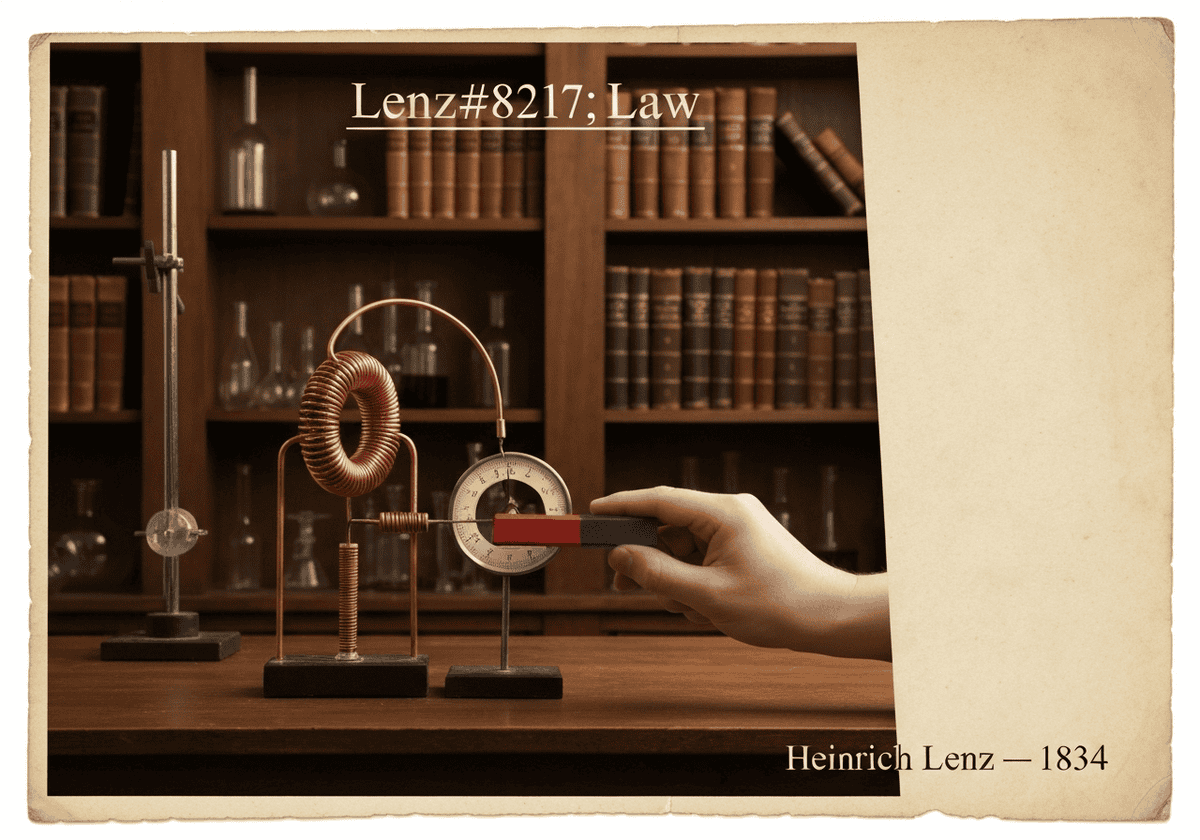
Laboratory setup demonstrating Lenz's Law with copper coil and galvanometer.

(설명을 위한 생성된 이미지입니다)

Lenz’s law provides the direction of the induced electromotive force (EMF) and current resulting from electromagnetic induction. It states that the induced current will flow in a direction that creates a magnetic field opposing the change in magnetic flux that produced it. This principle is a consequence of the conservation of energy and is represented by the negative sign in Faraday’s law.
Lenz’s law is a crucial qualitative rule that complements Faraday’s law of induction by specifying the direction of the induced current. While Faraday’s law quantifies the magnitude of the induced EMF ([latex]\mathcal{E} = -\frac{d\Phi_B}{dt}[/latex]), the negative sign embodies Lenz’s law. The law is fundamentally a statement about 에너지 절약 in electromagnetic systems. If the induced current were to flow in a direction that reinforced the change in flux, it would create a larger change in flux, which would induce an even larger current, leading to a runaway process that generates infinite energy from nothing, violating the principle of 에너지 보존.

Instead, the induced current generates its own magnetic field that counteracts the initial change. For example, if the north pole of a magnet is moved towards a conducting loop, the magnetic flux through the loop increases. To oppose this increase, the induced current will flow in a direction that makes the loop’s face act like a north pole, repelling the incoming magnet. This requires work to be done to push the magnet against the repulsive force, and this mechanical work is converted into the electrical energy of the induced current.

Conversely, if the north pole is moved away from the loop, the flux decreases. The induced current will now flow in the opposite direction, creating a south pole on the loop’s face to attract the receding magnet, opposing its departure. This principle is elegantly applied in eddy current brakes, where a rotating metal disc moving through a magnetic field has circular eddy currents induced within it. These currents create magnetic fields that oppose the rotation, generating a smooth, contactless braking force that converts kinetic energy into heat within the disc.

UNESCO Nomenclature: 2205
전자기학

유형

물리적 원리

분열

상당한

용법

널리 사용됨

전구체

  • 마이클 패러데이의 전자기 유도 발견(1831)
  • 에너지 보존의 원리
  • 전류에 의해 생성되는 자기장에 대한 이해 (앙페르 법칙)

응용 프로그램

  • 와전류 브레이크
  • 인덕션 쿡탑
  • metal detectors
  • 감광저울의 감쇠 메커니즘
  • 누전 차단기(GFCI)
  • 심장 박동 조절기(감지용)
  • 하이브리드 차량의 회생 제동

특허:

NA

잠재적 혁신 아이디어

  • self-regulating thermal switches where induced currents generate heat to oppose a temperature-driven magnetic change
  • passive magnetic levitation systems for transport that are inherently stable due to opposing fields
  • haptic feedback gloves that use induced eddy currents to create resistance sensations
  • silent, frictionless door-closing mechanisms based on eddy current damping
  • fail-safe elevator braking systems that activate automatically during power loss
  • energy-harvesting shock absorbers for vehicles
  • contactless stirring devices for molten metals in industrial processes
  • self-orienting 태양광 panels that use induced currents to track the sun’s movement
관련 개념: 렌츠의 법칙, 전자기 유도, 유도 전류, 자기 선속, 에너지 보존 법칙, 오른손 법칙, 와전류, 역기전력.

역사적 맥락

렌츠의 법칙

1831
1831
1832
1834
1835
1838
1841
1829
1831
1831
1833
1834
1836
1839-01-01
1842

(날짜를 알 수 없거나 관련이 없는 경우, 예를 들어 "유체역학"의 경우, 주목할 만한 등장 시기를 대략적으로 추정하여 제공합니다.)

10년차 기념일

고화질 이미지 및 다운로드는 등록된 회원에게만 100% 무료로 제공됩니다.

> 로그인 <