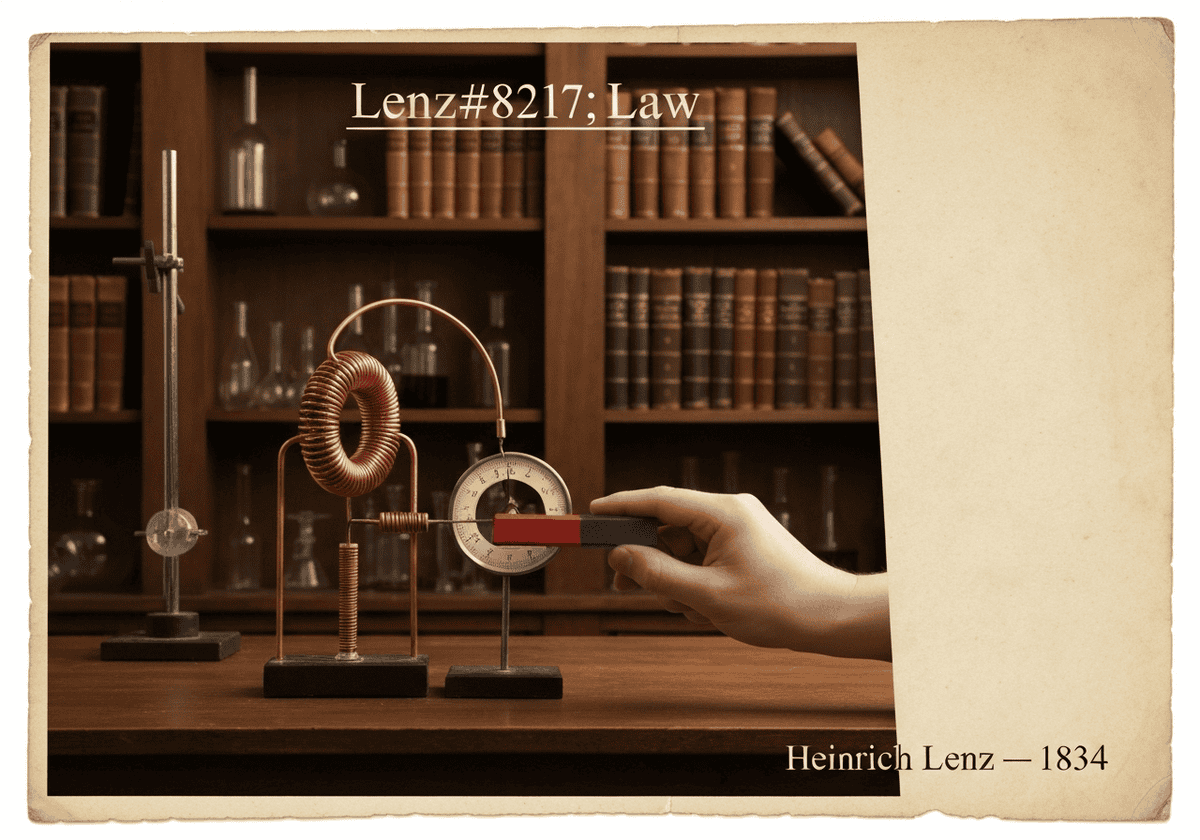
伦茨定律提供了感应电流的方向 电动势 (电磁感应产生的电磁场(EMF)和电流。它指出,感应电流的流动方向会产生一个与产生感应电流的磁通量变化相反的磁场。这一原理是 能量守恒 并在法拉第定律中用负号表示。

(图片仅供参考)
伦茨定律提供了感应电流的方向 电动势 (电磁感应产生的电磁场(EMF)和电流。它指出,感应电流的流动方向会产生一个与产生感应电流的磁通量变化相反的磁场。这一原理是 能量守恒 并在法拉第定律中用负号表示。
伦兹定律是一个重要的定性规则,它通过指定感应电流的方向来补充法拉第感应定律。法拉第定律量化了感应电磁场的大小([latex]\mathcal{E} = -\frac{d\Phi_B}{dt}[/latex]),而负号则体现了伦兹定律。该定律从根本上说是关于 节能 在电磁系统中。如果感应电流的流动方向加强了磁通量的变化,就会产生更大的磁通量变化,从而感应出更大的电流,导致失控过程,从无到有产生无限能量,违反能量守恒原理。
Instead, the induced current generates its own magnetic field that counteracts the initial change. For example, if the north pole of a magnet is moved towards a conducting loop, the magnetic flux through the loop increases. To oppose this increase, the induced current will flow in a direction that makes the loop’s face act like a north pole, repelling the incoming magnet. This requires work to be done to push the magnet against the repulsive force, and this mechanical work is converted into the electrical energy of the induced current.
Conversely, if the north pole is moved away from the loop, the flux decreases. The induced current will now flow in the opposite direction, creating a south pole on the loop’s face to attract the receding magnet, opposing its departure. This principle is elegantly applied in 涡流 brakes, where a rotating metal disc moving through a magnetic field has circular eddy currents induced within it. These currents create magnetic fields that oppose the rotation, generating a smooth, contactless braking force that converts kinetic energy into heat within the disc.
伦茨定律
(如果日期未知或不相关,例如“流体力学”,则提供其显著出现的近似估计)
只有注册会员才能免费获得 100% 的全尺寸图片和下载。.
> 登录 <