これらは連続体における運動を記述する2つの方法です。 力学:
- の ラグランジアン 仕様は個々の材料粒子を追跡し、交通渋滞の中の特定の車を監視するように、時間の経過に伴うその特性を追跡します。
- オイラー的な仕様は、空間内の固定点に焦点を当て、交通監視カメラが固定された交差点を観測するように、それらの点を通過する粒子の特性(速度、密度)を観測する。
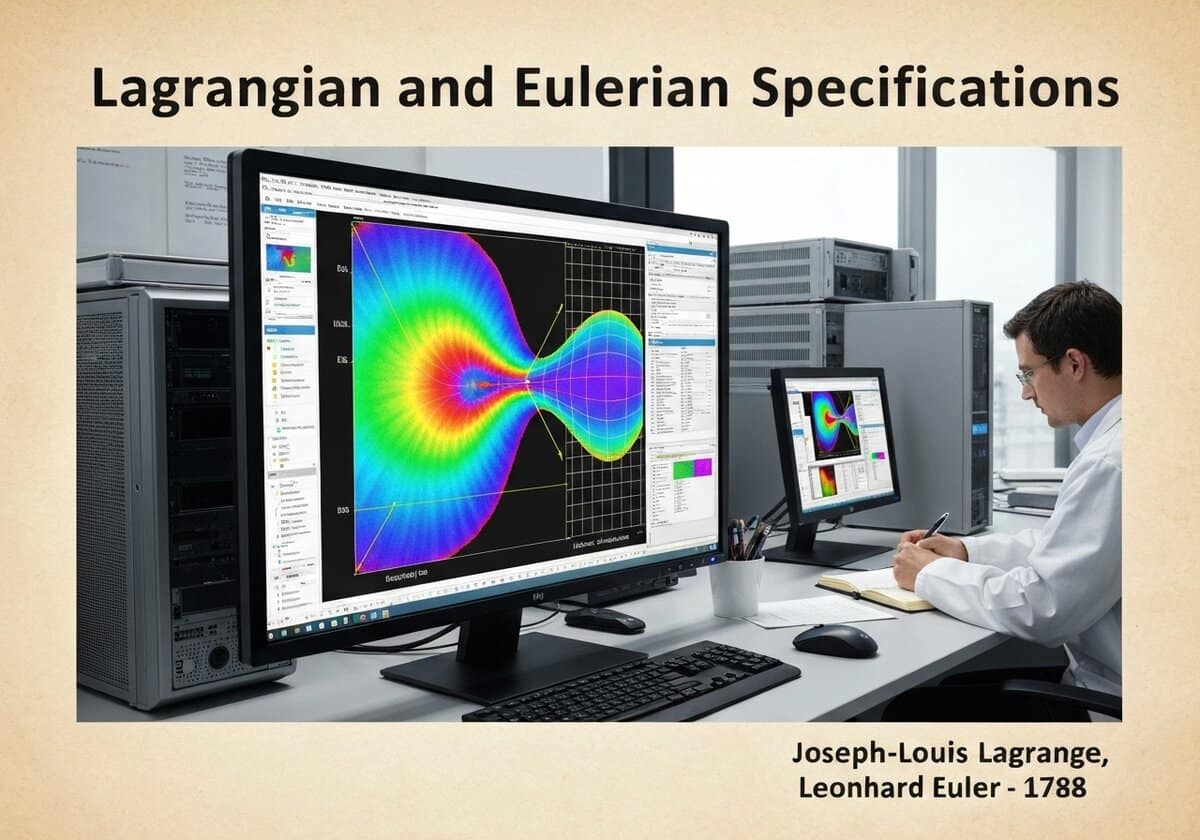
(画像はイメージです)
これらは連続体における運動を記述する2つの方法です。 力学:
では ラグランジアン description, the motion of a continuum is described by tracking the path of each individual particle. The position of a particle [latex]\mathbf{X}[/latex] in the initial configuration (at time [latex]t_0[/latex]) is used as its label. Its position at a later time [latex]t[/latex] is given by a function [latex]\mathbf{x} = \boldsymbol{\chi}(\mathbf{X}, t)[/latex]. Physical properties like velocity and acceleration are then calculated by taking time derivatives of this function while keeping [latex]\mathbf{X}[/latex] constant. This approach is intuitive as it mirrors how we observe individual objects. It is the natural framework for solid mechanics, where material points are tracked as the body deforms.
一方、オイラー的な記述では、空間内の固定位置で何が起こるかに焦点を当てます。粒子を追跡する代わりに、各物理量について、位置 [latex]mathbf{x}[/latex] と時間 [latex]t[/latex] の関数として場を定義します。たとえば、速度場は [latex]mathbf{v} = mathbf{v}(mathbf{x}, t)[/latex] で与えられ、これは時間 [latex]t[/latex] に点 [latex]mathbf{x}[/latex] にある粒子の速度を表します。この視点は、一般的に流体力学においてより便利です。オイラー座標系における流体粒子の加速度は、物質微分 [latex]Dmathbf{v}/Dt = partial mathbf{v}/partial t + (mathbf{v} cdot nabla)mathbf{v}[/latex] で表され、これはある点における局所的な加速度と、粒子が異なる速度で新しい場所に移動することによって生じる対流加速度の両方を含みます。
ラグランジュ的およびオイラー的仕様(流体)
(日付が不明または関連性がない場合、例えば「流体力学」などでは、その注目すべき出現時期の概算値が提示されます。)
フルサイズの画像とダウンロードは、登録会員のみが100%無料で利用できます。
> ログイン <