이는 연속체 내에서의 운동을 설명하는 두 가지 방법입니다. 역학:
- 그만큼 라그랑지안 사양은 개별 재료 입자를 추적하여 시간이 지남에 따라 그 속성을 관찰하는 것과 같습니다. 마치 교통 체증 속에서 특정 차량을 지켜보는 것과 같습니다.
- 오일러식 표현은 공간상의 고정된 지점에 초점을 맞추고, 마치 고정된 교차로를 관찰하는 교통 카메라처럼 해당 지점을 통과하는 입자의 속성(속도, 밀도)을 관찰합니다.
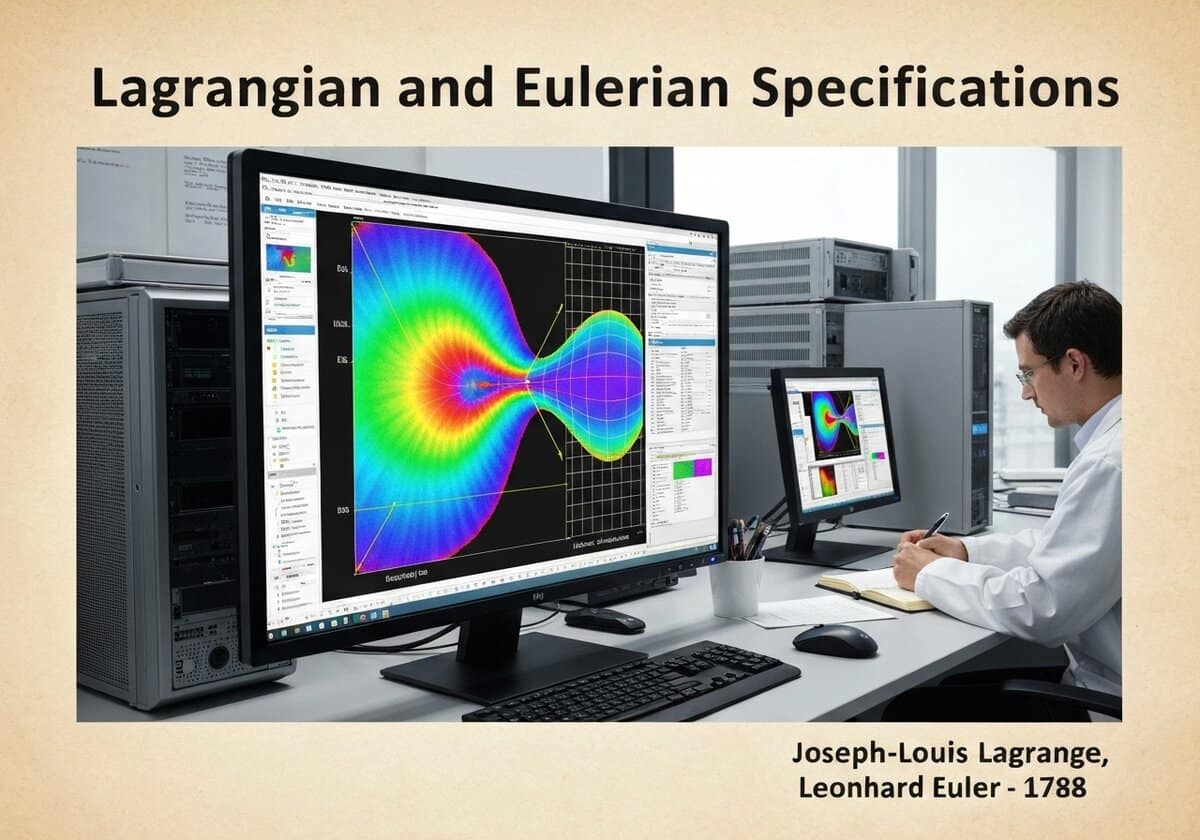
(설명을 위한 생성된 이미지입니다)
이는 연속체 내에서의 운동을 설명하는 두 가지 방법입니다. 역학:
그 안에서 라그랑지안 description, the motion of a continuum is described by tracking the path of each individual particle. The position of a particle [latex]\mathbf{X}[/latex] in the initial configuration (at time [latex]t_0[/latex]) is used as its label. Its position at a later time [latex]t[/latex] is given by a function [latex]\mathbf{x} = \boldsymbol{\chi}(\mathbf{X}, t)[/latex]. Physical properties like velocity and acceleration are then calculated by taking time derivatives of this function while keeping [latex]\mathbf{X}[/latex] constant. This approach is intuitive as it mirrors how we observe individual objects. It is the natural framework for solid mechanics, where material points are tracked as the body deforms.
반대로 오일러식 설명은 공간상의 고정된 위치에서 일어나는 현상에 초점을 맞춥니다. 입자의 움직임을 추적하는 대신, 각 물리적 속성에 대해 위치 [latex]와 시간 [latex]t[/latex]의 함수로 장을 정의합니다. 예를 들어, 속도장은 [latex]mathbf{v} = mathbf{v}(mathbf{x}, t)[/latex]로 주어지는데, 이는 시간 [latex]t[/latex]에 위치하는 입자의 속도를 나타냅니다. 이러한 관점은 일반적으로 유체 역학에 더 편리합니다. 오일러 좌표계에서 유체 입자의 가속도는 물질 미분 [latex]Dmathbf{v}/Dt = partial mathbf{v}/partial t + (mathbf{v} cdot nabla)mathbf{v}[/latex]로 기술되며, 이는 한 지점에서의 국소 가속도와 입자가 다른 속도로 새로운 위치로 이동함에 따른 대류 가속도를 모두 포함합니다.
라그랑주 및 오일러 사양(유체)
(날짜를 알 수 없거나 관련이 없는 경우, 예를 들어 "유체역학"의 경우, 주목할 만한 등장 시기를 대략적으로 추정하여 제공합니다.)
고화질 이미지 및 다운로드는 등록된 회원에게만 100% 무료로 제공됩니다.
> 로그인 <