Product Design, Manufacturing & Innovation Resources
بيت » ميكانيكا المواد الصلبة

ميكانيكا المواد الصلبة

1800
  • Galileo Galilei
  • Robert Hooke
  • Augustin-Louis Cauchy
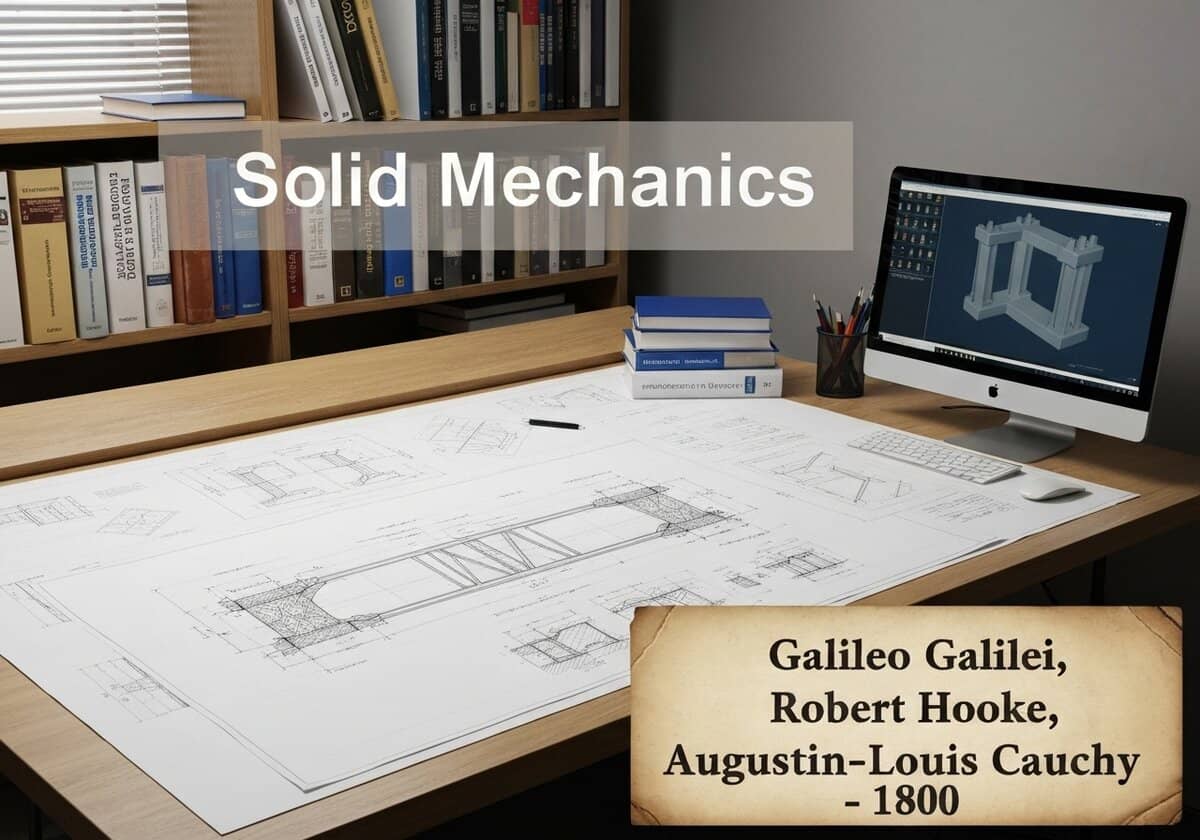
Drafting table with bridge blueprints and solid mechanics textbooks in an engineering office.

(صورة توضيحية فقط)

Solid الميكانيكا is a branch of continuum mechanics that studies the behavior of solid materials, especially their motion and deformation under the action of forces, temperature changes, or other external loads. It is fundamental to engineering for the design and analysis of structures. Key areas include elasticity (recoverable deformation), plasticity (permanent deformation), and fracture mechanics (crack initiation and propagation).
Solid mechanics provides the theoretical framework for understanding how solid objects respond to stimuli. A central concept is the relationship between stress (internal forces per unit area) and strain (relative deformation). For many materials under small loads, this relationship is linear and described by Hooke’s Law, [latex]\sigma = E \epsilon[/latex], where [latex]\sigma[/latex] is stress, [latex]\epsilon[/latex] is strain, and [latex]E[/latex] is the Young’s modulus, a measure of stiffness. In three dimensions, these quantities are represented by tensors, the stress tensor and the strain tensor, which capture the state of stress and deformation at any point within the body.

The field is broadly divided into statics, which deals with bodies at rest or in equilibrium, and dynamics, which studies bodies in motion and includes phenomena like vibrations and wave propagation. When loads exceed a material’s elastic limit, it enters the plastic regime, where permanent deformation occurs. Solid mechanics provides theories to predict the onset of this yielding, using criteria like the von Mises or Tresca yield criteria. Furthermore, fracture mechanics, a subfield, analyzes the behavior of materials containing cracks. It aims to predict crack growth and prevent catastrophic failure in structures. These principles are applied computationally using methods like the Finite Element Method (FEM) to solve complex real-world engineering problems that would be intractable to solve analytically.

UNESCO Nomenclature: 2210
الميكانيكا

يكتب

نظام مجرد

خلل

أساسيات

الاستخدام

استخدام واسع النطاق

مقدمات

  • افتراض ميكانيكا الاستمرارية
  • Newton’s laws of motion
  • تطوير حساب التفاضل والتكامل
  • العمل التجريبي على خصائص المواد من قبل شخصيات مثل روبرت هوك

التطبيقات

  • الهندسة الإنشائية (الجسور والمباني والسدود)
  • التصميم الميكانيكي (أجزاء المحرك، هياكل الآلة، معدات الهبوط)
  • علم المواد (توصيف السبائك والمركبات الجديدة)
  • الجيوميكانيكا (تحليل حركة الصفائح التكتونية والانهيارات الأرضية)
  • الميكانيكا الحيوية (نمذجة العظام والأنسجة)

براءات الاختراع:

NA

أفكار ابتكارية محتملة

  • 4d printed structures that self-assemble or change shape over time in response to environmental stimuli
  • واجهات المباني المتكيفة التي تغير صلابتها ديناميكيًا للاستجابة لأحمال الرياح
  • عظام اصطناعية تحاكي الكائنات الحية مع هياكل شبكية داخلية مُحسّنة للقوة وخفة الوزن
  • أنظمة مراقبة الصحة الهيكلية في الوقت الفعلي للجسور باستخدام أجهزة استشعار الضغط المضمنة
  • مواد مركبة من الجيل التالي لصناعات الطيران والفضاء ذات قدرات الشفاء الذاتي
  • أنظمة تخفيف الاهتزازات لمعدات التصنيع عالية الدقة
  • geomechanical models for carbon sequestration to ensure long-term stability of underground storage
  • الروبوتات الناعمة ذات الأجسام التي تتشوه وتتحرك مثل الكائنات الحية
Related to: solid mechanics, stress, strain, elasticity, plasticity, deformation, structural analysis, hooke’s law.

السياق التاريخي

ميكانيكا المواد الصلبة

1750
1757
1788
1800
1800
1800
1800
1738
1750
1785
1788
1800
1800
1800
1800

(إذا كان التاريخ غير معروف أو غير ذي صلة، على سبيل المثال "ميكانيكا الموائع"، يتم توفير تقدير تقريبي لظهوره الملحوظ)

أحدث الإضافات

أهم المنشورات والمقالات

أفضل الأدوات الأصلية

السنة العاشرة عيد

الصور والتنزيلات بالحجم الكامل متاحة فقط، ومجانية تمامًا، للأعضاء المسجلين.