Product Design, Manufacturing & Innovation Resources
家 » 拉格朗日和欧拉规范(流体)

拉格朗日和欧拉规范(流体)

1788
  • Joseph-Louis Lagrange
  • Leonhard Euler
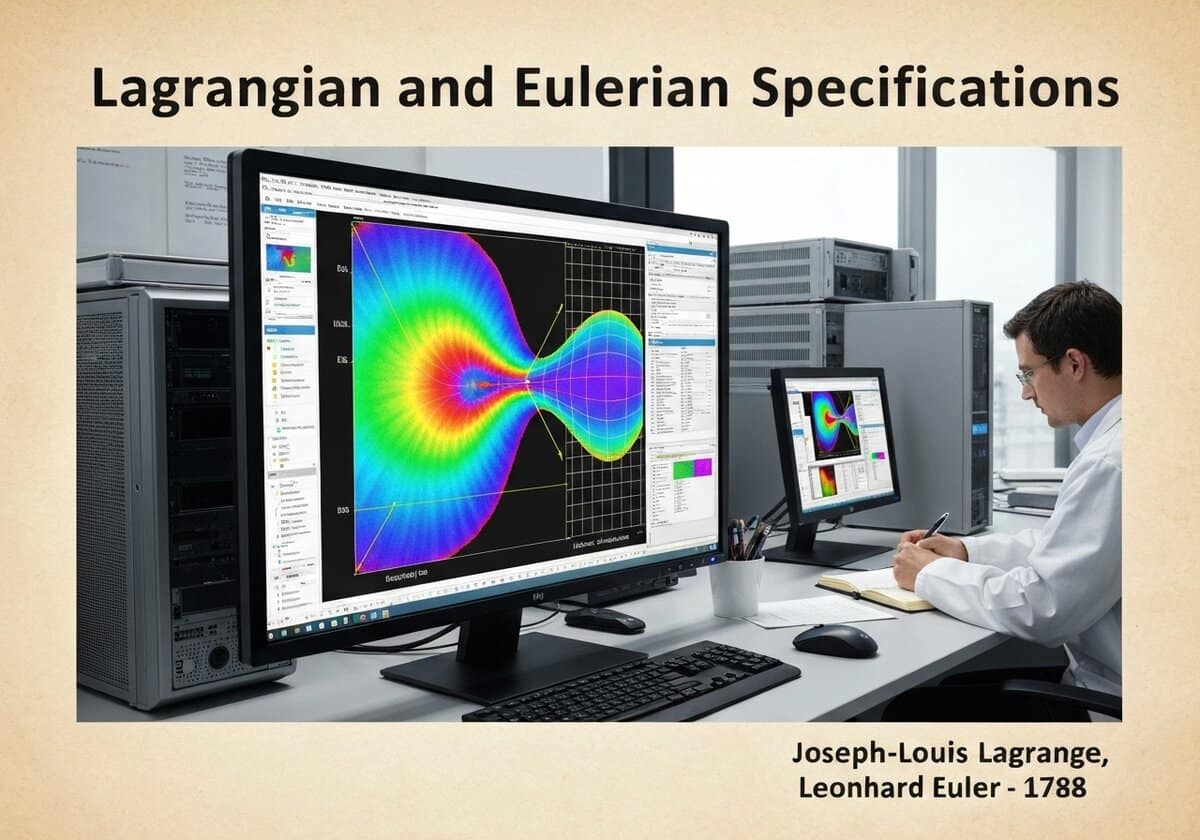
Computational fluid dynamics simulation illustrating Lagrangian and Eulerian specifications.

(图片仅供参考)

这是描述连续介质运动的两种方法。 力学:

  • 这 拉格朗日 技术规格会追踪单个材料颗粒的特性,就像观察交通中的特定车辆一样,长期跟踪它们的性能变化。
  • 欧拉规范关注空间中的固定点,观察通过这些点的任何粒子的属性(速度、密度),就像交通摄像头观察固定交叉路口一样。

在 拉格朗日 description, the motion of a continuum is described by tracking the path of each individual particle. The position of a particle [latex]\mathbf{X}[/latex] in the initial configuration (at time [latex]t_0[/latex]) is used as its label. Its position at a later time [latex]t[/latex] is given by a function [latex]\mathbf{x} = \boldsymbol{\chi}(\mathbf{X}, t)[/latex]. Physical properties like velocity and acceleration are then calculated by taking time derivatives of this function while keeping [latex]\mathbf{X}[/latex] constant. This approach is intuitive as it mirrors how we observe individual objects. It is the natural framework for solid mechanics, where material points are tracked as the body deforms.

Conversely, the Eulerian description focuses on what happens at fixed locations in space. Instead of tracking particles, we define a field for each physical property as a function of position [latex]\mathbf{x}[/latex] and time [latex]t[/latex]. For example, the velocity field is given by [latex]\mathbf{v} = \mathbf{v}(\mathbf{x}, t)[/latex], which represents the velocity of whichever particle happens to be at point [latex]\mathbf{x}[/latex] at time [latex]t[/latex]. This perspective is generally more convenient for fluid dynamics. The acceleration of a fluid particle in the Eulerian frame is described by the material derivative, [latex]D\mathbf{v}/Dt = \partial \mathbf{v}/\partial t + (\mathbf{v} \cdot \nabla)\mathbf{v}[/latex], which includes both the local acceleration at a point and the convective acceleration due to the particle moving to a new location with a different velocity.

UNESCO Nomenclature: 2209
– Fluid dynamics

类型

抽象系统

中断

Foundational

用法

广泛使用

前体

  • 牛顿力学
  • 变分法
  • 刚体运动学
  • Euler’s earlier work on fluid motion

应用程序

  • 计算流体动力学 (CFD) 求解器通常使用欧拉网格
  • solid mechanics and 有限元 analysis typically use a lagrangian description
  • 天气预报模型使用欧拉框架来描述固定位置的大气特性
  • 粒子追踪测速法(PTV)是一种拉格朗日测量技术

专利:

NA

潜在创新理念

  • 用于海洋喷雾等复杂多相流的混合拉格朗日-欧拉模拟模型
  • 可在框架之间动态切换以优化模拟性能的人工智能算法
  • 自主 无人机 swarms that use a lagrangian approach for individual navigation and an eulerian approach for group density control
  • 实时交通流优化系统使用混合模型来跟踪单个车辆并监控交叉路口密度
  • 个性化医疗模型,追踪血液欧拉流中的单个细胞路径(拉格朗日)
  • 先进的气候模型,使用拉格朗日粒子追踪欧拉大气网格内的污染物
  • 自组织机器人建造系统,其中单个机器人(拉格朗日)遵循全局设计场(欧拉)
  • 增强现实 displays for fluid dynamics experiments, visualizing both particle paths and field properties simultaneously
Related to: lagrangian, eulerian, flow field, material derivative, frame of reference, fluid dynamics, solid mechanics, kinematics.

历史背景

拉格朗日和欧拉规范(流体)

1738
1750
1757
1788
1800
1800
1800
1687
1738
1750
1785
1788
1800
1800
1800

(如果日期未知或不相关,例如“流体力学”,则提供其显著出现的近似估计)

第十年 周年纪念日

只有注册会员才能免费获取完整尺寸的图片和下载内容。

> 登录 <