Product Design, Manufacturing & Innovation Resources
家 » ベルヌーイの原理

ベルヌーイの原理

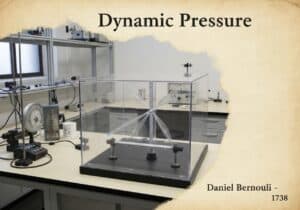
1738
  • Daniel Bernoulli
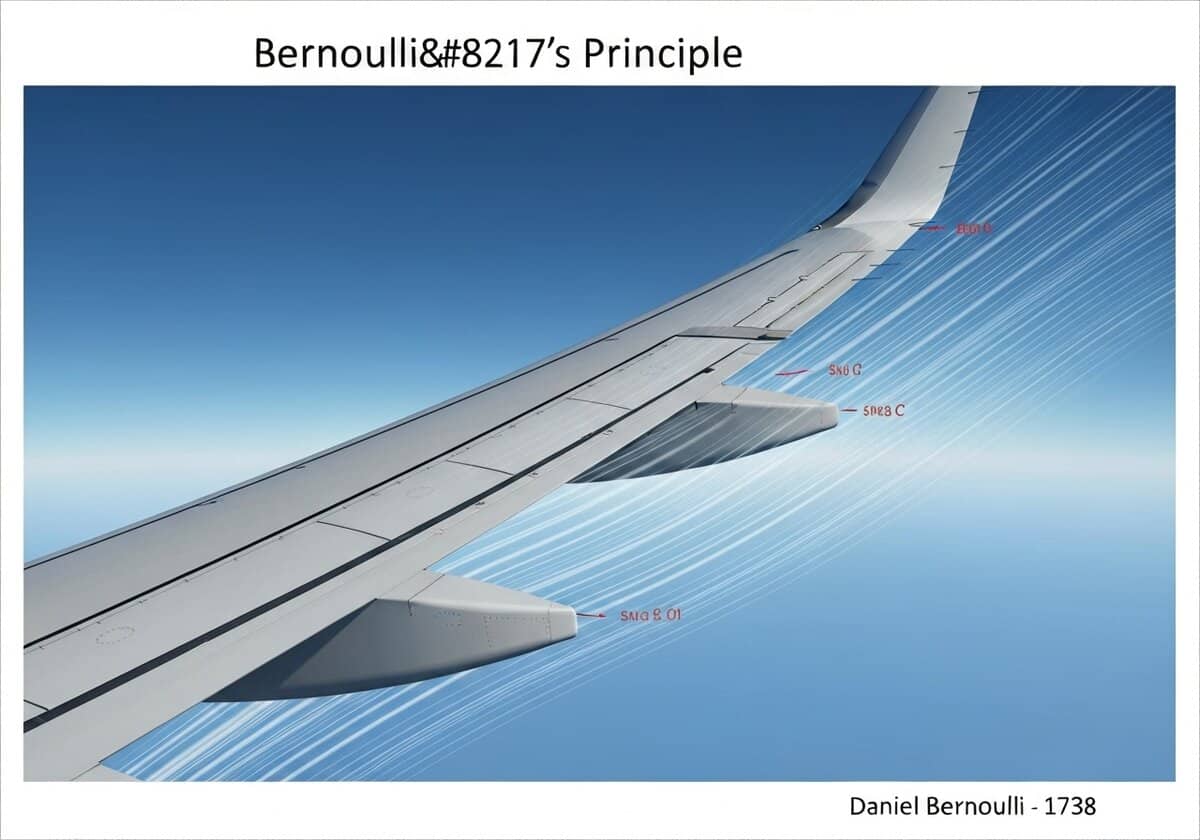
Aircraft wing demonstrating Bernoulli's principle in fluid mechanics for lift generation.

(画像はイメージです)

Bernoulli’s principle states that for an inviscid flow, an increase in a fluid’s speed occurs simultaneously with a decrease in pressure or a decrease in its potential energy. It is a statement of the conservation of energy for a moving fluid, commonly expressed as [latex]p + \frac{1}{2}\rho v^2 + \rho gh = \text{constant}[/latex] along a streamline.


Bernoulli’s principle is derived from the principle of エネルギー保存の法則 applied to an ideal fluid in motion. The equation’s three terms represent different forms of energy per unit volume. The term [latex]p[/latex] is the static pressure, representing the internal energy of the fluid. The term [latex]\frac{1}{2}\rho v^2[/latex] is the 動圧, which is the kinetic energy of the fluid in motion. The final term, [latex]\rho gh[/latex], is the 静水圧は、重力場 [latex]g[/latex]における流体の高さ [latex]h[/latex]による位置エネルギーを表します。この原理は、これら 3 つの項の合計が単一の流線に沿って一定に保たれると主張しています。

It is crucial to understand the assumptions under which Bernoulli’s principle is valid: the flow must be steady (velocity at a point does not change with time), incompressible (density is constant), and inviscid (no frictional forces from viscosity). These are significant limitations, meaning the principle is an idealization. In real-world applications, viscous effects can cause energy losses that are not accounted for in the basic equation.

While often used to provide a simplified explanation for aerodynamic lift—where air traveling faster over the curved upper surface of a wing creates lower pressure compared to the flatter bottom surface—this is an incomplete picture. A full explanation of lift also requires considering Newton’s third law and the deflection of air downwards (downwash). Nevertheless, Bernoulli’s principle provides a powerful and intuitive tool for a first-order analysis of many fluid dynamics phenomena, from measuring flow rates with a Venturi meter to understanding how a perfume atomizer works.

UNESCO Nomenclature: 2210
機械工学

タイプ

抽象システム

混乱

基礎

使用法

広く普及している

前駆物質

  • アイザック・ニュートンの運動法則
  • レオンハルト・オイラーの流体力学に関する研究
  • エネルギー保存の初期の概念
  • エヴァンジェリスタ・トリチェリとブレーズ・パスカルによる圧力の研究

アプリケーション

  • 航空機の翼の揚力発生(寄与要因として)
  • エンジンのキャブレター
  • 流量測定用ベンチュリ流量計
  • 噴霧器とスプレーガン
  • 対気速度を測定するためのピトー管

特許:

NA

潜在的なイノベーションのアイデア

  • self-adjusting building facades that minimize wind load during storms
  • high-efficiency 灌漑 systems that use venturi effects for fertilizer injection
  • passive air circulation systems for large habitats in space or underground
  • new types of musical instruments based on controlled air jets
  • bladeless エネルギーハーベスティング devices from low-speed water currents
  • micro-pumps for lab-on-a-chip devices with no moving parts
  • advanced fire suppression systems using high-speed mist atomizers
  • silent, high-speed hand dryers using pressure differential principles
関連:ベルヌーイの原理、流体力学、エネルギー保存則、圧力、速度、非粘性流、流線、空気力学。

歴史的背景

ベルヌーイの原理

1672
1687
1687
1738
1750
1757
1788
1650
1678
1687
1687
1738
1750
1785
1788

(日付が不明または関連性がない場合、例えば「流体力学」などでは、その注目すべき出現時期の概算値が提示されます。)

10年目 周年

フルサイズの画像とダウンロードは、登録会員のみが100%無料で利用できます。