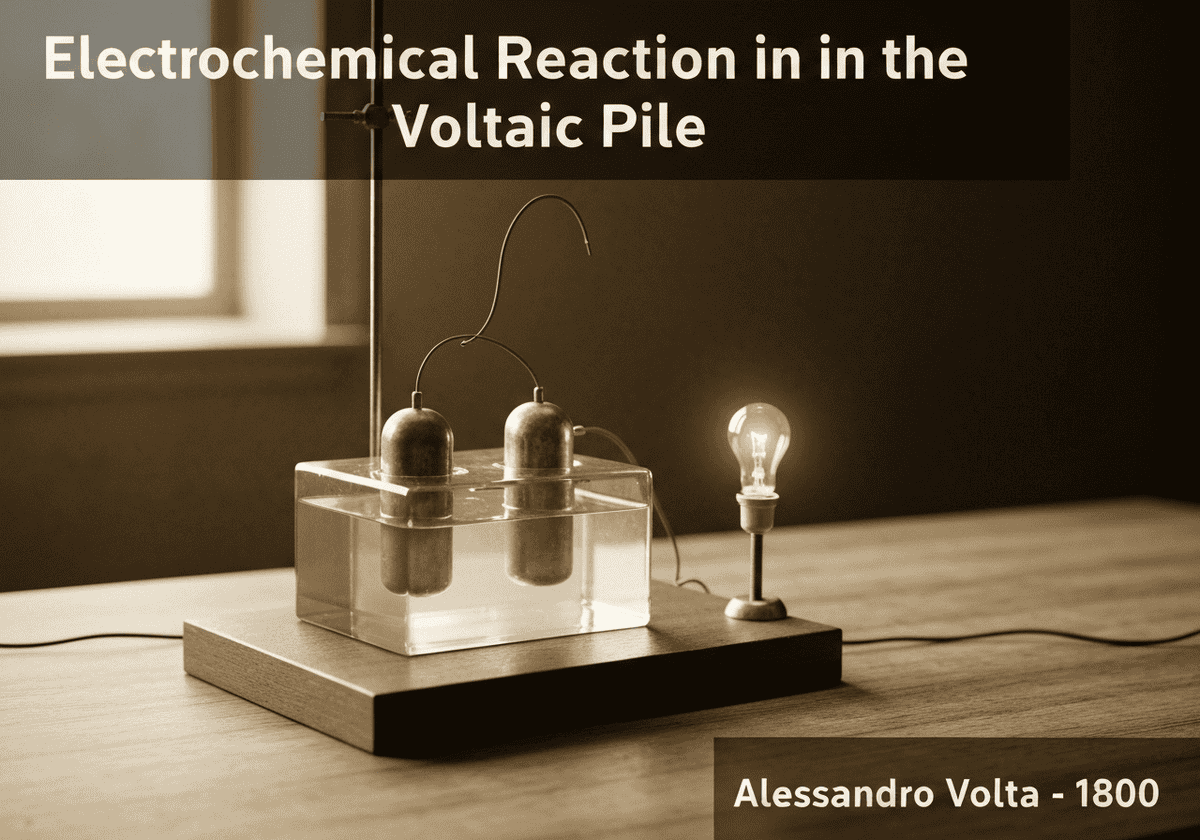
電流は Voltaic pile 酸化還元反応によって生成されます。亜鉛陽極では、亜鉛金属が酸化され、原子あたり2個の電子が放出されます([latex]Zn rightarrow Zn^{2+} + 2e^{-}[/latex])。これらの電子は外部回路を通って銅陰極に移動します。そこで、水溶液電解質からの水素イオンが還元され、水素ガスが生成されます([latex]2H^{+} + 2e^{-} rightarrow H_2[/latex])。


(画像はイメージです)
電流は Voltaic pile 酸化還元反応によって生成されます。亜鉛陽極では、亜鉛金属が酸化され、原子あたり2個の電子が放出されます([latex]Zn rightarrow Zn^{2+} + 2e^{-}[/latex])。これらの電子は外部回路を通って銅陰極に移動します。そこで、水溶液電解質からの水素イオンが還元され、水素ガスが生成されます([latex]2H^{+} + 2e^{-} rightarrow H_2[/latex])。

The operation of the Voltaic pile is governed by the principles of electrochemistry. Each metal has a different electrode potential, or tendency to lose electrons. Zinc is more reactive than copper, meaning it has a more negative electrode potential and is more easily oxidized. This difference in potential is what drives the flow of electrons from the zinc (anode) to the copper (cathode) through an external wire. The electrolyte’s role is crucial; it contains ions that can move between the electrodes to balance the charge, completing the electrical circuit. In a simple brine (NaCl) or acid (H2SO4) electrolyte, water molecules provide the hydrogen ions (H+) for the reaction at the cathode.
The overall reaction for a pile using a sulfuric acid electrolyte is [latex]Zn + 2H^{+} \rightarrow Zn^{2+} + H_2[/latex]. The copper itself does not chemically react; it serves as a noble, conductive surface for the reduction of hydrogen ions. The potential of a single zinc-copper cell is approximately 0.76 volts, though this can vary with the electrolyte concentration and temperature. This fundamental mechanism of converting stored chemical energy into electrical energy is the basis for all modern batteries, albeit with different materials and more sophisticated designs to improve efficiency and 長寿.
ボルタ電池における電気化学反応
(日付が不明または関連性がない場合、例えば「流体力学」などでは、その注目すべき出現時期の概算値が提示されます。)

フルサイズの画像とダウンロードは、登録会員のみが100%無料で利用できます。
> ログイン <