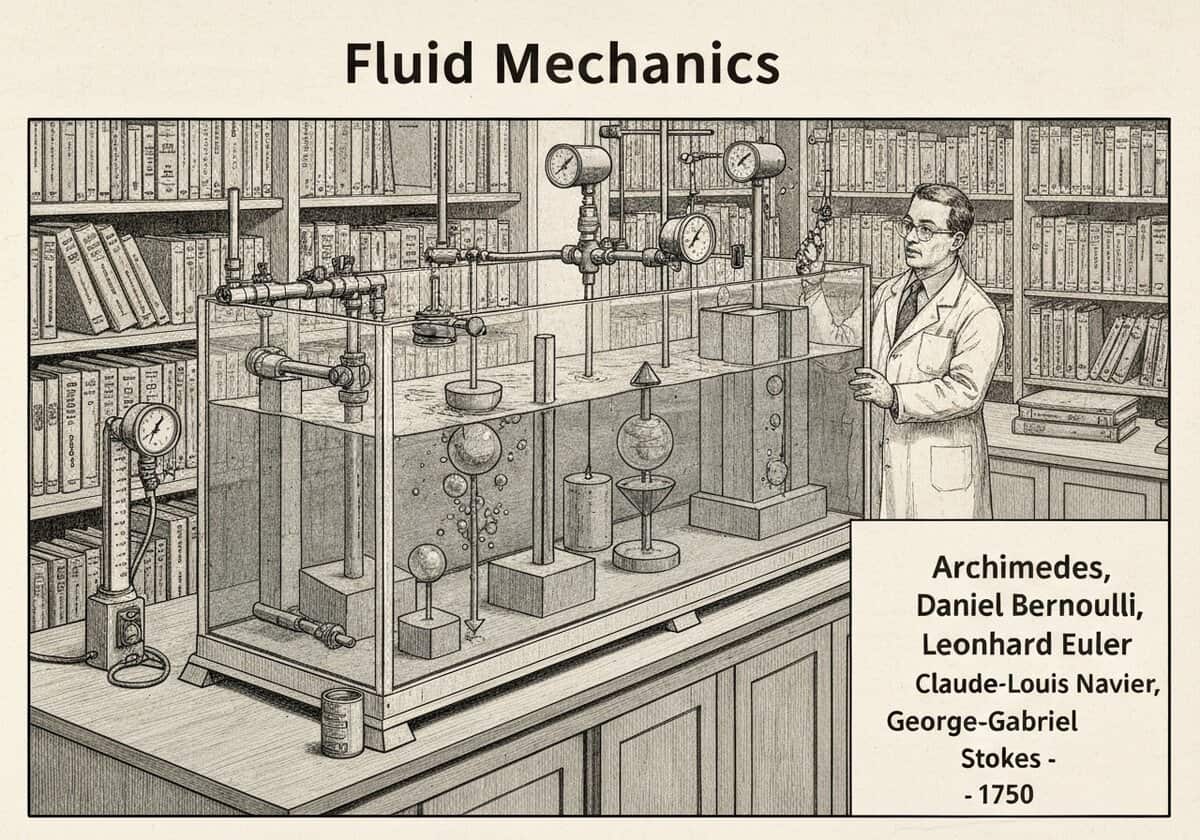
The governing equations of motion for a viscous fluid are the Navier-Stokes equations. These are a set of nonlinear partial differential equations that arise from applying Newton’s second law to fluid motion, combined with the assumption that fluid stress is the sum of a diffusing viscous term and a pressure term. For a compressible Newtonian fluid, the vector equation is: [latex]\rho(\frac{\partial \mathbf{v}}{\partial t} + \mathbf{v} \cdot \nabla \mathbf{v}) = -\nabla p + \nabla \cdot \mathbf{T} + \mathbf{f}[/latex], where [latex]\rho[/latex] is density, [latex]\mathbf{v}[/latex] is velocity, [latex]p[/latex] is pressure, [latex]\mathbf{T}[/latex] is the stress tensor, and [latex]\mathbf{f}[/latex] represents body forces. Solving these equations is a central challenge in the field.