Product Design, Manufacturing & Innovation Resources
家 » マイスナー効果

マイスナー効果

1933
  • Walther Meissner
  • Robert Ochsenfeld
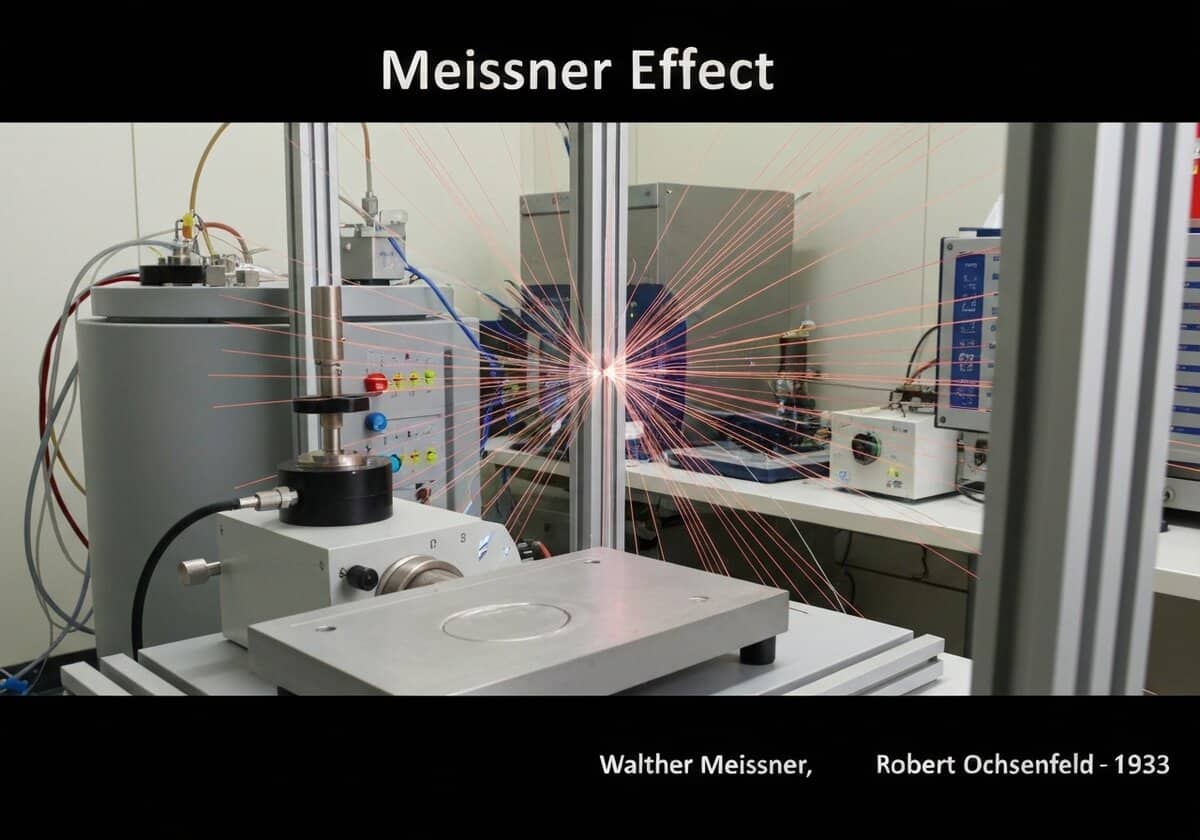
Superconductor in laboratory demonstrating Meissner effect in solid state physics.

(画像はイメージです)

Discovered in 1933 by Walther Meissner and Robert Ochsenfeld, the Meissner effect is the expulsion of a magnetic field from a superconductor during its transition to the superconducting state. When a material is cooled below its critical temperature ([latex]T_c[/latex]) in the presence of a weak external magnetic field, it actively cancels all magnetic flux inside it, becoming a perfect diamagnet.


The Meissner effect is a defining characteristic of superconductivity, distinguishing it from a hypothetical perfect conductor. A perfect conductor, according to Lenz’s law, would trap any existing magnetic field inside it as it cools, because changing the flux would induce currents to oppose the change. In contrast, a superconductor actively expels the field. This expulsion is achieved by the generation of screening currents on the surface of the material. These currents create a magnetic field that perfectly cancels the external field within the bulk of the superconductor. The magnetic field penetrates only a small distance into the surface, known as the London penetration depth ([latex]\lambda[/latex]). This discovery was crucial because it showed that superconductivity is a true thermodynamic phase transition, not just a case of infinite conductivity. It provided a key piece of the puzzle that any microscopic theory of superconductivity would have to explain. The effect is the basis for the dramatic levitation demonstrations where a magnet floats above a high-temperature superconductor cooled with liquid nitrogen. The expulsion of the magnet’s field by the superconductor creates a repulsive force strong enough to counteract gravity.

マイスナー効果は、印加磁場が強すぎると破綻します。タイプI超伝導体では、臨界磁場[latex]H_c[/latex]を超えると超伝導が突然破壊されます。タイプII超伝導体では、下限臨界磁場[latex]H_{c1}[/latex]を超えると、量子化された磁束渦の形で磁場が物質に浸透し始めますが、物質ははるかに高い上限臨界磁場[latex]H_{c2}[/latex]に達するまで超伝導状態を維持します。

UNESCO Nomenclature: 2211
固体物理学

タイプ

物理的資産

混乱

基礎

使用法

広く普及している

前駆物質

  • 超伝導の発見(1911年)
  • マクスウェルの電磁気学方程式
  • レンツの法則
  • 反磁性の理解

アプリケーション

  • 磁気浮上式鉄道(マグレブ)
  • 超伝導磁気軸受
  • 超伝導材料の診断
  • 量子現象の実証

特許:

NA

潜在的なイノベーションのアイデア

  • frictionless high-speed transportation systems in vacuum tubes
  • self-assembling structures using programmable magnetic fields and superconductors
  • active shielding for sensitive electronics against electromagnetic interference
  • contactless manipulation of objects in manufacturing and medicine
  • hoverboards using high-temperature superconductors
  • stabilization systems for floating architecture
  • haptic feedback devices creating levitating tactile shapes
  • waste 並べ替え systems using magnetic levitation to separate materials
  • silent, frictionless pumps for corrosive or sensitive fluids
  • gyroscopes with levitating rotors for ultra-precise navigation
Related to: Meissner effect, superconductivity, diamagnetism, magnetic field expulsion, London penetration depth, critical temperature, Type I superconductor, screening currents, magnetic levitation, phase transition.

歴史的背景

マイスナー効果

1930
1931
1932
1933
1937
1940
1947
1930
1930
1931
1932
1936-01-01
1938
1940
1950

(日付が不明または関連性がない場合、例えば「流体力学」などでは、その注目すべき出現時期の概算値が提示されます。)

10年目 周年

フルサイズの画像とダウンロードは、登録会員のみが100%無料で利用できます。