Product Design, Manufacturing & Innovation Resources
집 » 마이스너 효과

마이스너 효과

1933
  • Walther Meissner
  • Robert Ochsenfeld
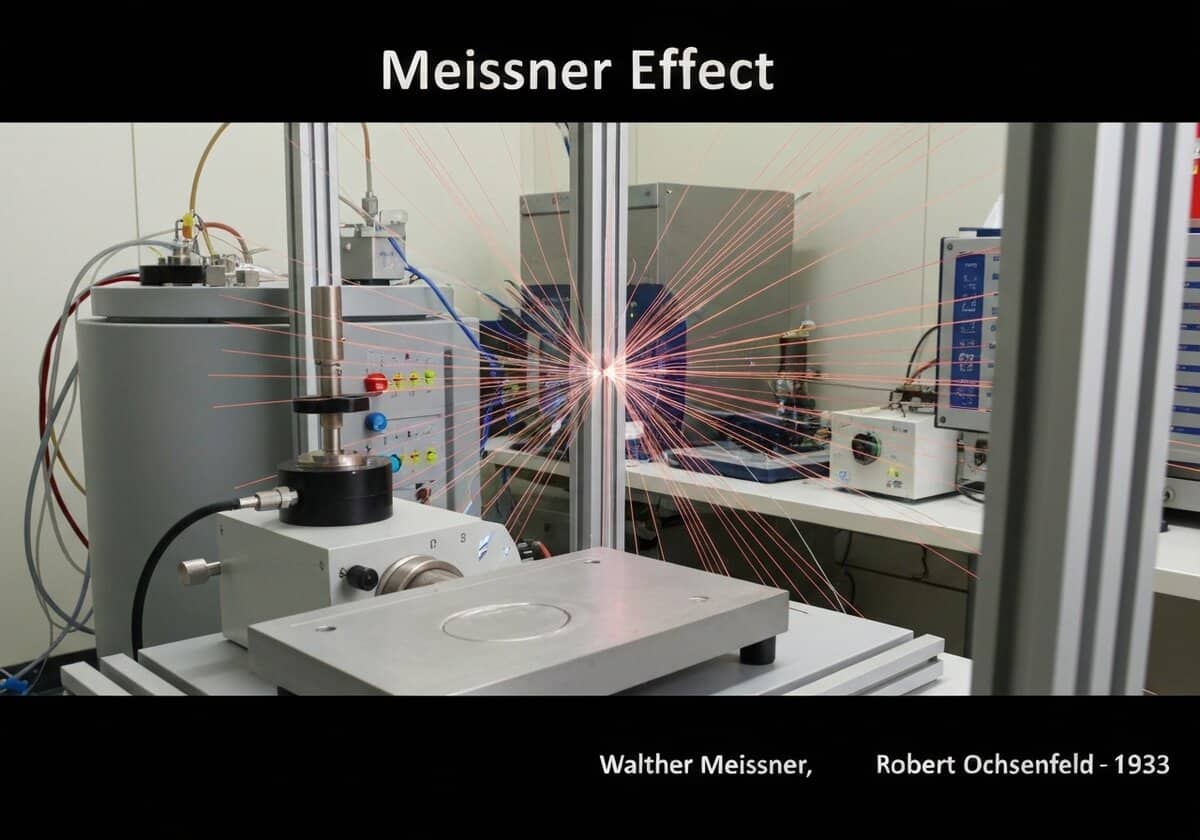
고체 물리학에서 마이스너 효과를 시연하는 실험실의 초전도체.

(설명을 위한 생성된 이미지입니다)

Discovered in 1933 by Walther Meissner and Robert Ochsenfeld, the Meissner effect is the expulsion of a magnetic field from a superconductor during its transition to the superconducting state. When a material is cooled below its 임계 온도 ([latex]T_c[/latex]) in the presence of a weak external magnetic field, it actively cancels all magnetic flux inside it, becoming a perfect diamagnet.


The Meissner effect is a defining characteristic of 초전도성, distinguishing it from a hypothetical perfect conductor. A perfect conductor, according to Lenz’s law, would trap any existing magnetic field inside it as it cools, because changing the flux would induce currents to oppose the change. In contrast, a superconductor actively expels the field. This expulsion is achieved by the generation of screening currents on the surface of the material. These currents create a magnetic field that perfectly cancels the external field within the bulk of the superconductor. The magnetic field penetrates only a small distance into the surface, known as the London penetration depth ([latex]\lambda[/latex]). This discovery was crucial because it showed that superconductivity is a true thermodynamic phase transition, not just a case of infinite conductivity. It provided a key piece of the puzzle that any microscopic theory of superconductivity would have to explain. The effect is the basis for the dramatic levitation demonstrations where a magnet floats above a high-temperature superconductor cooled with liquid nitrogen. The expulsion of the magnet’s field by the superconductor creates a repulsive force strong enough to counteract gravity.

마이스너 효과는 인가된 자기장이 너무 강할 때 깨집니다. 1종 초전도체의 경우, 임계 자기장 [latex]H_c[/latex] 이상에서 초전도성이 갑자기 소멸됩니다. 2종 초전도체의 경우, 더 낮은 임계 자기장 [latex]H_{c1}[/latex] 이상에서 양자화된 자속 소용돌이 형태로 자기장이 물질 내부로 침투하기 시작하며, 물질은 훨씬 더 높은 상위 임계 자기장 [latex]H_{c2}[/latex]까지 초전도 상태를 유지합니다.

UNESCO Nomenclature: 2211
고체물리학

유형

물리적 속성

분열

기초적인

용법

널리 사용됨

전구체

  • 초전도 현상의 발견 (1911년)
  • 맥스웰의 전자기 방정식
  • Lenz’s law
  • 반자성에 대한 이해

응용 프로그램

  • 자기부상열차 (자기부상)
  • 초전도 자기 베어링
  • 초전도 물질의 진단
  • 양자 현상의 시연

특허:

NA

잠재적 혁신 아이디어

  • frictionless high-speed transportation systems in vacuum tubes
  • self-assembling structures using programmable magnetic fields and superconductors
  • active shielding for sensitive electronics against electromagnetic interference
  • contactless manipulation of objects in manufacturing and medicine
  • hoverboards using high-temperature superconductors
  • stabilization systems for floating architecture
  • haptic feedback devices creating levitating tactile shapes
  • 쓰레기 정렬 systems using magnetic levitation to separate materials
  • silent, frictionless pumps for corrosive or sensitive fluids
  • gyroscopes with levitating rotors for ultra-precise navigation
Related to: Meissner effect, superconductivity, diamagnetism, magnetic field expulsion, London penetration depth, 임계 온도, Type I superconductor, screening currents, magnetic levitation, phase transition.

역사적 맥락

마이스너 효과

1930
1931
1932
1933
1937
1940
1947
1930
1930
1931
1932
1936-01-01
1938
1940
1950

(날짜를 알 수 없거나 관련이 없는 경우, 예를 들어 "유체역학"의 경우, 주목할 만한 등장 시기를 대략적으로 추정하여 제공합니다.)

10년차 기념일

고화질 이미지 및 다운로드는 등록된 회원에게만 100% 무료로 제공됩니다.

> 로그인 <