Product Design, Manufacturing & Innovation Resources
Hogar » Efecto Meissner

Efecto Meissner

1933
  • Walther Meissner
  • Robert Ochsenfeld
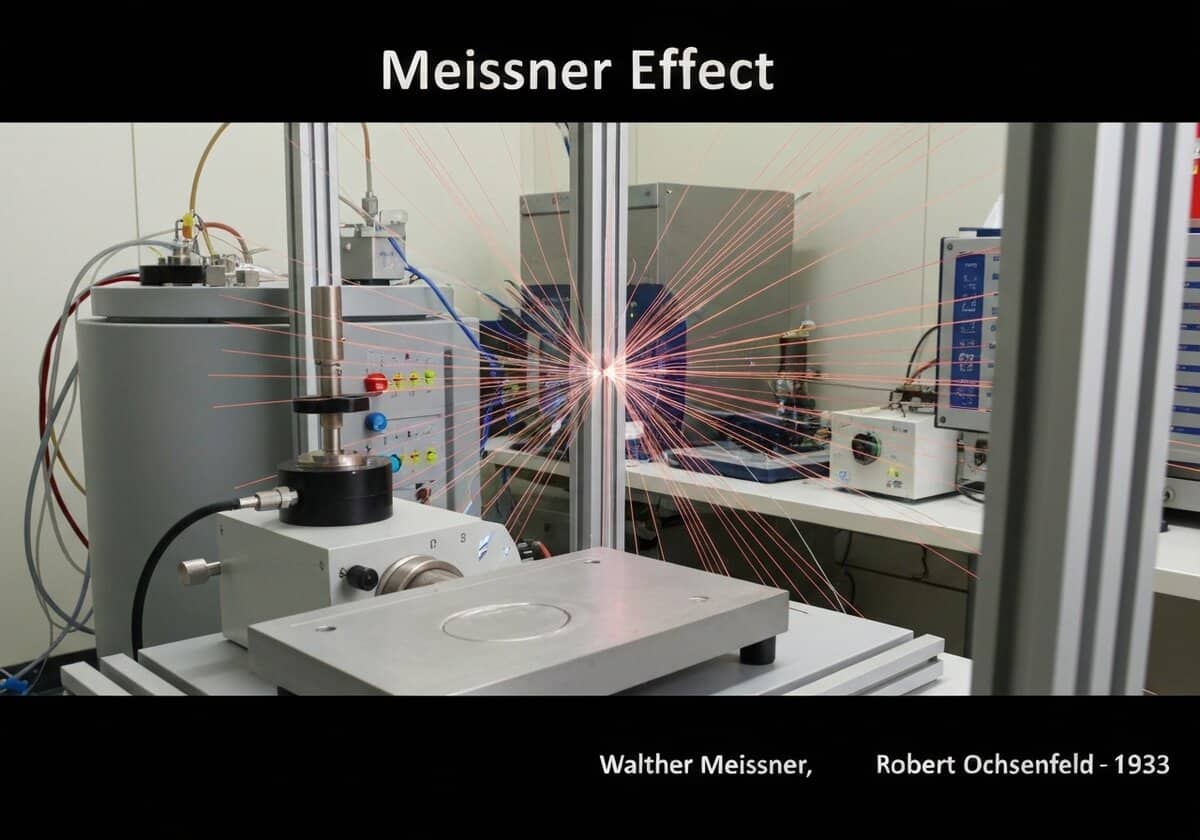
Superconductor en laboratorio que demuestra el efecto Meissner en la física del estado sólido.

(Imagen generada únicamente con fines ilustrativos)

Discovered in 1933 by Walther Meissner and Robert Ochsenfeld, the Meissner effect is the expulsion of a magnetic field from a superconductor during its transition to the superconducting state. When a material is cooled below its temperatura crítica ([latex]T_c[/latex]) in the presence of a weak external magnetic field, it actively cancels all magnetic flux inside it, becoming a perfect diamagnet.


The Meissner effect is a defining characteristic of superconductividad, distinguishing it from a hypothetical perfect conductor. A perfect conductor, according to Lenz’s law, would trap any existing magnetic field inside it as it cools, because changing the flux would induce currents to oppose the change. In contrast, a superconductor actively expels the field. This expulsion is achieved by the generation of screening currents on the surface of the material. These currents create a magnetic field that perfectly cancels the external field within the bulk of the superconductor. The magnetic field penetrates only a small distance into the surface, known as the London penetration depth ([latex]\lambda[/latex]). This discovery was crucial because it showed that superconductivity is a true thermodynamic phase transition, not just a case of infinite conductivity. It provided a key piece of the puzzle that any microscopic theory of superconductivity would have to explain. The effect is the basis for the dramatic levitation demonstrations where a magnet floats above a high-temperature superconductor cooled with liquid nitrogen. The expulsion of the magnet’s field by the superconductor creates a repulsive force strong enough to counteract gravity.

El efecto Meissner se rompe cuando el campo magnético aplicado es demasiado fuerte. En los superconductores de tipo I, la superconductividad se destruye abruptamente por encima de un campo crítico [latex]H_c[/latex]. En el caso de los superconductores de tipo II, el campo comienza a penetrar en el material en forma de vórtices de flujo cuantizados por encima de un campo crítico inferior [latex]H_{c1}[/latex], mientras que el material sigue siendo superconductor hasta un campo crítico superior mucho más alto [latex]H_{c2}[/latex].

UNESCO Nomenclature: 2211
- Física del estado sólido

Tipo

Propiedad física

Ruptura

Fundacional

Uso

Uso generalizado

Precursores

  • descubrimiento de la superconductividad (1911)
  • Las ecuaciones de Maxwell sobre el electromagnetismo
  • Ley de Lenz
  • comprensión del diamagnetismo

Aplicaciones

  • trenes de levitación magnética (maglev)
  • cojinetes magnéticos superconductores
  • diagnóstico de materiales superconductores
  • demostraciones de fenómenos cuánticos

Patentes:

NA

Ideas para posibles innovaciones

  • Sistemas de transporte de alta velocidad sin fricción en tubos de vacío
  • Estructuras autoensamblables utilizando campos magnéticos programables y superconductores
  • Blindaje activo para electrónica sensible contra interferencias electromagnéticas
  • Manipulación sin contacto de objetos en la industria y la medicina
  • hoverboards using high-temperature superconductors
  • sistemas de estabilización para arquitectura flotante
  • Dispositivos de retroalimentación háptica que crean formas táctiles levitantes
  • residuos clasificación systems using magnetic levitation to separate materials
  • Bombas silenciosas y sin fricción para fluidos corrosivos o sensibles
  • Giroscopios con rotores levitantes para una navegación ultraprecisa
Related to: Meissner effect, superconductivity, diamagnetism, magnetic field expulsion, London penetration depth, temperatura crítica, Type I superconductor, screening currents, magnetic levitation, phase transition.

Contexto histórico

Efecto Meissner

1930
1931
1932
1933
1937
1940
1947
1930
1930
1931
1932
1936-01-01
1938
1940
1950

(Si la fecha es desconocida o no es relevante, por ejemplo "mecánica de fluidos", se proporciona una estimación redondeada de su aparición notable)

décimo año aniversario

Las imágenes en tamaño completo y las descargas solo están disponibles, de forma totalmente gratuita, para los miembros registrados.

> Acceso <